Top Navbar

  • Home
  • About Us
  • Guest Posts
  • Liner Notes

Searchbar

Showing posts with label Public vs. Private. Show all posts

Wednesday, January 12, 2022

Wednesday, January 12, 2022

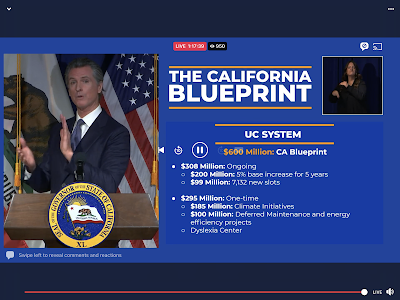
I've fixed the mistake in the Los Angeles Times headline on Gov. Gavin Newsom's higher ed budget proposal for 2022-23.  In fact, if you add one-time money from the current and coming years, Newsom is proposing overall cuts to UC and CSU.

The base general fund increase is five percent next year (see summary slide above), with five percent promised each year for five years total in a new compact between the university systems and the state.  

Newsom delivered  the compact promise with a joke about how he knows the people who lived through the last (broken) compacts will doubt this one too.  Newsom signaling he knows we think Sacramento compacts are worthless doesn't make Sacramento compacts less worthless.  So I assume only next year's five percent.

Newsom's five percent is better than Gov Jerry Brown's annual two or three percent--apparently twice as good.  However, Newsom gets an inflation rate that is twice Brown's too. The Personal Consumption Expenditures (PCE) Index accelerated from 4.2 percent to 5.7 percent from July to November 2021. CPI hit 6.8 percent, and projections for inflation in 2022 by Fannie Mae and others suggest a five percent increase will be entirely consumed by inflation.  Hence the term "flat," and also my sense that the corrected headline is still optimistic.  For more than a decade, two Democratic governors have been giving UC and CSU flat annual budgets--when they are not cutting them.  That is not changing.

The other touted feature is that the state is funding residential enrollment growth.  Newsom proposes it support 6,230 new California undergraduates with $67.8 million (or $10,882.83 per student).  Again, it looks good compared to Jerry Brown.  He proposes an additional $31 million to buy out 902 nonresident slots at the three flagships (Berkeley, Los Angeles, and San Diego), at $34,368.07 per student. Don't ask me how they came up with those numbers.  What is clear is that the nonflagships are not getting state funding for the nonresident students they have been unable to admit because of the enrollment cap that emerged from the political blowback caused by the flagships.  Newsom sets up UC for a multi-year series of tuition carve-outs that allow the flagships to keep their nonresident tuition premiums, maintaining intra-campus budget inequality.

Most UC campuses are at capacity and have been for some time, so getting new students means hiring new faculty and staff and building or expanding facilities.  In practice, it means more costs and also more hardships for existing students. They will have even more trouble getting courses and housing.  Next year's per-student rate is less than half of what UCOP says is the average cost of instruction of each student (that is vastly more than most departments receive per major but never mind). We can say that $10,882.83 will at best cover costs of the new students and at worse create new deficits.  Like the base increase, this is not an increase in UC's per-student operating budget.  (The small "cohort tuition" hike will also make very little difference.)

Last fall, I suggested 2021 might well be, financially speaking, Peak UC.  The governor's new proposal confirms that fear about a stagnant 2020s of unfunded mandates.  Further confirmation came from UC president Michael Drake ritually praising the governor's generosity, putting a cap on growth in the bigger revenues.

I'm not going to go into more detail on the numbers until they settle down, and won't chart any trends until spring.  Newsom is right to see budgets as "expressing our values," as he said at the end, but his presentation was a numerical mess, referencing three different sizes of surplus ($42 billion, $20 billion, $31 billion), two from his own office, and identifying dozens of individual program totals from two different budget years.  So in the meantime, let's take a look at some other issues raised by the presentation, both on the campuses and the state as a whole.

Newsom has exactly two ideas about higher education. One is that it maximize access on the basis of diversity, equity, and inclusion (DEI).  The other is that it prepare students for jobs, and by jobs he means jobs in technology. 

Newsom makes state funding contingent on several 2030 goals: UC eliminating racial gaps in grad rates, getting grad rates to 76 percent for four-year students, and getting students to debt-free graduation. These are essential goals and UC must achieve them. But they require fundamental change in the UC business model.  That now depends on undergrad tuition subsidizing research and other activities--so less money is in instruction and student support, which hurts retention differentially across racial groups.  The business model also depends on saving a lot of university money (my estimate is $755 million in 2019-20 using Accountability data) by capping financial aid, therefore forcing undergrads to borrow and work during the academic year (see Stage 2 and Stage 5 respectively).  

This is such an important point--the need to fund goals rather than simply assert them--that I'll expand a bit. You improve graduation rates in part by hiring enough instructors so that every student can get every class they need, when they need it. Because of chronic underfunding, many or most students on all UC campuses wait quarters or years to get admitted into at least a few of their core required courses.

How do you reduce racial gaps in graduation rates? You offer personalized, individual advising to every student who wants or needs it.  You don't tolerate caseloads of 740 students for each advisor, which Laura Hamilton and Kelly Nielson, in their important book Broke, report is the case at UC Merced's school of Social Sciences, Humanities, and Arts (page 123). 

You also reduce racial gaps in graduation rates by taking students of color out of the cafeteria job they use to reduce their borrowing and into class: you cut their work hours ideally to zero while they are enrolled full time. You do not impose a Self-Help Expectation of $8,500 or $9,200 or $10,000 on every student with financial aid, even if they are low income, as every UC campus does. In other words, if you want to reduce racial gaps in graduation, you don't do this, for years and years: have a net cost of attendance of $10,000 per year (after financial aid) for students whose whole family earns $60,000 or less.
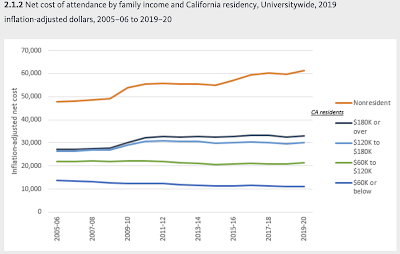
You also don't allow the poorest students to have the most debt at graduation.  

You stop doing these things by buying out financing gaps for poor and otherwise disadvantaged students, and then you put money into  personalized, intensive advising, well-funded student centers, and other things most UC faculty and staff could name off the tops of their heads.  When you start paying to provide these things, you're then able close your graduation gaps.

These are all things UC campuses want to do. None of them are things that either the governor or the legislature want to pay for.  None of them are things whose costs UCOP has itemized and justified in public in order to inspire the desire to pay for these essential things.

The governor mentioned diversifying university faculty.  This has been an explicit UC goal since the 1980s. Again there are racio-cultural obstacles. But the material ones are at least as important.  A diverse faculty comes from diverse doctoral programs, which means strong retention in those programs, means fully funding grad students from working-class backgrounds who are at greater risk of dropping out for lack of funds or excess debt.  UC does not fund its doctoral programs at the needed level.  

Thus in 2019-20, grad students went on a multi-campus strike over their rent burden, demanding a cost of living increase outside their union contract so they could cover costs in the private rental market. Nothing was done, and the students who started it (at UC Santa Cruz) were expelled for a while.  In the midst of the pandemic in early 2021, UCSD grads had to protest in the face of massive rent hikes in campus housing.  In 2022, rent burden is, if anything, even worse. The diversity of the faculty stops there, with unmanageable costs of living.  If it is serious about faculty diversity, UC should announce debt-free doctoral programs. But the governor and legislature would have to pay for it.

In sum, Newsom insists that UC close graduation gaps with essentially the same per-student funding that caused the gaps in the first place.  UC officials should point this out.

Now, on this question of college for jobs: Newsom and most policy people continue to work with a version of Human Capital Theory (HCT) descended from the 1950s, in which "learning equals earning."  In reality that is true only for a subset of students (generally already financially advantaged--for the theory's flaws see our LARB review-essay).  Policymakers are trying to fix the theory by saying, "tech learning equals earning," and UCOP encourages this splitting of STEM from other fields by publishing wages-by-major data.). 

Enter Gavin Newsom: propelled by half-baked but established neo-HCT, he is making these five percent state funding increase contingent on "supporting workforce preparedness and high-demand career pipelines," requiring 25 percent increases in degrees in STEM "and Education or Early Education" disciplines, as well as the same increase in "academic doctoral degrees," all by 2026-27.  The requirement is not exactly water-tight, and it also has a very weak justification in existing jobs projections.  The original 2015 report that started this "million missing college degrees" fixation shows most new jobs appearing outside of STEM (Figure 4).   Did anyone in the governor's office read the current occupational breakdowns for the state? It's the same story here, with tech a minor employer by size (though not by wages, which are high). But the STEM quota sails anyway, towing a legitimate fear about teaching shortages behind.

Even if the job market really did say STEM, it's an invasive step for a governor to mandate changes in degree outputs in a university.  Californians felt sorry for Floridians having to put up with Gov. Rick Scott making nasty cracks about anthropology and saying he didn't want taxpayers to foot the bill for useless degrees. Newsom is effectively doing the same thing. It raises allocation questions: Will new faculty lines to teach the expanded enrollments all go to STEM plus a few for education?  Will provosts need to stop hiring in arts and humanities for a number of years to pool lines in the "high demand careers"? Should California's future musicians, screenwriters, architects, designers, painters, film editors, historians, novelists, and journalists avoid the experience of being second-class citizens by going to UC? 

There are no answers, and this brings me to the experience of watching a governor's budget presentation on dozens of topics where the word "education" wasn't uttered until well after minute 70. Newsom organized his address around five existential threats. He had no vision of a New California, but ran through a series of hard problems that must be solved. I sympathize: he has not been having a joyful time. There's pandemic illness and also its political madhouse, with the recall trying to get rid of him for doing his public health job. There's drought and fire and the climate crisis behind them. There's the cost of living crisis. There's decades of underinvestment in transportation and other infrastructure.  There's a very polarized state economy, where a third of the workforce earns less than $15 per hour (page 3). There's a decades-old housing crisis, where so much private wealth has been absorbed into inflated housing assets that the state spent $5.2 billion last year--an additional University of California state budget--paying people's rent. 

Newsom brings a lot of energy to this slate of problems. He fired dozens of powerpoint bullets at them, each carrying a $100 M or $200 M or $1 B payload. But it's all the equivalent of filling (very important) potholes, keeping the electricity on, getting the shots in arms, giving the kids something to do in school until their parents get home.  

Even the tech future of green transition is remedial, trying to undig the hole of climate change in a state still almost entirely dependent on the private car.  There was something hollow in Newsom's enthusiasm for the state's green tech leadership: he cast the state's investment as bait for private investors, took it as an opportunity to hype the hegemonic tech sector that I think he quietly dislikes for its entitlement and arrogance as do most Californians, overpraised legislative honchos and others, and started referring to California as a "leader in this space" or that space--space being a term he used dozens of times.

Contrast this with how Newsom sounds on things he cares about. Then he is serious, knowledgeable, plainspoken, and open. What he really cares about is pre-K, school nutrition, homelessness, getting people out of encampments, mental health, universal health care, summer school for poor kids, a decent access to basic goods for disadvantaged people.  Whatever his neoliberal policies might be, Newsom's deeper desire, I felt watching him, is to ease the worst suffering.  This is also where he feels useful, even perhaps a bit of a hero.  But this desire doesn't find much to feed on in higher education as officials present it to him.

It's not just Newsom: the media isn't interested in higher ed either. During question time, the press had crisp questions about Newsom's contradictions on personal exemptions from Covid vaccines, his concrete plans for supporting reproductive rights, his borrowing of his recall opponents' plans for the mental health system, and his proposed changes in the Medicaid prescription program. They had nothing about higher ed.  This is a real problem for the sector. The governors' office doesn’t get vigorously questioned about higher ed, so they don’t prep for that, they rightly think the media and its consumers don't care about the details, so they never think, "we’re going to get pounded on mandating STEM degrees so we’d better think this through."  

I’ve written about Biden-era Democrats assigning college to a dedicated space in the welfare state. The good news is that they want government-run social development—Biden has in fact broken with key tenants of neoliberal Obama-Clintonism.  The bad news for higher ed is that the Biden-Newsom mainstream has no intellectual developmental plan for higher ed to address. Biden-Newsom are a real policy advance on Obama-Brown--an advance for children, the food insecure, the mentally ill, the unhoused, the uninsured, but not an advance for college students or the educational system.  

For them, the knowledge economy is abstract scenery, a slightly smoggy familiar sky.  We may need a million more college degrees, but that's just a logistics problem—there’s no interest in process or content or quality upgrades to say nothing of revolutions in thought or in the public's collective cultural and political capabilities. For them, UC and CSU are server farms that should run quietly in the background. There's nothing heroic about them, and they won't make a hero of any president or governor.  They are of modest interest as economic infrastructure. They are certainly not, for this Democratic party, a state engine of destiny.  

This could be changed, in a couple of diverging ways. One would be all three segments busting out of the workforce preparation trap and developing exciting stories of college-fueled individual and social transformation.  I know some deans and individual faculty who could do this. I don't know anyone at the senior manager level who would. Please correct me if I've missed some folks. 

The second, more plausible path is to comply fully with the mainstream Democrat welfarist passion. Inspiration is also needed here, that makes the state's politicians heroes of social justice. But that means defining the processes that would allow UC (and CSU) really to meet graduation and the other targets, and then setting their actual price. 

Fix the funding, or miss the goals. It shouldn't be a hard decision.


Posted by Chris Newfield | Comments: 1

Monday, May 24, 2021

Monday, May 24, 2021
A few things have happened since California Gov. Gavin Newsom proposed an austerity budget in January

State tax receipts came in higher than expected (though they will not rise next year).

A recall campaign collected signatures amounting to the required 12 percent of registered voters, so Newsom is now running for governor. 

Joe Biden's American Rescue Plan sent the state $27 billion.

And Biden's three big Plans far outstripped anything California Democrats have offered the state since Grey Davis was recalled in 2003, leaving them paddling in Biden's wake. 

Needing to get out in front of Biden's quasi-New Deal advance, and to show some post-pandemic achievement, on May 14th Newsom announced his "generational" state budget, a "historic, transformational budget."  Here of course we welcome with open arms Newsom's recognition that solving California's problems means massive government spending, since it is true. The K-12 increases are especially welcome, as are those trying to reduce the state's long epidemic of houselessness. 

Yet like Biden, Newsom sees a narrowed function for four-year colleges and universities, and is funding them accordingly, meaning meagerly.

The press did find his historic numbers hard to follow.  Writing in the LA Times, John Myers noted the range of the proposals 

The governor’s list of spending priorities, which rely on a surprise cash infusion spread over several years that is projected to ultimately top $100 billion, is dizzying: money to house those who are homeless, support entrepreneurs, train workers, educate students and connect them to the internet, fix roadways, prevent wildfires and strengthen California’s power grid.

He then added politely, "It could be some time before the numbers outlined by Newsom can be fully reconciled. The governor frequently uses unorthodox ways to measure state spending, lumping together dollar amounts that span multiple years." The $100 billion in economic assistance translates into a budget increase of $40 billion in the current year--still an excellent increase, but one that should be defined correctly.

Reconciliation will involve a couple of simple moves. One is to separate multi-year from single-year numbers. Myers does that in contrasting the headline $100 billion with the annual $40 billion.

The other move that's especially relevant to higher ed budgeting is separating ongoing from one-time funds. The former commits the state to program building over time. The latter does not. 

UC's president and Board of Regents chair issued a statement to say, "The University of California is deeply grateful to Gov. Newsom for proposing the largest state investment in UC’s history: more than $807 million."  In his press conference (around minute 52 in the version helpfully archived by Dan Mitchell) Newsom correctly describes the permanent investment as an increase in $506 million. It's better than the $136 million he proposed in January. But as with all these budget announcements, don't read the headline, read the top line (in the slide at the top).

Here's the table that Newsom's Department of Finance published, in the Higher Education section of the May Revision.

The second row of figures is UC's Ongoing General Fund. Newsom and legislative Democrats cut UC's general fund during the pandemic year; later they decided to give it back, but not until the following year (2021-22). 

We can redo the table so that it tracks only the state's permanent commitment to UC, in the form of ongoing general funds.  I give the one-time general fund restoration back to the year to which it belongs--2020-21.  


UC Ongoing General Fund

2019-2020

2020-2021 (with cut retroactively restored)

2021-2022

2 year cumulative change


$3,724.3 M

$3,766.0 M

$3972.1

6.65%

The one-year increase is 5.5 percent. Note that UC's GF allocation still falls short of the magic $4 billion ceiling it's been trying to break through for twenty years (in unadjusted dollars, so the real problem is worse--I discussed this issue in "Shortfall," covering the history that made Newsom's January budget such an affront).  

This increase is obviously better, but you don't get to break the $4 B barrier by restoring a cut to permanent general funds one year late. More importantly, an average annual increase of a bit more than 3¼ percent does not qualify as "the largest state investment in UC history."  It doesn't justify the "huge budget boost" trumpet blast in this LA Times headline, or the statement cosigned by UC president Drake and board chair PĂ©rez.

There are other commitments, all one time, where the main money goes to 2 things: workforce preparedness and student housing.  

State underfunding has helped turn student housing into a scandal of private development, one that has led to overpricing, blown open this March when UCSD housing announced average rent increases for doctoral and professional students of 31 percent. Newsom proposes $4 billion (over 2 years) for a "low-cost student housing grant program focused on expanding the availability of affordable student housing." The money may well go to subsidize the private developers that helped cause the affordability problem--details are sparse.  It's a major problem, but would best be solved by the state restarting continuing allocations to capital projects, which it ended around 2006.

For the workforce, Newsom proposes $1 billion (over 2 years) "to establish the Learning-Aligned Employment program, which would promote learning-aligned, long-term career development for UC, CSU, and CCC students." The money would form a permanent endowment.  Again there are no details: much better student advising is not mentioned, but employer partnerships are, so it may turn out to be a state subsidy for apprenticeship programs. 

Newsom proposes little or nothing in core needs.  Deferred Maintenance, a problem totaling tens of billions, gets $325 million in one-time funding, which for DM is a contradiction in terms. UCLA's Asian American Studies Center gets $5 million in one-time funding to research "the prevention of hate incidents." He recommends $40 million more than that for the animal shelter medicine program at Davis. 

A better way to fight racist hate crimes would be to fully fund critical ethnic studies, gender, queer, and trans studies, political theory, sociology, history, and the other non-STEM fields that study these issues systematically and have long offered detailed solutions. That is not happening, and I will return to this issue a bit later this year.

Newsom's thinking aligns with Biden's and the national party in a few important ways. They both continue the decades-old drift toward giving public funds to students rather than to institutions.  Student money escapes the instructional and (non-sponsored) research core, whose complexity and costs keep rising, but whose growth in operating money does not keep up. 

Second, they are using higher ed as a kind of renewed welfare state. Newsom knows it is politically hard to address the state's housing affordability crisis with a massive public housing program for working- and middle-class people, but politically easy to subsidize private developers to build public housing for students.  The public colleges' working poor would be affordably housed for a few years. 

The same goes for health and related social services (legal support for undocumented students, food security, transition support for formerly incarcerated students).  I favor this full suite of public support systems--it's the point of the Real College movement--but want them to be integrated into the society at large, funded through progressive taxation of the overall population, and not used as a substitute for funding advanced education.  

Third, Newsom and Biden see higher education as workforce training for economic growth. They also tie that mainly to community colleges rather than to four-year degrees.  Newsom bundles his two biggest one-time programs into an aggregate with a largish headline number that must be shared by the 3 segments, and which treats the segments and their students as the same.  Newsom is joining Biden in demoting four-year colleges and universities, which is an anti-progressive trend that universities will need to fight.

This budget is a lot better than a cut. But it's not the New New Deal.  I'd feel better about where it might lead had president Drake and board chair PĂ©rez described it accurately and set out ongoing needs.  But they did not.  

Here's an update of the January chart, for context.


Posted by Chris Newfield | Comments: 0

Sunday, March 22, 2020

Sunday, March 22, 2020
Shutdowns are now spreading as fast as the coronavirus. On March 19, Gov. Gavin Newsom ordered 40 million Californians to stay home, claiming that the infection rate puts the state on track for 25.5 million infections.  The order has no end date.  New York and other states and counties have since followed suit: by noon on March 21st, 75 million US residents were under some kind of lockdown.

In this post I'm going to talk about what I've learned during a sustained effort to apply analytical expertise to a topic outside of my normal subject areas, as I try to build a base for a series of citizen judgements about health policy, and also the related areas of educational and economic policy that I know more about.

This learning process has changed my mind about a number of Covid-related issues: for example, when I learned March 10th of UCSB's shutdown--at the end of my senior seminar, thanks to Jenna, multitasking on her email again!--I was a skeptic about the benefits of widespread closures. Now I'm a believer: I think that widespread social distancing is our only chance to avoid levels of infection that would overwhelm hospitals and clinics and lead to much excess death.  At the same time, I'm also more optimistic about reducing infections than I was a week ago.

The main part of this post close-reads the one published infection model that I've been able to find-Neil Ferguson et al.'s paper, from Imperial College London.  The U.S. Centers for Disease Control and Prevention (CDC) has not released its modeling, though it was discussed in a bootleg version by the New York Times.  My caveat up front is that the SARS-CoV-2 infection model I analyze does not offer any certainty about the future. But I will talk about the powers of the suppression regime we've entered into, and how the disease might be made less deadly than many of us now assume.

An overview:
  • The policy of virus suppression does appear to reduce Covid-19's spread. I'll define this and other terms below, since terminology is all over the place in media reports. (The one journalist I've found to have interviewed Neil Ferguson--Nicholas Kristof of the New York Times--conflates mitigation and suppression.)  Suppression has worked well in South Korea, Singapore, and post-lockdown Hubei in China when social distancing is combined with mass testing. 
  • The U.S. simply does not have the testing capability to do the most effective form of suppression.  (Santa Barbara County has brilliant and frequently exercised emergency services.  As of March 22nd it has 13 confirmed Covid-19 cases, a shortage of test kits, and 200 tests out whose results won't be in for awhile.) The U.S. has not been able to do contact-tracing, which would have allowed a much more efficient form of isolation than the mass version we're doing now.  In spite of some encouraging reports of new equipment coming on line, the U.S. is in the midst of what statistician John A. Ioannidis calls an "evidence fiasco," and its public health capacities have been downsized (personnel down 20 percent since 2008, according to David Himmelstein) to the point that we're likely stuck with the crudest, most disruptive, and most economically damaging form of suppression. 
  • This has implications for rebuilding social and public capabilities that I'll save for a later post on how SARS-CoV-2 is putting neoliberalism out of its misery--and how to keep that from causing further misery for diverse publics.
  • A theory point: public officials are using projections of high infection and death rates to install suppression regimes, but these suppression regimes are designed to invalidate the numbers that justify them (by producing much lower rates of infection and death).  Either you infect 81 percent of California by doing nothing, or you lockdown California and get a much lower infection percentage.  You don't do both.  I elaborate on this point because it's important for people not to think lockdown = death (regardless), but to think the opposite.  
  • A policy point: public officials must not bullshit the public with exaggerated numbers, withheld models (CDC!), and mashup policies that will encourage cheating. Newsom did the right thing, but he didn't give clear, honest reasons for it.  That has to change.
To take the last point first: Where did Newsom get the number that he used to shut down most of the state economy without an end date? We don't actually know. The LA Times reports, "the governor’s office declined to provide an explanation of the state’s projection that 25.5 million Californians will be infected with this virus. Instead, a spokesman for the governor said the state’s mitigation efforts could lower that estimate."

The last part is true (though "mitigation" is the wrong word, as I'll explain), but the public should be told the source.  In the meantime, I'll guess that Newsom's people got that number from the now-famous pandemic modeling paper I mentioned at the top, Ferguson et al. Their baseline reproduction number (Ro) for the disease is 2.4--meaning each case typically goes on to infect 2.4 other people. You can get to 25.5 million Covid-19 infections by taking California's Covid infection count when Newsom spoke--around 1000--and giving it an exponent of 2.45.  (Updated: See Akos Rona-Tas's correction of this speculation below, under March 23.)

The Ferguson paper derived that Ro in part from from the spread of the virus in Wuhan, China, before the government began its many non-pharmaceutical interventions (NPIs)--forced quarantining, widespread testing, etc.  (Wuhan's Ro was previously reported as 3.11).  The projection that 56 percent of the California population will become infected appeared as a math error in Newsom's letter to Trump requesting a hospital ship: it's actually 64 percent, or alternately, 39.56 million Californians * 0.56 = 22.15 million inflections.  The point isn't the bad math but the need to offer credible numbers and explain clearly where they come from.  People will take honest, fully disclosed estimates more seriously.  Health policy needs to be open to establish the trust that government now desperately needs, to discourage cheating, and to allow meaningful democratic judgment about overall policy. 

Public officials, including Newsom, seem to be now focused on using big numbers to stampede the masses into social distancing, RTFN. This is understandable, since, in the suppression arsenal, social distancing is pretty much all we've got.  But one major effect of their statements is to muddle the difference between mitigating and suppressing a pandemics: the former allows infection rates like 55 percent. The latter slows growth rates and can put them into reverse.  Suppression also requires a rigor that people won't pursue if they don't understand the massive difference it can make.

To put this in the form of a question, could the U.S. and the European Union (and other regions) achieve suppression and thus decline in the number of new cases?  The current tracking in California is not good.


But look at  the South Korean case pattern.


South Korea had our hockey stick and has now bent it down into slower growth of new cases.  As is now widely discussed, South Korea, Singapore, Hong Kong, Taiwan, and now Wuhan have slowed the spread.  This is the effect of suppression strategies.  There's some important news here, which is that Covid-19 infections rates can be reduced, and its case-mortality rate can be kept low (not the 3.4 percent reported by the World Health Organization, but about 1 percent in South Korea, or 0.54 percent for cases under age 60).  Germany currently has a 0.3 percent case-mortality rate. SARS-CoV-2 kills people by doing horrible damage to their lungs (see the images around 0'30" in this Santa Barbara Cottage Health grand rounds lecture).  And yet the virus does so little to so many other victims that 86 percent of cases in China were undocumented prior to travel restrictions. 

On to the model: the Ferguson et al. paper draws on previous work with influenza pandemics to compare three responses-- doing nothing, mitigation, and suppression.  Doing nothing seems to have been the preferred option of the Boris Johnson and Donald Trump governments until about March 15th-16th  (Johnson, Trump), with the Johnson government allegedly working on a trust that infection would create "herd immunity" without disrupting the economy.  At least in the UK, they seem to have taken on board the Ferguson et al. calculations that "doing nothing" will lead to infection in 81 percent of the population (at  2.4 Ro), producing 510,000 deaths in the UK, plus 2.2 million deaths in the United States, both over a 2 year period.

With doing nothing now ruled out, the alternatives that Ferguson et al. modeled are mitigation or suppression. Suppression is China after January 23rd and South Korea, among others; Britain is moving to suppression with one escalating announcement after another (which may defeat the purpose).  Some parts of the U.S. are now doing suppression, including New York and California. The Ferguson paper divides these two strategies into two groups of non-pharmaceutical interventions (NPIs).

 The most effective set of mitigation measures are:
  • Case isolation in the home (CI): symptomatic cases stay at home for 7 days.
  • Voluntary home quarantine (HQ): all members of a household with a case stay home for 14 days
  • Social distancing of those over age 70 (SDO).
Note that this falls short of "lockdown," which includes social distancing for the whole population (SD) and, in most cases, closures of schools and universities.

Mitigation is the famous "flattening the curve." The serious cases that need hospital services are pushed out over time, with the goal of relieving some of the stress on the health care system. Mitigation is "predicted to reduce peak critical care demand by two-thirds and halve the number of deaths" (8).  Assuming the ratio of infections to critical care cases is constant, and that the syntax means mitigation yields 2/3rds of the "do nothing" infection rate, this leads to 54 percent of the population being infected, and to 1.1 million deaths in the U.S.  (When Kristof quotes Ferguson saying his best case is 1.1 million deaths, I think he ran Ferguson et al.'s two regimes together: in my view, the sentence should read, "his best case for mitigation" is 1.1 million deaths.

Clearly mitigation isn't good enough.  A million deaths in the U.S. is unacceptable, and the model suggests that under mitigation health care systems will still be overwhelmed (10). Since something like Italy's hospital crisis and high fatalities are the combination everyone wants to avoid, the UK, the EU, California, and now several other U.S. states have moved into suppression.

A side note: I would normally read the quotation to mean that mitigation reduces peak care demand (and infections) by 2/3rds, down to 1/3rd of their previous level, which is a 27 percent infection rate.  I don't know if that's what Ferguson et al. meant, but it's still more than double this year's seasonal flu rate (so far this season, flu has killed 22,000 Americans). 

Much of the U.S. is now following Italy, France, Spain, and other countries into suppression. The key benefit is that it reduces the reproduction number (Ro) to close to 1 or below, which China has shown is feasible.  Here's a nice stretch goal for the West.


 In the Ferguson et al. model, suppression adds to mitigation's measures:
  • school and university closures (PC)
  • social distancing expanded to the whole population (SD)
I've reproduced the table that shows the results. I'd recommend starting in column 1 with the baseline Ro of 2.4 (510,000 "do nothing" deaths) and look at the medium case of 200 (which means that the full suppression program is suspended when ICU cases fall below 200 in Great Britain, and are re-engaged when they rise above that number). (The paper does not have a similar table for the U.S.) 
California is now doing the full suppression program.  If you look at the right-hand column under Total Deaths you can see the results.  Deaths in Great Britain drop from 510,000 to 24,000, or by a factor of around 20.  The U.S. equivalent would be 110,000 deaths, not Kristof's 1.1 million.

Note two other features of this model.  The interventions all have finite periods: mitigation is modeled over 3 months (to mid-June 2020) and suppression over 5 months (to mid-August 2020).  They don't extend to the full 18 month "vaccine" period, nor are they open-ended.

Second, they are adjusted according to thresholds of infection and hospitalization that can be selected and monitored.  Governments have a great deal of agency here.  In other words, this new coronavirus is bad, but it is not an irresistible event like a giant asteroid hitting the earth.

A big catch is that the versions of suppression in South Korea, Taiwain, Hong Kong, Singapore, and China include mass testing.  Neither the US nor the UK have done this, nor do we seen to have the capability to ramp this up.  There's been much excoriating commentary on this point.  I had been hoping that UC Health could make a big difference to California public health. A potentially exciting March 14th headline, "UC has a solution to the national shortage of coronavirus testing," didn't, with our weak public sector, mean UC is gearing up mass testing for the public, but that it has a private test for its own patients.  I've heard ambitious UC plans--in this week's board meetings, one UC regent suggested for the installation of MASH hospitals on empty land that UC owns. But because of testing and equipment shortages, UC medical centers have to focus on protecting themselves (see 0'44"-0'49" or so in this very useful UCSF infectious diseases division' grand rounds). I'll end by adding a few items to the summary list above:
  • The virus is going to be terrible for public health workers, who deserve not only massive sympathy and support but also personal protective equipment, which they may now have more hope of getting.  Mass testing also depends on cranking out PPE.
  • Public health interventions in Asia have had enough success with suppression to give  credibility to the Imperial College model--most interestingly, its suggestion that deaths can be reduced by an order of magnitude. 
  • On the other hand, hospital access remains a potential catastrophe.  Full suppression reduces ICU need to 1/3rd of "doing nothing."  In the bootlegged C.D.C.’s scenarios, "2.4 million to 21 million people in the United States could require hospitalization, potentially crushing the nation’s medical system, which has only about 925,000 staffed hospital beds. Fewer than a tenth of those are for people who are critically ill."
  • Still, suppression seems to make a big difference even if it is leaky: the Ferguson et al modeling assumed incomplete success and still got major reductions (see Table 2 on page 6).
  • The US has a weak health system (or no health "system" at all, as Robert Reich rightly observes). This is a big problem. But the US has some other advantages: a lot of really good, dedicated health personnel, lower population density than Europe's or East Asia's and, ironically, dependency on the self-isolating feature of private cars.  Our version of suppression might be more successful than we now expect.
  • Officials should give expiration dates to the current suppression regimes. They can be extended later, depending on conditions.  As I noted, the Ferguson et al. model assumes a kind of regular adjusting depending on infection numbers. (Hong Kong has reimposed quarantine and testing on arrivals after an uptick in cases.) Indefinite lockdowns are bad for both people and the economy.  Once people are scared indoors, and the infection curve is bent like South Korea's, governments should throw the lockdown into partial reverse, lest they create another Great Depression x 2.4.
I'll move on to political, economic, and university dimensions in other posts.  From the Haley Street Bunker: stay well, and keep your distance! 
Monday March 23rd

Statistical chemist Michael Levitt hammers on one of this post's key points: "The virus can grow exponentially only when it is undetected and no one is acting to control it."  The media, he says, should focus not on total number of cumulative cases but on rates of growth of new cases. 
Speaking of which,  South Korea's number dropped again, so the chart looks a bit better today.

The coming U.S. health crisis will owe much to a social system that can't anticipate non-market public needs.   That's not what this WaPo piece says in so many words, but it has all the raw material--shortages of masks, gowns, tests, ventilators.  What aren't we short of Covid-wise?

This piece, by a Mass General physician, specifies how the market power of large hospitals will mal-distribute emergency equipment: "We are currently taking an every-hospital-system-for-themselves approach, in which some hospitals will surely say “we’ll take them all” while others will lack the capital to make such large purchases in advance and therefore will be reliant on FEMA, which will be forced to ration scarce, lifesaving equipment. These already cash-strapped hospitals serving poorer populations will soon be put in even greater jeopardy.

From Akos Ronas-Tas (Prof of Sociology, UC San Diego): How Newsom got his numbers (over half of Californians being infected) is a mystery, but it is surely not by raising 1000 to the power of 2.45. I am no epidemiologist either, but the Ro produces an estimate only if you specify how many generations of infections you count. So if the base (generation 0) is 1000 and Ro is 2.4 (used by Ferguson), the first generation will be 1000*2.4=2400, the second generation 2400*2.40 = 5760 and so on. The total number infected will be by then 1000+2400+5760=9160, adding up generations 0,1 and 2. In the Ferguson paper they use a 6.5 day generation time. The key here is that Newsom made his prediction for 8 weeks out. So he is counting roughly 8 generations. The number of newly infected in the 8th generation will be 1000*2.4^8=1,100,753. You have to add to this those from the earlier generations. That will give you the total number of those infected (roughly, 1.9 million). Some of them will have recovered by then and happily immune, others would have died. I don’t see how this adds up to 25.5 million, either as the number of all people who have ever been infected, let alone all people needing care at a certain date.  You would get to a cumulative 26 million in 11 generations with 15 million new infections. That is 71.5 days, 10 weeks, still only late May.

You can make the model more complicated. Ferguson assumed a variable R in each generation and it should also vary across generation as the number of people getting immunity increases.

Here is a nice calculator that adds a few other considerations.

The real scary numbers come from the healthcare system. There are only 74,000 hospital beds in California, and 6,300 in SD  county, only 32% of which are available. This is probably similar in the state overall. But what you really need is ICU beds (only 800 available in SD county). There are about 50,000 ICU beds in the entire US and about 100,000 respirators. And you also have to add to this that beds, even ICU beds are useless unless you have trained personnel attending to them. So if we suppose only 2 million people being sick at the same time in CA, and only 10%  (100,000) needing hospital beds and only 4% (40,000) ICU beds, we have a major catastrophe. 


Tuesday, March 24

On the duration of the shutdown, Jeffrey Sachs invokes the example of China. Their ironclad version of suppression, including mass testing, suggests the spread of SARS-CoV-2 can be stopped in 60 days.  Sachs says 60-90 days.

This is not what's happening in Italy, where exasperated mayors berate their citizenry.

Buzzfeed does funniest home videos for the Covid quarantine

As India's government orders a 3-week "total lockdown,"  nearly 60 percent of the U.S. population is not under stay-at-home orders or being mass-tested.  The U.S. is therefore not, overall, doing suppression, but mitigation of SARS-CoV-2.  Note that this predicts some "flattening of the curve" of infection--reducing but not eliminating the overload on health care-- but not reversing the spread of the disease (Ro stays above 1). Some red state politicians are actively resisting social distancing (Texas, Mississippi), as is POTUS himself.

Speaking of testing, California is way behind New York, working "piecemeal."
This piecemeal approach, said Harvard epidemiologist Michael Mina, is a key problem with testing in California and nationwide.
“We have a decentralized healthcare system and we have no way to scale for government means,” Mina said. “Everything is privatized, everything is individualized in our country and it’s become our Achilles’ heel in this case.”
   
Wednesday, March 25  It's Bailout Day!

NYT summaryEssential first take by David Dayen. Trigger warning: wow will this analysis not reassure you that any economic reforms are in the offing.

Yes we have no protection: "A very American story about capitalism consuming our national preparedness and resiliency"  Painful contrast between the American scramble for the most basic equipment and Germany's highly successful health system for radically minimizing fatalities.

Half-assed LAT reporting on the coming fiscal crisis of the state of California.  No real info, and other annoying stuff. How do you find the school lobbyist who will say this will be really bad for the schools, and then add, "under current law, it is likely that schools could withstand a total statewide revenue loss of around $5 billion. But more than that and schools will face significant problems."  So your own lobbyist just told the state that a 7 percent cut is fine. 

Where's higher ed in the stimulus bill? Inside Higher Ed's summary:
Six-Month Loan Deferment in Senate Bill
March 25, Noon. Student loan borrowers would be allowed to defer making payments for six months, without interest, through Sept. 30, according to a summary of the $2 trillion stimulus package Senate leaders agreed to at 1 a.m. Wednesday morning. The full bill is still being written and hasn’t yet been released.
But according to summaries of the bill making the rounds among education advocacy groups and obtained by Inside Higher Ed, the measure will also include changes sought by advocates such as not requiring Pell Grant students to repay money to the federal government if their terms are disrupted by the coronavirus emergency.
However, the bill is expected to disappoint advocates who had embraced Democratic proposals in the House and Senate, in which the federal government would have made the payments on behalf of borrowers, reducing their balances by at least $10,000. The summary did not mention any loan cancellation.
A separate summary contains $30.75 billion in grants to “provide emergency support to local school systems and higher education institutions to continue to provide educational services to their students and support.” That amount appears be about $29 billion less than what higher education institutions could potentially get in the bill proposed by House Democrats, but $21 billion more than what Senate Republicans had initially proposed, one higher education lobbyist said.  Associations representing institutions that were disappointed with the previous proposals were still waiting for the full bill before they commented on the level of funding.
The bill requires the secretary to defer student loan payments, principal, and interest for six months, through Sept. 30, 2020.

Thursday, March 26

Covid revealing America's rear guard place in the world 

Zero Hedge's mashup of hostility to the shutdown, mixing vulnerability of SARS-CoV-2 to treatment (it isn’t a superbug) with statistical problems (extensive) with lockdown’s effect on the economy (bad but unavoidable). Playing rural roulette because lockdowns are Democrat.

Suppression works, says none other than Neil Ferguson!!
He said that expected increases in National Health Service capacity and ongoing restrictions to people’s movements make him “reasonably confident” the health service can cope when the predicted peak of the epidemic arrives in two or three weeks. UK deaths from the disease are now unlikely to exceed 20,000, he said, and could be much lower.
But don't go back outside! Because, on the other hand,
This measure of how many other people a carrier usually infects is now believed to be just over three, he said, up from 2.5. “That adds more evidence to support the more intensive social distancing measures,” he said.
Special bonus for modeling fans: Oxford now has a model too. More on this coming soon.

Hope for a UK Covid-19 home test within two weeks.

And We're Number 1 - in Covid-19 cases.
Posted by Chris Newfield | Comments: 4

Tuesday, October 16, 2018

Tuesday, October 16, 2018
The biggest mainstream media higher ed story last week--and this--has been the lawsuit charging Harvard with discrimination against  Asian American applicants. My piece on it has been delayed by my study of the documents, which has changed my mind from pro to con on Harvard admissions.  We may be seeing the end of the Powell Era's frustrating but functional compromise on race in college admissions, in part thanks to the Harvard practices that created it.  More on that soon.  Meanwhile, the other big higher ed story last week was confirmation of the shockingly un-Harvard conditions in the rest of higher education.

The American Association of University Professors (AAUP) released some data snapshots last week, reporting (again) that 73 percent of instructional positions are non-tenure track (NTT). In spite of the hundred or hundreds of applicants per tenure track job, academic work isn't a great thing for most of the people doing it.  By that I mean that college teaching is mostly precarious and is a proverbial middle class job only for a minority.

State legislatures and others regularly lament the inefficiencies of tenure, but it is mostly gone:  fewer than 20 percent of post-secondary instructors actually have it.   The public image of the privileged "college professor" lags decades behind the common reality. 

The employment structure also changes the nature of universities. Neither academic freedom nor faculty governance can have much general impact when only a quarter to a fifth of "the faculty" are in a position to exercise them.

This pie chart for the best case scenario-- Research 1 universities--is startling.
What most people think of as professors are only 30 percent of teaching staff. About the same share are grad students. These proportions don't say "only PhDs can teach university students." Nor do they say "university professors must be engaged in their own research." And these numbers
 are for the most research-oriented universities.

At the same time, R1s offer multi-year contracts to a much higher percentage of their NTT faculty than do non-doctoral institutions (2/3rds at R1s, half at R2).  (See Colleen Flaherty's Inside Higher Ed overview for this and related points). And yet even these NTT faculty teach 2-3 times more courses per year than TT faculty and are paid less: one UC official recently praised their "teaching power," meaning the cost-benefit advantages of their high teaching loads.

Continued austerity means that public university administrators no longer imagine replacing NTT with TT faculty, who have research and governance obligations, and whose lower teaching loads give them more time to do intensive, personalized teaching.  These are the university's three core public goods--creating knowledge, spreading knowledge, and governing knowledge in the general interest.  Keeping most faculty contingent diminishes all of these.

College teaching is also frequently hunger work. Postsecondary teaching conditions are often unethical, exploitative, and cruel.  See, for one of many recent example, the excellent "Going Hungry at the Most Prestigious MFA in America" (h/t Audrey Watters).

More public-good damage: look at the teaching conditions in community colleges.

2/3rds of community college instructors work part time.  It doesn't matter how brilliant or dedicated they are: teaching loads in CCs are 5 courses per term, and for part-timers five generally don't add up to a living wage in any one place.  A typical CC student will have 2 of 3 courses taught by a part-timer, and only 1 in 8 taught by a tenured professor.

Again, the instructors can be superbly skilled and dedicated and yet lack the working conditions to deliver.  CCs have the worst completion rates in the nation, which is partly tied to a mostly non-permanent teaching force that doesn't know each student well enough to give them personalized attention.

In their general indifference to teaching and learning quality, policymakers love CCs, ostensibly for linking their minority-majority student bodies directly to middle-skill jobs. But CCs aren't working well, and their temp teaching staffs and excessive teaching lords are two major reasons why.  (I say this in full awareness of two generations of transfers to UCSB telling me about beloved instructors at their CC: great people teach great classes there, just not at scale.)  I know of no state legislature that is worried about instructor working conditions at CCs, and the reason is that politicians really like CCs because they're cheap.


The obvious danger is this: if the majority experience of college converges with their experience of high school, the public will pay less, not more--as will the students themselves.  Politics, ethics, and knowledge aside, quality upgrades are the only business answer. It is not to be found in these employment charts.

While everyone (or at least readers of the New York Times and WeChat) obsess about Harvard admissions, it's worth remembering that 38 percent of Asian American and Pacific Islander students are in community colleges (Figure 19.6). That is almost exactly the same proportion as Black students (39 percent).  CC's house 49 percent of Latinx students, 35 percent of white students, and 45 percent of Native American/Alaskan Native students. Public colleges and universities teach 76 percent of all students and 81 percent of Asian Americans. The well-being of public college instructors is far more important to national life than anything that happens at Harvard.


Posted by Chris Newfield | Comments: 2

Thursday, September 13, 2018

Thursday, September 13, 2018

I don't see how we're going to survive the 21st century without much better human relations. I do see ideas about better human relations as depending on humanities expertise. Silicon Valley and Wall Street don't agree with me, and put their faith in programming. Yuvai Harari, the historian of all human history, doesn't agree either. He was on KQED's Forum talking about his new book, 21 Lessons for the 21st Century. There was really only one lesson in his radio answers: the rise of artificial intelligence (AI).

It was odd because Harari has a real historian's sense of specificity, which helped him reject callers' claims for trends that will be uniform across the planet. For example, he said that guaranteed minimum income might address jobs lost to robots in Germany and Japan but not in Bangladesh and Honduras. I waited for a reference to building global planning agencies through upgraded capacities to do trans-cultural cooperation. It didn't come.

Again and again, Harari placed whatever hope he had in "hacking the human." Code had to overwrite human factors. Algorithmic progress was inevitable and AI was here to accelerate it. He knew that only a minority of the world population would benefit, but he said nothing about how to solve the political and cultural problems so tech could help overcome inequality rather than making it worse.

I was listening to him while reading Facebook posts about the new MLA Job List. One friend counted a total of 16 tenure-track jobs in African American literature-- for a country with 7000 colleges. The survival of much if not all of the humanities is at risk. But in Harari's model, that wouldn't slow down progress.

This KQED Harari is wrong-- the world absolutely needs what humanities scholars know--about languages, the history of cultural conflicts, the communal effects of every kind of identity in their startling fluidity, the psycho-cultural impacts of economic inequality, for starters. So what can we do, besides what we've been doing, which is accepting austerity?

Here are two things.

The first is confronting the Great Mistake from within humanities-based theory. That mistake was to retreat from defining academic knowledge as a public good and restructuring it for market forces. Economists generally define public goods too narrowly, as non-excludable and non-rivalrous. We got confused about higher ed because we exclude people from higher education all the time and make them rivals to get the really good versions of it, so maybe it was an individual private good, which is what colleges say to prospective students when they recruit them.

In reality, about half of the total value of college is nonmarket, indirect, and/or social-- according to the one guy who heroically tried to add it up. This is what the idea of public goods expresses. All sorts of educational effects are what economists call "nonpecuniary." They have a value that is greater than what individuals receive as a private return, and often don't have any equivalent monetary quantity. (See Stage 1 of TGM for more on this -- now in paper!)

These effects are well known, and everybody from students to business executives call for basic ones like critical thinking, problem solving, oral communication skills, or a capacity for lifetime learning. And yet by measuring their value as a pecuniary return like an increased salary, we systematically neglect the nonpecuniary effects. We underinvest in them, or in other words subject them to market failure, with some fairly obvious social results.

Many other nonpecuniary effects are equally important. In lit crit we roll our eyes when a radio show host talks about how reading novels teaches empathy. Yet it is broadly true. It is also true that empathy is a public good that can change the world. It's hard to imagine international political progress without a very big increase in cross-religious empathy, and on a global scale.

The troubles of the humanities flow inevitably from the decline cycle that this retreat from public goods set up. That retreat induces not only the bad accounting I just mentioned but also a shift to the relentless pursuit of non-state funds, nearly all of which is returns-tested, meaning it's not allowed just to benefit people and society generally. The veneration of revenues with calculable returns discourages universities from having enough internal, institutional funds to support their noncommercial research (TGM Stage 2). That includes all the research that cannot be justified with claims to future revenues through the sale of a license or product or service. "Small science" doesn't get properly funded. And the humanities fields are barely funded at all. All sorts of research outputs simply never exist. The same is true for the nonpecuniary / social benefits they might have produced.

The decline cycle also routinizes "limited learning." It's really hard to grasp something like the big picture of a culture's history by grasping the main lines of hundreds of years of literary output. It also takes a long time. Maybe it takes 10,000 hours, but we teach literary history and everything else in 40 hour chunks, giving in a 10-week term as much direct intellectual contact as some college sports require over 10 days. Private return-on-investment calculations will always underfund real learning, leading us to replace mastery as a B.A goal with something like mechanical competence in written communication for most students (TGM Stage 6). MOOCs and other short-cuts fill the gap. Since we haven't detailed the nonpecuniary benefits, politicians want professors to teach twice as many students for today's workplace tasks. But deep learning probably means teaching half as much, more intensely, with more than twice as many professors. The point here is not a particular number, but that the private-good model keeps us from even admitting the losses to both individuals and society of limited learning, to say nothing of doing something about it.

The second issue is why Theory (our HT from last time) hasn't done much with institutional and economic value. I remember, around 25 years ago, when the Village Voice was really a thing, that the critic Scott Malcomson asked why Derridean theorists weren't also critiquing the premises of finance capital. We never did answer that question, or just actually do it. Now the answer seems to me to be a lack of intellectual confidence.

The Ronell case has produced some examples. In a fairly nasty piece, the eminent modernist Marjorie Perloff spent much of her commentary saying how worthless Ronell's kind of theory is. She didn't say Ronell argued A and B on topic C when a good HT person would have argued X and Y on topic Z. She made the whole field seem empty.

To make matters worse, she concluded, "the focus . . . should shift, as it has at many institutions, to undergraduate education, for it is the undergraduates who will determine the future course of a discipline like Comp Lit." It's completely true that the drop in major numbers does need to be reversed with better undergrad curriculae. But Perloff's message is that lit crit doesn't produce the kind of worldly knowledge that requires doctoral training and tenure-track jobs. Backing away from humanities doctoral education will make the whole situation worse.

Equally senior Germanist Bernd did the same thing in a belated score-settler with Ronell (see the Salon translation of the original German): he produced such a wall-to-wall trashing of Ronell's legacy as authoritarian in thought and deed that he trashed the entire field.

I thought this might just the the message from people who had already hated HT in the 1980s. But then there's this passage from NYU grad student Andrea Chu's powerful piece, which got relayed enough times for me to ponder it carefully.
Structural problems are problems because real people hurt real people. You cannot have a cycle of abuse without actually existing abusers. That sounds simple, which is why so many academics hate it. When scholars defend Avital — or “complicate the narrative,” as we like to say — in part this is because we cannot stand believing what most people believe. The need to feel smarter is deep. Intelligence is a hungry god.
In this way, Avital’s case has become a strange referendum on literary study. Generations of scholars have been suckled at the teat of interpretation: We spend our days parsing commas and decoding metaphors. We get high on finding meaning others can’t. We hoard it, like dragons. We would be intellectually humiliated to learn that the truth was plain: that Avital quite simply sexually harassed her student, just as described. Sometimes analysis is simply denial with more words. Sometimes, as a frustrated student in a first-year literature course always mutters, the text just means what it says it means.
I'm horrified that any graduate student would have this experience of PhD-level literary study, in which it is nothing more than belabored overcomplexity yielding errors to be used in power shows.

We have to fix the second problem before we can address the first. We can't just say that Chu's description isn't typical. Folks in HT, lit crit, cultural studies, will need to be relentless and systematic in saying what our research programs are. We need to explain why we pursue them the way we do.

Above all, we now have to spell out the humanities' nonpecuniary benefits. Theorize this.
Posted by Chris Newfield | Comments: 8