Top Navbar

  • Home
  • About Us
  • Guest Posts
  • Liner Notes

Searchbar

Showing posts with label public goods. Show all posts

Saturday, May 2, 2026

Saturday, May 2, 2026

Wayne State, Detroit on April 12, 2019  

This is the corrected text of a talk I gave online to the Wayne State University conference, “Public Budgets, Public Good,” on April 30, 2026.  Many thanks to the audience, whose questions about theory and practice were excellent. Thanks also to the sponsors: Labor@Wayne, AAUP, HELU, and Public Good U. I’m still sorry I wasn’t there in person.

∞∞∞

I’ve always seen the university as a force for the general development of society, having been influence by a tradition that includes Humboldt & Fichte, Kant, Hegel, Marx, Douglass, Ida B. Wells, Du Bois, John Dewey, CJR James, and many thinkers since.   This has made it easier to grasp the fact that the university’s largest effects are a combination of non-monetary and public.  These public effects have been rendered “dark matter” by the political and business worlds, which have steered people exclusively toward the private pecuniary effect of the B.A. wage increment over high school. College presidents and other officials have simply echoed them.  This is overbearingly true in the US and the UK, and amounts to a mass miseducation about education. But it is also true elsewhere, and apparently in China.

Posted by Chris Newfield | Comments: 0

Saturday, November 1, 2025

Saturday, November 1, 2025

Royce Hall, UCLA on October 29, 2025   
I spent most of October on the road, and one especially happy stop was a UCLA conference, "Academic Freedom and the Crisis of the Democratic University: A Symposium in Honor of Michael Meranze."  Michael is my longtime partner on this blog: the paper I've posted below is about his scholarship on university topics.  I sketch towards the end the elements of his theory of a radically rebuilt university, one that would properly support teaching and research; I also broach the issue of faculty time (lack thereof) for the work of institutional activism.  Other speakers were Wendy Brown, Rana Jaleel, Hank Reichman, and Joan Wallach Scott, and I am hoping Michael will reconstruct and soon post his excellent response to all of us at the end of a truly enjoyable day.

 **

Michael wound up being my partner on the blog, Remaking the University, back in 2009, not because he’d always dreamed of writing every week about universities but because of his commitment to real universities and to their consistent presence in society.  He had a commitment  the University of California, of course, where he first arrived as a doctoral student over 4 decades ago—but beneath that to the practice of the university as an indispensable intellectual agent in the world.


We’ve heard today about his research on the university as society’s special, perhaps unique, site of academic and intellectual freedom. It’s true that much of his work on the blog reflected his protective vigilance towards academic freedom.  But this work was also connected to everything else he wrote about, including state budgeting, student protest, weak-minded administration, and faculty governance (or its lack).  All of these issues affected the university’s ability to function as society’s special, place of scholarship, and its ability to underwrite communities of scholars. 


My relationship with Michael was shaped by the fact that  he created this community of scholars with me, by enacting it through continuous knowledge exchange and analysis.  This meant in practice his tireless search for evidence instanced in a nonstop flow of links to articles and, equally, to archival material.  He had a set of email colleagues and he sent them overlapping sets of links—only Michael’s devices know the full extent of his daily address to multiple scholarly communities (studying, for example, the perma-crisis of universities, academic freedom, 18th century history, the history of prisons, Foucault and the theory of history, psychoanalytic theory & society, etc). His presence and daily engagement with materials new and old helped constitute these groups across distance.  Scholarly community in my case also meant his reading and critiquing draft posts, often within an hour or two of my sending them.  These communities were created through Michael’s personal enactment of what such a community should actually do, and do in an ordinary, everyday way. They were constituted by Michael’s remarkable breadth of interests, and especially, by his striking, unending generosity.


**

The blog took off during the 2009-10 fiscal crisis of the University of California and California State University. In response to the GFC, the State of California subjected UC and CSU to a third round of multi-year double-digit cuts to their state appropriation.  We covered the budget cuts and the budget’s administrative discourse in constant detail. But we also saw the budget crisis as a crisis of faculty governance and a crisis of the university’s social strategy, which was and is controlled by senior managers and governing boards.  By December 2009, Michael was analyzing both budget and governance through the underlying problem of the state’s poor understanding of the purpose of the university as such.


One landmark post was “Looking Back and Looking Forward” (December 7, 2009).  Michael noted a “fundamental lack of connection between UCOP and the Regents on the one hand and students and the Campuses on the other.” This lack of interconnection within the university extended to the faculty’s ambivalent relation to students and in particular to the faculty split over student opposition to capped or lowered tuition hikes. Many if not most faculty had decided to give up on the state and wanted big tuition hikes to protect their resources.


Michael took a step back and wrote that we should refuse to choose between blaming the state for funding cuts and blaming UC’s senior managers for not fighting cuts even as they hoarded reserves. “The first narrative allows the faculty to avoid accepting responsibility for what UC has become; the second narrative effectively reduces it to its money flows and money management.”  So did some of the statements of the Berkeley student occupation movement: Michael detected overlap between the managerial and the oppositional narratives.

As the “CommuniquĂ© from an Absent Future” put it: "The university has no history of its own; its history is the history of capital. Its essential function is the reproduction of the relationship between capital and labor.” But to put things this way is to ignore history and not even correctly understand the present. The university is older than the dominance of capital, and as an institution it retains traditions and practices that cannot be reduced to capital. To reduce the university in the way of the CommuniquĂ© is, like the managerial ethos, to reduce it to its utility to capital. It is to ignore the practices of curiosity, of communication, of self-formation, of deepening engagement with thought that, however much they are devalued in the larger world, are essential aspects to any social change or even human life. 

Michael here identified the pervasiveness of a managerial ethos that can capture even its political opponents. He pointed to a vacuum in the thinking about what we do in universities that was shared and mutually reinforced by students, staff, managers, and faculty alike. So Michael was addressing all these groups in writing, “I worry that we are running around like people with fingers in the dike trying to patch up this and that but losing sight of what we think UC should be.”


What we think: three key words.  The institution of thinking has to proceed from that.  Michael wrote what he thought.


Much of what we do depends on suspending the immediacy of the present—even when it is most problem-centered. It is in the gap between the given and the imagined that insight flourishes.  This aspect of our work is hard to explain and communicate effectively. Humanistic education, at its best, provides students and society with worlds (both past, imaginary, and distant) that are not their own; social scientific education, at its best, provides students and society with ways to conceive of problems that escape from the given logics of the day; scientific education, at its best, allows students and societies ways of bracketing out the everyday in order to better understand the material world that we all inhabit.


In all cases, it is the suspension of the immediate and the possibility of the creative and contested communication of ideas that makes knowledge and understanding possible. It cannot be predicted in advance nor confined to a given product or utility.


The problem with seeing the University as a business or as a tool of capital is that it misses the day to day work that everyone actually does. Instead of allowing the University to be remade in the terms of narrow utility we need to insist that it deepen its commitment to the democratic exchange of ideas. This means developing solutions to problems in society, developing individuals who seek out further opportunities for public and intellectual engagement with society, and developing individuals whose curiosity and inquiry reshape themselves. . . .

That we all have allowed ourselves to be confined within increasingly narrow intellectual limits and failed to effectively converse across the university about the university and about what we do is one of our major intellectual weaknesses in the face of the serial crises that confront us all.  


Michael characteristically stresses the deep purposes of the humanities in the context of a whole university, one where all of the fields of study are together.  The fields should be talking amongst themselves, though that now mainly happens in the academic Senate.  And he was already warning everyone that the university without a narrative of its sheer intellectuality would be under permanent threat of destruction. In these things he was complete right. It’s better to listen to Michael the first time he tells you something.


**

That was written at the dismal dawn of the decade of the 2010s. Obama was president; his administration was bailing out Wall Street and abandoning Main Street, and the Tea Party was about to rise in anger. It was a good time for the Democrats to act like they had some sense. More fundamentally, it was the essential time for what Michael called the suspension of the immediate and the possibility of the creative. The university was letting itself get dragged into the crisis as passive collateral damage and Michael wanted it to make a serious collaborative internal effort to write its own destiny.


For Michael, the university couldn’t fulfill its social function if it weakened its scholarly function, and “scholarly” was rooted in the humanities.  Michael has always had sympathy and respect for scientists, but in November 2013 he wrote a post about making humanities methods stand out from the sciences.  The piece is called, “Curating the Humanities” (November 28, 2013). It identifies elements of what turns out to be the community of scholars. (Also see “Towards a New Community of Scholars.”)


Michael gets at this issue through some work by medievalist and punctum books impresario Eileen Fradenburg-Joy, and her emphasis on curation. “Forms of thinking matter,” Fradenburg-Joy wrote, “and there is no need to discard anything. Every area requires special curators and we should seek to increase the ranks of those, for this is a matter of the care as well as of the increase of knowledge.”   Michael outlines a proto-theory of university study under pressure:


First is the connection between the knowledge and the scholar that produces it:

 we tend--despite whatever commitments to method or theory we have--to take our specific research subjects seriously and personally.  To actually curate our fields today, though, means doing more than simply teaching or writing about them. . . .  we cannot succeed by turning away from what drew us to the humanities or interpretive social sciences in the first place. . .  . If we are going to curate both objects and subjects we need to recognize the personal dimension of our commitments.  We teach and write about them because we think that it is important that they be preserved and extended in some way.  We do so because we find them personally engaging and challenging.  Insofar as we claim that our knowledge can be transforming, we might give more thought to how, and if, our knowledge is transforming ourselves.


The second element of this theory is bringing in undergraduates.

“Faculty at … research universities will need to assume more responsibility for advising.  . . . At liberal arts colleges faculty are deeply involved with advising undergraduates and at research universities they are involved in advising graduate students.  But there is a large lacuna there: undergraduates at large research institutions.  In these situations students are left to overworked staff advisers.  . . . UC faculty will need to take more responsibility for the intellectual development of their students both undergraduate and graduate.  Disciplines in the humanities and social sciences often claim that their teaching and knowledge is designed for transformation; but without figuring out ways to make [teaching] part of the intellectual process of  education, it rings false.


Third, Michael wrote, “I think we might take some lessons from museums and libraries because it is in those latter spaces that curators and librarians aim to develop public knowledge.  For in curating you not only preserve but you present.”  The community of scholars would thus collaborate to produce both traditional peer-reviewed research and also forms of public address that would bring the general public back into scholarly processes and research results. Curating would also, in the midst of our mushrooming knowledge crisis, reduce the alienation between university and non-university populations.


Fourth, communities require serious efforts of maintenance by their members.  And one of Michael’s perennial themes is the slowly unfolding disaster of outsourced administration. It seemed like a good idea at the time: the educators hire professional administrators to handle institutional functions. UC had originally split tuition into a “registration fee” and an “education fee,” which were assumed to be distinct, and the ed fee was to be essentially zero while reg fees could go up in keeping with the expansion of administrative needs.  For Michael such a split was a major scholarly mistake. He wrote,


 If faculty in the humanities and social sciences do not take more collective responsibility for the institutions that make our scholarship and teaching possible and work in solidarity with other institutions or other departments, then our students will find themselves without a sustainable field to work in.  We need to acknowledge the centrality of the sustainability of the humanities infrastructure and of the crucial task of the university as a place for conserving knowledge as well as producing it. We must take greater responsibility for our conduct as it relates to the larger project that the humanities and social sciences engage in. 

In other words, the community of scholars requires meaningful self-governance, but this couldn’t be simply to set policy and go away. The community of scholars requires a faculty labor of administration—of shared participation in administrative decisions and also practices.  It would mean some meaningful administrative insourcing.  How much and how this would be done, giving research and teaching duties/desires, would have to be decided over time in a process managed by the community. And it would have to be done across departments, so as to avoid the current situation in which they are “pitted against each other.”


So Michael’s community of scholars requires four things: affective bonds between scholar and scholarship; involvement of students in thinking as such; curation of the resulting knowledge in public; and active governance of the scholarly infrastructure. It’s a powerful model, it would work!--and it’s also a lot.


I lectured (and appeared on The American Vandal podcast) at the University of Pennsylvania last week. Someone in the audience asked me, how would we start to bring about these changes you describe, concretely, in practice? I suggested several things, starting with collective faculty self-education about the institution---budgeting in relation to teaching and research, in particular. “It would involve something like a seminar for interested faculty and students, maybe 10 hours of meetings over the  course of a term,” I added.  At dinner that night, an eminent member of the department said, “Chris, you really had me until you said 10 hours of meetings in a term.  I just don’t have the time for that!”


Translated, that also means faculty scholars don’t have the time to constitute Michael’s community of scholars.  We’ve already seen this problem once, when medical expertise lost its independence to health insurance companies who promised cheap and complete administrative support, and it’s pretty far along in large universities. The time grind helped HMOs with doctors and administrative bloat seems to most professors like a help to them.  This has been possibly the heart of the resistance to these ideas about self-governance and to the blog’s calls for action over many years. “I’m just drowning in work,” many faculty can quite accurately say.  “How am I supposed to take on more?”


The short answer is always, “not more work, different work.”  In the community of scholars, democracy is less work not more. But this needs to be worked through and made concrete. Otherwise, faculty (or staff, or students) won’t be willing to try.


I was recently at a dinner with UC friends, and of the 6 faculty around the table, I was the only one of them who had never spent several years serving on the Senate’s Council for Academic Personnel. (I always volunteered for Planning and Budget instead.)  Academic Personnel (CAP) is important work, since it is the heart of the faculty’s collective self-governance of professional performance and advancement.  Yet CAP exhausts its faculty members--really drains them. They find it very interesting, and yet in my experience they have no thought left over for wider strategy and policy. CAP focuses entirely on individualistic dimensions of scholarship and reward, and not on the community of scholars, its purposes or support.  Our colleagues shudder at the idea of adding policy to their existing workload: it seems to them to be like serving on CAP and Planning and Budget at the same time. 


Much of Michael’s writing examined why our current shared governance system exhausted faculty rather than empowered them.   One fix for CAP would be to increase the size of the council, but more fundamentally the fix is to increase trust in the lower layers of review, particularly the department’s, so that the top layer doesn’t essentially duplicate the personnel review that has already been conducted by 3 layers before it. 


However, these kinds of practical changes that would make more self-governance less work would require a shift in ethos at UC towards first, reciprocal trust, and second, effort shifted towards collective rather than individual goods. These changes both enable and require the democratization of management.   


***

This was indeed one of Michael’s major themes: democratization.  University governance is always bad unless knowledge flows upwards.  One example of the badness—UC’s Office of the President (UCOP) at peak autocracy--was the state audit fiasco of Spring 2017, when the state found UCOP to have scrubbed surveys that it had sent to UC campuses of even the mildest, most balanced campus criticisms of UCOP’s performance.  Then-president Janet Napolitano and her office had managed to turn some routine audit problems and reasonable criticisms into a statewide scandal, leading to the dawn of a new era of legislative distrust of UC and new levels of micromanagement.  On May 7, 2017, Michael wrote:

Amidst all of the heated disagreement, …  there has been one fundamental, and fundamentally wrong, point about which all of the arguing parties appear to agree:  that the answer to the problems the audit revealed can and should be solved from the top down.  Wherever you turn in the discussion, . . . the common element in all of the proposals is that the answer is to be found in a closed loop of decision makers shuttling between Oakland and Sacramento (with the occasional nod to the campus chancellors). 


In fact, the most striking aspect of the auditor's report and UCOP's response was the almost total absence of any acknowledgement of faculty or staff knowledge or perspectives.  Where were the formal responses of Senate Committees in the report?  How exactly is the auditor to know if the programs that UCOP oversees are productive if they don't get unfiltered responses from the people who are providing the education and front-line services to students, are engaging in research, and are attempting to convey that research to the public?


He noted the Regents’ response to their own management disaster was to hire another set of outside consultants, ignoring the legions of UC faculty in business and public policy schools with precisely that expertise.  The Regents are now paying and outside contractor, he fumed, for the clarity and documentation they never bothered to demand from UCOP in the first place.


He concludes, “If the University really wants to think about how to educate and create knowledge more effectively for the twenty-first century,  they would do well to recognize that in universities knowledge flows upward”—when it isn’t actively obstructed.


This was the context in which Michael and I continued to write in the later 2010s: bloat, autocracy, declining managerial performance, and deepening resource starvation in the educational core. It was also the context in which we were begging our colleagues to embrace the labor of democratic practice—learning institutional information, sharing and discussing it, struggling to implement the better ideas that result from learning in a march through the institutions.  Michael was particularly aware of faculty sentiment—of how infuriating and pointless arguing with a dean seemed to our ambitious, focused, dedicated, high-output research colleagues compared to the relative lightness of being of their teaching and research.


This was awkward.  The one thing that would save the University’s finances—greatly increased public funding—was the one thing managers wouldn’t seek. The one thing that would save the University’s management—a fully informed and engaged faculty—was the one thing the faculty couldn’t do.


Or so the faculty might have thought.  Michael persisted on this theme of the community of scholars governing itself.  When a later audit of the earlier doctored audit came out in autumn 2017, Michael posted at length.  He concluded as follows (November 27, 2017):

UC needs new leadership.  But this cannot be limited to finding a replacement for President Napolitano.  The UC Regents, after all, have made the decisions--through their choices of presidents and policies--that have brought us to this point.  The Regents and UC must give up on trying to mimic the failed Michigan model in finance and the failed managerial model in administration.  The new leadership of the university must restore the primacy of academic judgment over the demands of finance, must seek new ways to transfer funds from administration to education, and must be open to ideas from below.  Meanwhile, the Senate must move beyond its current reactivity and begin to act as a producer of vision and not just a commentator on administrative proposals.  In addition, faculty throughout the system need to take ownership of their local budgets and campus futures.

Yes yes yes yes—this is where I should take off my shoe and bang it on the table.


**


What Michael did then was practice what he preached.  A consultant would call it “leading by example.”  He became increasing active in the Senate, culminating as you have heard with his vice chairship and chairship of the UCLA senate and co-chairship of a campuswide Covid task force. He has also been a stalwart on the AAUP’s Committee A, which analyzes and intervenes in violations of academic freedom and has produced a series of important reports.  These were an enormous existential investment in the well-being of the institution and its grinding processes, in the infrastructure of national higher education, and in acting in such a way that governance itself can function as a scholarly community. 


Michael wrote increasingly about some key ingredients of democratization: academic freedom, unionization, and student protest. Writing in support of the UC graduate strike in December 2022, he read the strike as “a sign of how deep the failure of the University has been in (not) providing a sustainable funding model both for students and faculty supporting students.”  Noting that “the Academic Senate has been pointing to this problem for at least two decades,” and citing chapter and verse, he concluded, “the long-term question raised by the strike is whether UC will continue as a research university; if we don’t make it possible for future scholars to attend, we will have forfeited our purpose.”  Michael read the grad strike as a defense of the infrastructure of the community of scholars, and never flinched from saying exactly how bad a problem actually is. The research university’s future depended on the strike’s success.


He made a similar argument about the protests against Israel’s annihilation of Gaza after the October 7th attacks.  Michael wasn’t happy about a lot of the protests, but the attacks on them flipped a switch.  In “The Authoritarian Personality Comes to College,“ he wrote, “the current suppression of divestment encampments and the mobilization of anti-Semitism against them (despite the many Jewish alumni, faculty, and students who participate in and support the divestment movement), must be seen [as part of] the years long right wing attempt to destroy higher education as source of independent thinking.”  “For years,” he continued, “free speech warriors and nattering nabobs of neutrality have been complaining about the heckler's veto.  I share those concerns.  But this week we saw the result of one of the largest heckler's vetoes in recent history, as two universities responded to violence [against] and condemnation of protest by shutting down the protest itself.  No clearer message can be sent to those who disapprove of both dissent and American colleges and universities that their aggression will get them what they want.”  The attack on protesters was an attack on the core purpose of the university—the pursuit and dissemination of the truth of things---and a desecration the community of scholars that the university was supposed to protect.


My sense of Michael’s writing, as one title suggests, is that it looks backwards and forward, and that the vision of a community of scholars is not nostalgic but ahead of its time.  It remains to be constructed with the elements Michael has identified: the personal scholar-scholarship bond; undergraduates as scholars; curation; intellectual freedom; self-governance, plus a full embrace of dispute, conflict, protest, and resolutions that comes not from above but from the participants within. 


Here’s the main point.  For Michael the university is an enormous, powerful thing.  The university is a wonderful big thing.  Knowledge is great, students are great, study is great, scholarship is great, unionization is great, the community isn’t great but it’s a work in progress.  So Michael, with that gigantic ambition for the university that you always have, welcome to your retirement so you can get back to work on building the community of scholars inside and outside the university.

Posted by Chris Newfield | Comments: 0

Wednesday, January 12, 2022

Wednesday, January 12, 2022

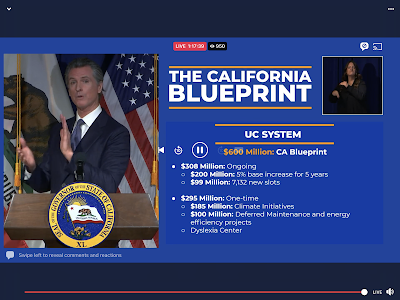
I've fixed the mistake in the Los Angeles Times headline on Gov. Gavin Newsom's higher ed budget proposal for 2022-23.  In fact, if you add one-time money from the current and coming years, Newsom is proposing overall cuts to UC and CSU.

The base general fund increase is five percent next year (see summary slide above), with five percent promised each year for five years total in a new compact between the university systems and the state.  

Newsom delivered  the compact promise with a joke about how he knows the people who lived through the last (broken) compacts will doubt this one too.  Newsom signaling he knows we think Sacramento compacts are worthless doesn't make Sacramento compacts less worthless.  So I assume only next year's five percent.

Newsom's five percent is better than Gov Jerry Brown's annual two or three percent--apparently twice as good.  However, Newsom gets an inflation rate that is twice Brown's too. The Personal Consumption Expenditures (PCE) Index accelerated from 4.2 percent to 5.7 percent from July to November 2021. CPI hit 6.8 percent, and projections for inflation in 2022 by Fannie Mae and others suggest a five percent increase will be entirely consumed by inflation.  Hence the term "flat," and also my sense that the corrected headline is still optimistic.  For more than a decade, two Democratic governors have been giving UC and CSU flat annual budgets--when they are not cutting them.  That is not changing.

The other touted feature is that the state is funding residential enrollment growth.  Newsom proposes it support 6,230 new California undergraduates with $67.8 million (or $10,882.83 per student).  Again, it looks good compared to Jerry Brown.  He proposes an additional $31 million to buy out 902 nonresident slots at the three flagships (Berkeley, Los Angeles, and San Diego), at $34,368.07 per student. Don't ask me how they came up with those numbers.  What is clear is that the nonflagships are not getting state funding for the nonresident students they have been unable to admit because of the enrollment cap that emerged from the political blowback caused by the flagships.  Newsom sets up UC for a multi-year series of tuition carve-outs that allow the flagships to keep their nonresident tuition premiums, maintaining intra-campus budget inequality.

Most UC campuses are at capacity and have been for some time, so getting new students means hiring new faculty and staff and building or expanding facilities.  In practice, it means more costs and also more hardships for existing students. They will have even more trouble getting courses and housing.  Next year's per-student rate is less than half of what UCOP says is the average cost of instruction of each student (that is vastly more than most departments receive per major but never mind). We can say that $10,882.83 will at best cover costs of the new students and at worse create new deficits.  Like the base increase, this is not an increase in UC's per-student operating budget.  (The small "cohort tuition" hike will also make very little difference.)

Last fall, I suggested 2021 might well be, financially speaking, Peak UC.  The governor's new proposal confirms that fear about a stagnant 2020s of unfunded mandates.  Further confirmation came from UC president Michael Drake ritually praising the governor's generosity, putting a cap on growth in the bigger revenues.

I'm not going to go into more detail on the numbers until they settle down, and won't chart any trends until spring.  Newsom is right to see budgets as "expressing our values," as he said at the end, but his presentation was a numerical mess, referencing three different sizes of surplus ($42 billion, $20 billion, $31 billion), two from his own office, and identifying dozens of individual program totals from two different budget years.  So in the meantime, let's take a look at some other issues raised by the presentation, both on the campuses and the state as a whole.

Newsom has exactly two ideas about higher education. One is that it maximize access on the basis of diversity, equity, and inclusion (DEI).  The other is that it prepare students for jobs, and by jobs he means jobs in technology. 

Newsom makes state funding contingent on several 2030 goals: UC eliminating racial gaps in grad rates, getting grad rates to 76 percent for four-year students, and getting students to debt-free graduation. These are essential goals and UC must achieve them. But they require fundamental change in the UC business model.  That now depends on undergrad tuition subsidizing research and other activities--so less money is in instruction and student support, which hurts retention differentially across racial groups.  The business model also depends on saving a lot of university money (my estimate is $755 million in 2019-20 using Accountability data) by capping financial aid, therefore forcing undergrads to borrow and work during the academic year (see Stage 2 and Stage 5 respectively).  

This is such an important point--the need to fund goals rather than simply assert them--that I'll expand a bit. You improve graduation rates in part by hiring enough instructors so that every student can get every class they need, when they need it. Because of chronic underfunding, many or most students on all UC campuses wait quarters or years to get admitted into at least a few of their core required courses.

How do you reduce racial gaps in graduation rates? You offer personalized, individual advising to every student who wants or needs it.  You don't tolerate caseloads of 740 students for each advisor, which Laura Hamilton and Kelly Nielson, in their important book Broke, report is the case at UC Merced's school of Social Sciences, Humanities, and Arts (page 123). 

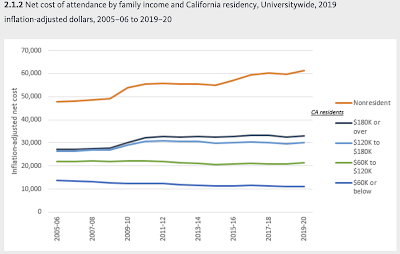
You also reduce racial gaps in graduation rates by taking students of color out of the cafeteria job they use to reduce their borrowing and into class: you cut their work hours ideally to zero while they are enrolled full time. You do not impose a Self-Help Expectation of $8,500 or $9,200 or $10,000 on every student with financial aid, even if they are low income, as every UC campus does. In other words, if you want to reduce racial gaps in graduation, you don't do this, for years and years: have a net cost of attendance of $10,000 per year (after financial aid) for students whose whole family earns $60,000 or less.

You also don't allow the poorest students to have the most debt at graduation.  

You stop doing these things by buying out financing gaps for poor and otherwise disadvantaged students, and then you put money into  personalized, intensive advising, well-funded student centers, and other things most UC faculty and staff could name off the tops of their heads.  When you start paying to provide these things, you're then able close your graduation gaps.

These are all things UC campuses want to do. None of them are things that either the governor or the legislature want to pay for.  None of them are things whose costs UCOP has itemized and justified in public in order to inspire the desire to pay for these essential things.

The governor mentioned diversifying university faculty.  This has been an explicit UC goal since the 1980s. Again there are racio-cultural obstacles. But the material ones are at least as important.  A diverse faculty comes from diverse doctoral programs, which means strong retention in those programs, means fully funding grad students from working-class backgrounds who are at greater risk of dropping out for lack of funds or excess debt.  UC does not fund its doctoral programs at the needed level.  

Thus in 2019-20, grad students went on a multi-campus strike over their rent burden, demanding a cost of living increase outside their union contract so they could cover costs in the private rental market. Nothing was done, and the students who started it (at UC Santa Cruz) were expelled for a while.  In the midst of the pandemic in early 2021, UCSD grads had to protest in the face of massive rent hikes in campus housing.  In 2022, rent burden is, if anything, even worse. The diversity of the faculty stops there, with unmanageable costs of living.  If it is serious about faculty diversity, UC should announce debt-free doctoral programs. But the governor and legislature would have to pay for it.

In sum, Newsom insists that UC close graduation gaps with essentially the same per-student funding that caused the gaps in the first place.  UC officials should point this out.

Now, on this question of college for jobs: Newsom and most policy people continue to work with a version of Human Capital Theory (HCT) descended from the 1950s, in which "learning equals earning."  In reality that is true only for a subset of students (generally already financially advantaged--for the theory's flaws see our LARB review-essay).  Policymakers are trying to fix the theory by saying, "tech learning equals earning," and UCOP encourages this splitting of STEM from other fields by publishing wages-by-major data.). 

Enter Gavin Newsom: propelled by half-baked but established neo-HCT, he is making these five percent state funding increase contingent on "supporting workforce preparedness and high-demand career pipelines," requiring 25 percent increases in degrees in STEM "and Education or Early Education" disciplines, as well as the same increase in "academic doctoral degrees," all by 2026-27.  The requirement is not exactly water-tight, and it also has a very weak justification in existing jobs projections.  The original 2015 report that started this "million missing college degrees" fixation shows most new jobs appearing outside of STEM (Figure 4).   Did anyone in the governor's office read the current occupational breakdowns for the state? It's the same story here, with tech a minor employer by size (though not by wages, which are high). But the STEM quota sails anyway, towing a legitimate fear about teaching shortages behind.

Even if the job market really did say STEM, it's an invasive step for a governor to mandate changes in degree outputs in a university.  Californians felt sorry for Floridians having to put up with Gov. Rick Scott making nasty cracks about anthropology and saying he didn't want taxpayers to foot the bill for useless degrees. Newsom is effectively doing the same thing. It raises allocation questions: Will new faculty lines to teach the expanded enrollments all go to STEM plus a few for education?  Will provosts need to stop hiring in arts and humanities for a number of years to pool lines in the "high demand careers"? Should California's future musicians, screenwriters, architects, designers, painters, film editors, historians, novelists, and journalists avoid the experience of being second-class citizens by going to UC? 

There are no answers, and this brings me to the experience of watching a governor's budget presentation on dozens of topics where the word "education" wasn't uttered until well after minute 70. Newsom organized his address around five existential threats. He had no vision of a New California, but ran through a series of hard problems that must be solved. I sympathize: he has not been having a joyful time. There's pandemic illness and also its political madhouse, with the recall trying to get rid of him for doing his public health job. There's drought and fire and the climate crisis behind them. There's the cost of living crisis. There's decades of underinvestment in transportation and other infrastructure.  There's a very polarized state economy, where a third of the workforce earns less than $15 per hour (page 3). There's a decades-old housing crisis, where so much private wealth has been absorbed into inflated housing assets that the state spent $5.2 billion last year--an additional University of California state budget--paying people's rent. 

Newsom brings a lot of energy to this slate of problems. He fired dozens of powerpoint bullets at them, each carrying a $100 M or $200 M or $1 B payload. But it's all the equivalent of filling (very important) potholes, keeping the electricity on, getting the shots in arms, giving the kids something to do in school until their parents get home.  

Even the tech future of green transition is remedial, trying to undig the hole of climate change in a state still almost entirely dependent on the private car.  There was something hollow in Newsom's enthusiasm for the state's green tech leadership: he cast the state's investment as bait for private investors, took it as an opportunity to hype the hegemonic tech sector that I think he quietly dislikes for its entitlement and arrogance as do most Californians, overpraised legislative honchos and others, and started referring to California as a "leader in this space" or that space--space being a term he used dozens of times.

Contrast this with how Newsom sounds on things he cares about. Then he is serious, knowledgeable, plainspoken, and open. What he really cares about is pre-K, school nutrition, homelessness, getting people out of encampments, mental health, universal health care, summer school for poor kids, a decent access to basic goods for disadvantaged people.  Whatever his neoliberal policies might be, Newsom's deeper desire, I felt watching him, is to ease the worst suffering.  This is also where he feels useful, even perhaps a bit of a hero.  But this desire doesn't find much to feed on in higher education as officials present it to him.

It's not just Newsom: the media isn't interested in higher ed either. During question time, the press had crisp questions about Newsom's contradictions on personal exemptions from Covid vaccines, his concrete plans for supporting reproductive rights, his borrowing of his recall opponents' plans for the mental health system, and his proposed changes in the Medicaid prescription program. They had nothing about higher ed.  This is a real problem for the sector. The governors' office doesn’t get vigorously questioned about higher ed, so they don’t prep for that, they rightly think the media and its consumers don't care about the details, so they never think, "we’re going to get pounded on mandating STEM degrees so we’d better think this through."  

I’ve written about Biden-era Democrats assigning college to a dedicated space in the welfare state. The good news is that they want government-run social development—Biden has in fact broken with key tenants of neoliberal Obama-Clintonism.  The bad news for higher ed is that the Biden-Newsom mainstream has no intellectual developmental plan for higher ed to address. Biden-Newsom are a real policy advance on Obama-Brown--an advance for children, the food insecure, the mentally ill, the unhoused, the uninsured, but not an advance for college students or the educational system.  

For them, the knowledge economy is abstract scenery, a slightly smoggy familiar sky.  We may need a million more college degrees, but that's just a logistics problem—there’s no interest in process or content or quality upgrades to say nothing of revolutions in thought or in the public's collective cultural and political capabilities. For them, UC and CSU are server farms that should run quietly in the background. There's nothing heroic about them, and they won't make a hero of any president or governor.  They are of modest interest as economic infrastructure. They are certainly not, for this Democratic party, a state engine of destiny.  

This could be changed, in a couple of diverging ways. One would be all three segments busting out of the workforce preparation trap and developing exciting stories of college-fueled individual and social transformation.  I know some deans and individual faculty who could do this. I don't know anyone at the senior manager level who would. Please correct me if I've missed some folks. 

The second, more plausible path is to comply fully with the mainstream Democrat welfarist passion. Inspiration is also needed here, that makes the state's politicians heroes of social justice. But that means defining the processes that would allow UC (and CSU) really to meet graduation and the other targets, and then setting their actual price. 

Fix the funding, or miss the goals. It shouldn't be a hard decision.


Posted by Chris Newfield | Comments: 1

Monday, March 30, 2020

Monday, March 30, 2020
Covid-19 has brutally laid bare the devastating impact of several decades of privatization and capitalist globalization.  The rapidity of the virus' traversing of the globe, its powerfully unequal impact on different countries, and on different segments of the population within countries, are all linked together by the simultaneous expansion of the movement of goods and people and the evisceration of the public welfare and public health in many countries.  In the United States, to take the case closest at hand, the absolute under-funding of public health and the refusal to prepare for pandemics adequately is now reaping havoc on the population and on the doctors and nurses who are trying to heal them.  Three decades of diverting resources to commercializing publicly-funded research has only made this situation worse.  As the LAT has reported, Jerry Brown, with his usual lack of foresight, managed to dismantle a program that Arnold Schwarzenegger had created to respond to pandemics; in this he is an odd precursor to Donald Trump even if he did oppose him on many other things.  As I watch my medical colleagues struggle with insufficient safety equipment, a lack of ICU beds, an inability to test on a mass scale, and the exhaustion of overwork, I often wish that I lived in a modern country.

In the United States, of course, the pandemic is striking at a society riven by increased inequality.  Wage stagnation and the growth in corporate profits, along with its effect, the gig economy, has left more and more people without the resources to ride out the crisis.  Unemployment claims have skyrocketed to remarkable levels.  Neoliberal policy and practice have displaced alternative forms of rationality; public goods and solidarity are devalued in favor of individual capital; they return only in their ghostly mirror image of ethno-nationalistic anger.  Knowledge, both of nature (climate change, epidemiology) and of society are denied in the name of the populist wisdom of the president's gut.

Universities, of course, are deeply embedded in these crises--both the immediate and the long-term.  Colleges and universities across the country have moved to remote learning; moving staff, students, and faculty off-campus, shutting down labs, and, where they have medical centers trying to move as many resources as possible to support them.  Despite some skepticism, this was clearly the right thing to do.  But we should acknowledge the likely damage that it will cause: not only in student learning, but in financial resources, faculty and staff careers, scholarship disrupted if not derailed, and the damage to thinking together that is, or at least should be, the hallmark of the community of scholars.

At the same time, higher education has itself been embedded in growing inequality.  If knowledge is devalued, some part of that is due to the reality that colleges and universities have themselves contributed to inequality: seeking out prestige through selectivity, eagerly participating in the games of rankings, and turning towards satisfying the demands of donors over public needs.  This latter behavior, of course, is rooted in, and reinforces, the relative decline of public funding.  The return of the private took place in the decade following the dramatic expansion in the numbers of women and people of color on campus, not to mention the decade of student revolt.  Universities have been paying for this ever since.

But if higher education faces daunting challenges, it is not to soon to think about what we want in the aftermath of the pandemic.  There is an opportunity here for new thinking.  No, I don't mean giving in to the ed-tech gurus or those administrators now circling the crisis like vultures, wishing to strip away from students their residential education, and from faculty their control over curriculum and its forms. If the forced separation that Covid-19 has taught us anything it is that certain aspects of universities and colleges are essential and that they can only be saved by rethinking that which is not.

First, rather than proof that the future is online, the present retreat into distance learning is revealing the exact opposite.  Students have made clear exactly how much they value the residential experience-- just as faculty are remembering how important the shared classroom is for education.  The problem, as Chris and I have been arguing for years, is not the reality of in-person instruction but its lack of proper funding.  Universities will need to develop a new public contract; more people--not fewer--should be enabled to have the residential experience if they choose.  This means increasing public resources to reduce price across the whole spectrum of costs.

As I suggested a few weeks back in the days before Covid, universities especially need to more effectively defend the importance of research and graduate education across all disciplines.  Although attention now is focused appropriately on the search for medical remedies and care, the pandemic shows once again how deeply important knowledge of culture, politics, history, and society are for responding to crises, as those domains largely control the development of the crises themselves.  STEM is not going to answer the questions of the costs of privatization or the effects of the emphasis on commercialized tech transfer; nor will it help us solve the problem of homelessness or housing; or provide people with the perspective to learn from previous crises; nor, even on its own, enable us to try to prevent climate catastrophe.  Those are all eminently political and social problems and need to be understood as such.  Nor will STEM help UC address the ethical issues of allowing graduate students to lose their healthcare or live in their cars in the middle of a pandemic.  We need far more natural science--both pandemics and the climate crisis demand it.  But we need social and cultural knowledge as well.

To even begin to do these things, two large shifts will be necessary, if not sufficient, conditions. The first is an end to the pretense that tuition and philanthropy can overcome the challenges facing public higher education.  The rote repetition of some UC leaders that "free college is a dangerous idea," bears more than passing resemblance to the apocryphal "let them eat cake."

The same can be said for the repeated claims of UCOP that a tuition increase is better for poorer students than having the state buy it out.  This is true from one perspective of course--but it depends on concealing the fact that this situation is a result of a policy decision at OP, not built into the nature of things.  UC could just as easily decide to spend the same percentage of the state buyout on financial aid. They simply don't. 

But even these points remain trapped in the wrong ballpark.  States do have budget limitations; the answer is going to have to come in a new national contract.  I know that at the moment, with a knowledge-despising president and a science-denying party in control of the executive, judicial, and half of the legislative branch this seems like an impossibility.  But if the 2 trillion dollar stimulus should put paid to any myth, it is that Republicans care about budgets or deficits when their own access to public money is at stake.   Covid-19 increases the credibility, by the day, to modern monetary theory's notion that the real challenge in economic life is the underused capacity of the real economy.  From the Green New Deal to a new social contract for health and education, universities must take the lead.  Or they will have failed to live up to their name.

This will mean hard choices for the community of scholars as well.  Those colleges and universities who recover from this crisis will need to think deeply about their purposes and not simply fall back into patterns formed over the last several decades.  Managers will need to reject their dependence on precarious faculty whose numbers expanded in the name of market flexibility. Faculty will need to think through what is essential in their teaching and research organizations and the hyper-individualism and localism that they can fall prey to.  Both faculty and administration will need to rethink authority so that decisions are made by those--even within the university--who are closest to practice and knowledge.  And underlying all of these decisions and debates will lie the most important one: are colleges and universities--and those who work in them--going to continue to see who can triumph in the struggle for private prestige?  Or are they going to work to help produce a revitalized, and international, public good?

It will be the struggle of the 2020s.
Posted by Michael Meranze | Comments: 4

Sunday, March 22, 2020

Sunday, March 22, 2020
Shutdowns are now spreading as fast as the coronavirus. On March 19, Gov. Gavin Newsom ordered 40 million Californians to stay home, claiming that the infection rate puts the state on track for 25.5 million infections.  The order has no end date.  New York and other states and counties have since followed suit: by noon on March 21st, 75 million US residents were under some kind of lockdown.

In this post I'm going to talk about what I've learned during a sustained effort to apply analytical expertise to a topic outside of my normal subject areas, as I try to build a base for a series of citizen judgements about health policy, and also the related areas of educational and economic policy that I know more about.

This learning process has changed my mind about a number of Covid-related issues: for example, when I learned March 10th of UCSB's shutdown--at the end of my senior seminar, thanks to Jenna, multitasking on her email again!--I was a skeptic about the benefits of widespread closures. Now I'm a believer: I think that widespread social distancing is our only chance to avoid levels of infection that would overwhelm hospitals and clinics and lead to much excess death.  At the same time, I'm also more optimistic about reducing infections than I was a week ago.

The main part of this post close-reads the one published infection model that I've been able to find-Neil Ferguson et al.'s paper, from Imperial College London.  The U.S. Centers for Disease Control and Prevention (CDC) has not released its modeling, though it was discussed in a bootleg version by the New York Times.  My caveat up front is that the SARS-CoV-2 infection model I analyze does not offer any certainty about the future. But I will talk about the powers of the suppression regime we've entered into, and how the disease might be made less deadly than many of us now assume.

An overview:
  • The policy of virus suppression does appear to reduce Covid-19's spread. I'll define this and other terms below, since terminology is all over the place in media reports. (The one journalist I've found to have interviewed Neil Ferguson--Nicholas Kristof of the New York Times--conflates mitigation and suppression.)  Suppression has worked well in South Korea, Singapore, and post-lockdown Hubei in China when social distancing is combined with mass testing. 
  • The U.S. simply does not have the testing capability to do the most effective form of suppression.  (Santa Barbara County has brilliant and frequently exercised emergency services.  As of March 22nd it has 13 confirmed Covid-19 cases, a shortage of test kits, and 200 tests out whose results won't be in for awhile.) The U.S. has not been able to do contact-tracing, which would have allowed a much more efficient form of isolation than the mass version we're doing now.  In spite of some encouraging reports of new equipment coming on line, the U.S. is in the midst of what statistician John A. Ioannidis calls an "evidence fiasco," and its public health capacities have been downsized (personnel down 20 percent since 2008, according to David Himmelstein) to the point that we're likely stuck with the crudest, most disruptive, and most economically damaging form of suppression. 
  • This has implications for rebuilding social and public capabilities that I'll save for a later post on how SARS-CoV-2 is putting neoliberalism out of its misery--and how to keep that from causing further misery for diverse publics.
  • A theory point: public officials are using projections of high infection and death rates to install suppression regimes, but these suppression regimes are designed to invalidate the numbers that justify them (by producing much lower rates of infection and death).  Either you infect 81 percent of California by doing nothing, or you lockdown California and get a much lower infection percentage.  You don't do both.  I elaborate on this point because it's important for people not to think lockdown = death (regardless), but to think the opposite.  
  • A policy point: public officials must not bullshit the public with exaggerated numbers, withheld models (CDC!), and mashup policies that will encourage cheating. Newsom did the right thing, but he didn't give clear, honest reasons for it.  That has to change.
To take the last point first: Where did Newsom get the number that he used to shut down most of the state economy without an end date? We don't actually know. The LA Times reports, "the governor’s office declined to provide an explanation of the state’s projection that 25.5 million Californians will be infected with this virus. Instead, a spokesman for the governor said the state’s mitigation efforts could lower that estimate."

The last part is true (though "mitigation" is the wrong word, as I'll explain), but the public should be told the source.  In the meantime, I'll guess that Newsom's people got that number from the now-famous pandemic modeling paper I mentioned at the top, Ferguson et al. Their baseline reproduction number (Ro) for the disease is 2.4--meaning each case typically goes on to infect 2.4 other people. You can get to 25.5 million Covid-19 infections by taking California's Covid infection count when Newsom spoke--around 1000--and giving it an exponent of 2.45.  (Updated: See Akos Rona-Tas's correction of this speculation below, under March 23.)

The Ferguson paper derived that Ro in part from from the spread of the virus in Wuhan, China, before the government began its many non-pharmaceutical interventions (NPIs)--forced quarantining, widespread testing, etc.  (Wuhan's Ro was previously reported as 3.11).  The projection that 56 percent of the California population will become infected appeared as a math error in Newsom's letter to Trump requesting a hospital ship: it's actually 64 percent, or alternately, 39.56 million Californians * 0.56 = 22.15 million inflections.  The point isn't the bad math but the need to offer credible numbers and explain clearly where they come from.  People will take honest, fully disclosed estimates more seriously.  Health policy needs to be open to establish the trust that government now desperately needs, to discourage cheating, and to allow meaningful democratic judgment about overall policy. 

Public officials, including Newsom, seem to be now focused on using big numbers to stampede the masses into social distancing, RTFN. This is understandable, since, in the suppression arsenal, social distancing is pretty much all we've got.  But one major effect of their statements is to muddle the difference between mitigating and suppressing a pandemics: the former allows infection rates like 55 percent. The latter slows growth rates and can put them into reverse.  Suppression also requires a rigor that people won't pursue if they don't understand the massive difference it can make.

To put this in the form of a question, could the U.S. and the European Union (and other regions) achieve suppression and thus decline in the number of new cases?  The current tracking in California is not good.


But look at  the South Korean case pattern.


South Korea had our hockey stick and has now bent it down into slower growth of new cases.  As is now widely discussed, South Korea, Singapore, Hong Kong, Taiwan, and now Wuhan have slowed the spread.  This is the effect of suppression strategies.  There's some important news here, which is that Covid-19 infections rates can be reduced, and its case-mortality rate can be kept low (not the 3.4 percent reported by the World Health Organization, but about 1 percent in South Korea, or 0.54 percent for cases under age 60).  Germany currently has a 0.3 percent case-mortality rate. SARS-CoV-2 kills people by doing horrible damage to their lungs (see the images around 0'30" in this Santa Barbara Cottage Health grand rounds lecture).  And yet the virus does so little to so many other victims that 86 percent of cases in China were undocumented prior to travel restrictions. 

On to the model: the Ferguson et al. paper draws on previous work with influenza pandemics to compare three responses-- doing nothing, mitigation, and suppression.  Doing nothing seems to have been the preferred option of the Boris Johnson and Donald Trump governments until about March 15th-16th  (Johnson, Trump), with the Johnson government allegedly working on a trust that infection would create "herd immunity" without disrupting the economy.  At least in the UK, they seem to have taken on board the Ferguson et al. calculations that "doing nothing" will lead to infection in 81 percent of the population (at  2.4 Ro), producing 510,000 deaths in the UK, plus 2.2 million deaths in the United States, both over a 2 year period.

With doing nothing now ruled out, the alternatives that Ferguson et al. modeled are mitigation or suppression. Suppression is China after January 23rd and South Korea, among others; Britain is moving to suppression with one escalating announcement after another (which may defeat the purpose).  Some parts of the U.S. are now doing suppression, including New York and California. The Ferguson paper divides these two strategies into two groups of non-pharmaceutical interventions (NPIs).

 The most effective set of mitigation measures are:
  • Case isolation in the home (CI): symptomatic cases stay at home for 7 days.
  • Voluntary home quarantine (HQ): all members of a household with a case stay home for 14 days
  • Social distancing of those over age 70 (SDO).
Note that this falls short of "lockdown," which includes social distancing for the whole population (SD) and, in most cases, closures of schools and universities.

Mitigation is the famous "flattening the curve." The serious cases that need hospital services are pushed out over time, with the goal of relieving some of the stress on the health care system. Mitigation is "predicted to reduce peak critical care demand by two-thirds and halve the number of deaths" (8).  Assuming the ratio of infections to critical care cases is constant, and that the syntax means mitigation yields 2/3rds of the "do nothing" infection rate, this leads to 54 percent of the population being infected, and to 1.1 million deaths in the U.S.  (When Kristof quotes Ferguson saying his best case is 1.1 million deaths, I think he ran Ferguson et al.'s two regimes together: in my view, the sentence should read, "his best case for mitigation" is 1.1 million deaths.

Clearly mitigation isn't good enough.  A million deaths in the U.S. is unacceptable, and the model suggests that under mitigation health care systems will still be overwhelmed (10). Since something like Italy's hospital crisis and high fatalities are the combination everyone wants to avoid, the UK, the EU, California, and now several other U.S. states have moved into suppression.

A side note: I would normally read the quotation to mean that mitigation reduces peak care demand (and infections) by 2/3rds, down to 1/3rd of their previous level, which is a 27 percent infection rate.  I don't know if that's what Ferguson et al. meant, but it's still more than double this year's seasonal flu rate (so far this season, flu has killed 22,000 Americans). 

Much of the U.S. is now following Italy, France, Spain, and other countries into suppression. The key benefit is that it reduces the reproduction number (Ro) to close to 1 or below, which China has shown is feasible.  Here's a nice stretch goal for the West.


 In the Ferguson et al. model, suppression adds to mitigation's measures:
  • school and university closures (PC)
  • social distancing expanded to the whole population (SD)
I've reproduced the table that shows the results. I'd recommend starting in column 1 with the baseline Ro of 2.4 (510,000 "do nothing" deaths) and look at the medium case of 200 (which means that the full suppression program is suspended when ICU cases fall below 200 in Great Britain, and are re-engaged when they rise above that number). (The paper does not have a similar table for the U.S.) 
California is now doing the full suppression program.  If you look at the right-hand column under Total Deaths you can see the results.  Deaths in Great Britain drop from 510,000 to 24,000, or by a factor of around 20.  The U.S. equivalent would be 110,000 deaths, not Kristof's 1.1 million.

Note two other features of this model.  The interventions all have finite periods: mitigation is modeled over 3 months (to mid-June 2020) and suppression over 5 months (to mid-August 2020).  They don't extend to the full 18 month "vaccine" period, nor are they open-ended.

Second, they are adjusted according to thresholds of infection and hospitalization that can be selected and monitored.  Governments have a great deal of agency here.  In other words, this new coronavirus is bad, but it is not an irresistible event like a giant asteroid hitting the earth.

A big catch is that the versions of suppression in South Korea, Taiwain, Hong Kong, Singapore, and China include mass testing.  Neither the US nor the UK have done this, nor do we seen to have the capability to ramp this up.  There's been much excoriating commentary on this point.  I had been hoping that UC Health could make a big difference to California public health. A potentially exciting March 14th headline, "UC has a solution to the national shortage of coronavirus testing," didn't, with our weak public sector, mean UC is gearing up mass testing for the public, but that it has a private test for its own patients.  I've heard ambitious UC plans--in this week's board meetings, one UC regent suggested for the installation of MASH hospitals on empty land that UC owns. But because of testing and equipment shortages, UC medical centers have to focus on protecting themselves (see 0'44"-0'49" or so in this very useful UCSF infectious diseases division' grand rounds). I'll end by adding a few items to the summary list above:
  • The virus is going to be terrible for public health workers, who deserve not only massive sympathy and support but also personal protective equipment, which they may now have more hope of getting.  Mass testing also depends on cranking out PPE.
  • Public health interventions in Asia have had enough success with suppression to give  credibility to the Imperial College model--most interestingly, its suggestion that deaths can be reduced by an order of magnitude. 
  • On the other hand, hospital access remains a potential catastrophe.  Full suppression reduces ICU need to 1/3rd of "doing nothing."  In the bootlegged C.D.C.’s scenarios, "2.4 million to 21 million people in the United States could require hospitalization, potentially crushing the nation’s medical system, which has only about 925,000 staffed hospital beds. Fewer than a tenth of those are for people who are critically ill."
  • Still, suppression seems to make a big difference even if it is leaky: the Ferguson et al modeling assumed incomplete success and still got major reductions (see Table 2 on page 6).
  • The US has a weak health system (or no health "system" at all, as Robert Reich rightly observes). This is a big problem. But the US has some other advantages: a lot of really good, dedicated health personnel, lower population density than Europe's or East Asia's and, ironically, dependency on the self-isolating feature of private cars.  Our version of suppression might be more successful than we now expect.
  • Officials should give expiration dates to the current suppression regimes. They can be extended later, depending on conditions.  As I noted, the Ferguson et al. model assumes a kind of regular adjusting depending on infection numbers. (Hong Kong has reimposed quarantine and testing on arrivals after an uptick in cases.) Indefinite lockdowns are bad for both people and the economy.  Once people are scared indoors, and the infection curve is bent like South Korea's, governments should throw the lockdown into partial reverse, lest they create another Great Depression x 2.4.
I'll move on to political, economic, and university dimensions in other posts.  From the Haley Street Bunker: stay well, and keep your distance! 
Monday March 23rd

Statistical chemist Michael Levitt hammers on one of this post's key points: "The virus can grow exponentially only when it is undetected and no one is acting to control it."  The media, he says, should focus not on total number of cumulative cases but on rates of growth of new cases. 
Speaking of which,  South Korea's number dropped again, so the chart looks a bit better today.

The coming U.S. health crisis will owe much to a social system that can't anticipate non-market public needs.   That's not what this WaPo piece says in so many words, but it has all the raw material--shortages of masks, gowns, tests, ventilators.  What aren't we short of Covid-wise?

This piece, by a Mass General physician, specifies how the market power of large hospitals will mal-distribute emergency equipment: "We are currently taking an every-hospital-system-for-themselves approach, in which some hospitals will surely say “we’ll take them all” while others will lack the capital to make such large purchases in advance and therefore will be reliant on FEMA, which will be forced to ration scarce, lifesaving equipment. These already cash-strapped hospitals serving poorer populations will soon be put in even greater jeopardy.

From Akos Ronas-Tas (Prof of Sociology, UC San Diego): How Newsom got his numbers (over half of Californians being infected) is a mystery, but it is surely not by raising 1000 to the power of 2.45. I am no epidemiologist either, but the Ro produces an estimate only if you specify how many generations of infections you count. So if the base (generation 0) is 1000 and Ro is 2.4 (used by Ferguson), the first generation will be 1000*2.4=2400, the second generation 2400*2.40 = 5760 and so on. The total number infected will be by then 1000+2400+5760=9160, adding up generations 0,1 and 2. In the Ferguson paper they use a 6.5 day generation time. The key here is that Newsom made his prediction for 8 weeks out. So he is counting roughly 8 generations. The number of newly infected in the 8th generation will be 1000*2.4^8=1,100,753. You have to add to this those from the earlier generations. That will give you the total number of those infected (roughly, 1.9 million). Some of them will have recovered by then and happily immune, others would have died. I don’t see how this adds up to 25.5 million, either as the number of all people who have ever been infected, let alone all people needing care at a certain date.  You would get to a cumulative 26 million in 11 generations with 15 million new infections. That is 71.5 days, 10 weeks, still only late May.

You can make the model more complicated. Ferguson assumed a variable R in each generation and it should also vary across generation as the number of people getting immunity increases.

Here is a nice calculator that adds a few other considerations.

The real scary numbers come from the healthcare system. There are only 74,000 hospital beds in California, and 6,300 in SD  county, only 32% of which are available. This is probably similar in the state overall. But what you really need is ICU beds (only 800 available in SD county). There are about 50,000 ICU beds in the entire US and about 100,000 respirators. And you also have to add to this that beds, even ICU beds are useless unless you have trained personnel attending to them. So if we suppose only 2 million people being sick at the same time in CA, and only 10%  (100,000) needing hospital beds and only 4% (40,000) ICU beds, we have a major catastrophe. 


Tuesday, March 24

On the duration of the shutdown, Jeffrey Sachs invokes the example of China. Their ironclad version of suppression, including mass testing, suggests the spread of SARS-CoV-2 can be stopped in 60 days.  Sachs says 60-90 days.

This is not what's happening in Italy, where exasperated mayors berate their citizenry.

Buzzfeed does funniest home videos for the Covid quarantine

As India's government orders a 3-week "total lockdown,"  nearly 60 percent of the U.S. population is not under stay-at-home orders or being mass-tested.  The U.S. is therefore not, overall, doing suppression, but mitigation of SARS-CoV-2.  Note that this predicts some "flattening of the curve" of infection--reducing but not eliminating the overload on health care-- but not reversing the spread of the disease (Ro stays above 1). Some red state politicians are actively resisting social distancing (Texas, Mississippi), as is POTUS himself.

Speaking of testing, California is way behind New York, working "piecemeal."
This piecemeal approach, said Harvard epidemiologist Michael Mina, is a key problem with testing in California and nationwide.
“We have a decentralized healthcare system and we have no way to scale for government means,” Mina said. “Everything is privatized, everything is individualized in our country and it’s become our Achilles’ heel in this case.”
   
Wednesday, March 25  It's Bailout Day!

NYT summaryEssential first take by David Dayen. Trigger warning: wow will this analysis not reassure you that any economic reforms are in the offing.

Yes we have no protection: "A very American story about capitalism consuming our national preparedness and resiliency"  Painful contrast between the American scramble for the most basic equipment and Germany's highly successful health system for radically minimizing fatalities.

Half-assed LAT reporting on the coming fiscal crisis of the state of California.  No real info, and other annoying stuff. How do you find the school lobbyist who will say this will be really bad for the schools, and then add, "under current law, it is likely that schools could withstand a total statewide revenue loss of around $5 billion. But more than that and schools will face significant problems."  So your own lobbyist just told the state that a 7 percent cut is fine. 

Where's higher ed in the stimulus bill? Inside Higher Ed's summary:
Six-Month Loan Deferment in Senate Bill
March 25, Noon. Student loan borrowers would be allowed to defer making payments for six months, without interest, through Sept. 30, according to a summary of the $2 trillion stimulus package Senate leaders agreed to at 1 a.m. Wednesday morning. The full bill is still being written and hasn’t yet been released.
But according to summaries of the bill making the rounds among education advocacy groups and obtained by Inside Higher Ed, the measure will also include changes sought by advocates such as not requiring Pell Grant students to repay money to the federal government if their terms are disrupted by the coronavirus emergency.
However, the bill is expected to disappoint advocates who had embraced Democratic proposals in the House and Senate, in which the federal government would have made the payments on behalf of borrowers, reducing their balances by at least $10,000. The summary did not mention any loan cancellation.
A separate summary contains $30.75 billion in grants to “provide emergency support to local school systems and higher education institutions to continue to provide educational services to their students and support.” That amount appears be about $29 billion less than what higher education institutions could potentially get in the bill proposed by House Democrats, but $21 billion more than what Senate Republicans had initially proposed, one higher education lobbyist said.  Associations representing institutions that were disappointed with the previous proposals were still waiting for the full bill before they commented on the level of funding.
The bill requires the secretary to defer student loan payments, principal, and interest for six months, through Sept. 30, 2020.

Thursday, March 26

Covid revealing America's rear guard place in the world 

Zero Hedge's mashup of hostility to the shutdown, mixing vulnerability of SARS-CoV-2 to treatment (it isn’t a superbug) with statistical problems (extensive) with lockdown’s effect on the economy (bad but unavoidable). Playing rural roulette because lockdowns are Democrat.

Suppression works, says none other than Neil Ferguson!!
He said that expected increases in National Health Service capacity and ongoing restrictions to people’s movements make him “reasonably confident” the health service can cope when the predicted peak of the epidemic arrives in two or three weeks. UK deaths from the disease are now unlikely to exceed 20,000, he said, and could be much lower.
But don't go back outside! Because, on the other hand,
This measure of how many other people a carrier usually infects is now believed to be just over three, he said, up from 2.5. “That adds more evidence to support the more intensive social distancing measures,” he said.
Special bonus for modeling fans: Oxford now has a model too. More on this coming soon.

Hope for a UK Covid-19 home test within two weeks.

And We're Number 1 - in Covid-19 cases.
Posted by Chris Newfield | Comments: 4