


 |
| Banff, Alberta back country on June 5, 2026 |
This is the third of the talks from the CHCI panel, "The Humanities We Can Build Right Now" in Banff, Alberta. The others were Chris Nealon’s and Asheesh Kapur Siddique’s is here, along with my introduction to the panel.
∞∞∞
This paper is a response to two trends I've noticed over the past couple of years.
On the one hand, among humanities academics, there is an emerging consensus about the deleterious effects of generative AI on teaching and scholarship and about the existential threat the technology poses to our disciplinary futures. On the other, it seems, students, too, are suspicious about the growing prominence of AI technologies in both education and white-collar work, and dubious about the potential for LLMs to help them develop the skills and knowledge they'll need after college.
Relatedly, there has been a revival of interest in humanistic learning, in part as a response to a world of work and education that devalues the human. Both among students and within the culture at large, there's a new appetite for philosophy, classics, and even canonical literature (much of which travels under the sign of the so-called Great Books).
Some of that is being driven by a political project that aims to turn back the clock on decades of scholarship in the humanities and reclaim the university for a revanchist project, as Asheesh Kapur Siddique observes in his contribution to our CHCI panel. But it's not all bad news: a generation of students who have long been told that only STEM training offers a reliable path to employment and life satisfaction are newly curious about what the humanities have to offer. Here I suggest that--if we can stave off the deskilling imposed by administrations who hope to use AI to reduce the cost of instructional labor (a point I make at greater length in the forthcoming issue of The Hedgehog Review)--we have an opportunity to reinvigorate our curricula and grow enrollments by presenting ourselves as an alternative to educational slopification.
Crucially, this does not require that we become the old-fashioned cult of greatness and whiteness for which some self-styled reformers seem to yearn (as Dwight A. McBride has recently argued in Inside Higher Ed), but that, by engaging students who are giving us a second, or first, look, we can awaken their curiosity and build a new consensus about the value our fields offer--and the values to which we are committed.
In this context, I’m going to talk about AI. But not so much about AI as about the renewed value proposition of the humanities. For now, as many talks at this conference have suggested, AI seems capable of generating unlimited interest. It’s not only that LLM outputs are impressive or that we are seeing the forcible integration of AI into every technology product. It’s also that the financial economy is heavily dependent on AI’s commercial success to continue delivering investment returns and to eventually make good on the enormous speculative boom that has driven huge stock market gains. The so-called magnificent 7 tech stocks—Nvidia, Alphabet, Microsoft, Amazon, Meta, and Tesla—that together represent 35 percent of the value of the S&P 500, are all companies that are either directly engaged in AI development or heavily invested in it). Universities counsel, or mandate, AI adoption. Students are using AI--that much is clear, though I think, as Phillipa Adams rightly argued yesterday, it’s not clear that students like using AI.
I understand the temptation to refuse the tech, to be—as one of the questioners put it during Prof. Alondra Nelson’s keynote on Monday—abolitionist. I’m not here to argue against that! But I do want to suggest that as humanists we have been too attracted to the moral argument against AI and not attracted enough to the strategic one.
Let me explain. I believe that a primary use of this technology across the economy, right now, is as a form of labor discipline. According to a report from the Commerce Department released just last week, workers in the US are taking home the smallest share of GDP at any point since record-keeping began in 1947. Tech executives like Elon Musk and Anthropic’s Dario Amodei have argued that AI will occasion an economic restructuring that eliminates huge numbers of jobs—I believe we need to understand this less in the way of a prediction and more in the way of a promise. Irrespective of whether AI manages to replace labor at scale, it is already being used to justify workforce reductions, and low compensation. It will be wielded as an ax hanging over the heads of the employed to keep them in line. It’s common to believe that young people are pro-AI, or at least more open to it, but that’s a mistake; this past month alone we have seen commencement speakers like Scott Borchetta at MTSU and Eric Schmidt at the University of Arizona booed for using their addresses to extol the benefits of an AI-driven future. Why, college graduates seem to ask, should I cheer the very people who are now responsible for a vanishing entry-level job market?
What does this short look at the political economy of LLMs and hiring mean for the humanities we can build now? My suggestion is that we have an opportunity to make the case to students that studying the humanities might be among the best economic choices they can make. It was not so long ago that we believed in the power of persuasion. During the period from perhaps 2008-2020, we lamented the flight of students from our programs—and the loss of institutional support that came with declining enrollments. Students wanted to study the humanities, we believed, but they faced pressures that prevented them from doing so. The task was to convince them to follow their hearts and nourish their souls.
Of course, a rising sticker price for college has become a major recruitment challenge for our disciplines. Even as the total cost of college attendance has, on average, flattened out, real affordability issues for ordinary families continue to fuel political assaults on the university mission. Rather than fight against the need to show students returns on investment, we should cautiously embrace that need, because in an era where AI deskilling has become the norm, a humanities education should be repackaged as a premium product.
The tale of computer science is especially instructive: CS was recently thought to be so reliable a path to postgraduate earnings and employment that the number of computer science majors quadrupled between 2005 and 2023. Now, entry-level computer programming positions are drying up and technology companies have discovered that the one thing AI is really good at—the one job category it can potentially replace—is basic computer programming.
As Rose Horowitch wrote in The Atlantic last year, schools like Princeton and Stanford are anticipating 20-25 percent declines in CS majors. At a recent event at Stanford, a panel of higher education leaders that included Provost Jenny Martinez, former Stanford President John Hennessy (now at Alphabet), Berkeley Chancellor Rich Lyons, Oregon President John Karl Scholz, and President Christina Paxson of Brown agreed that high-status employers, especially management consultants, had begun to seek out graduating students with liberal arts backgrounds. Indeed, my anecdotal canvass of my own students’ perspectives at an elite undergraduate institution suggests that students are now skeptical of domains of learning that rely too heavily on AI and speak derisively of classes that teach them to become “prompt engineers,” skilled at directing AI systems to do tasks rather than skilled at doing tasks themselves.
I want to suggest a few implications for this new reality.
First, I predict that as AI continues to dominate students’ lives inside and outside the classroom, they will seek out places that feel like a refuge from technologization—just as students have a preference for in-person classes rather than online ones. Crucially, however, convenience is at odds with value. In other words, a student who can choose to attend an in-person class may nevertheless select an online modality because it’s easier, more convenient, or works better for their schedule. Instructors and advisors both need to make the value (not values)-based case for choosing a less convenient path: you can get credit for sitting in an online course with your camera off for an entire semester, but you won’t have much to show an employer (this isn’t to say that it’s not possible to deliver high quality remote instruction, just to be clear!). Students want things like low-tech classrooms and digital detoxes, but everything in their lives is set up to make those choices hard. Choosing the hard thing is not just better for their souls but likely for their futures as well. Students want challenges, too—they often choose to study STEM subjects, for example, not despite their reputation for rigor but because of it!
Second, we need to be aware of an emerging class divide between students who have the opportunity to choose a low- or no-AI education and those who do not. Here I draw the analogy to screen use in elementary and secondary grades: whereas integration of technology was at one time a mark of distinction, wealthier schools and districts now reduce tech dependence, ban devices and restrict screen use. Meanwhile, poorer schools and districts use EdTech as a substitute for in-person instruction, compensating for la ack of resources. Technology may be cheaper and in many cases compulsory.
On the apparent cheapness of tech: we should be wary of the Uber and Airbnb effect. AI tech that is now free to use is running at a loss because it’s backed by speculative capital, but once it has completed its disruption cycle and embedded itself into all our processes, we’ll see the costs climb, monopolizing educational resources across the spectrum. Students at elite schools who benefit from more in-person hours and lower student-faculty ratios will have the option to choose no- or low-tech courses of study while students at big public schools and other less-resourced institutions will accept a heavily AI-inflected education as their only option.
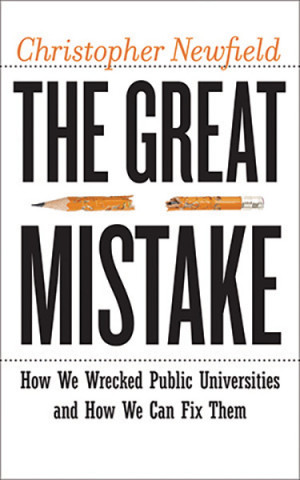
This is not just an artefact of schools stretching resources, either, but reflective of the place that educational stratification will assign students in the economy: elite schools will train students for high-status, high-autonomy jobs, while the majority of institutions will offer an education that corresponds to their students’ presumptive place in the economy, turning out prompt engineers whose work is strictly surveilled and dependent on interaction with technological systems that leave them little room for creativity or judgment. Chris Newfield’s The Great Mistake contrasts two different levels of higher ed that create different experiences: the experience of students at large public schools who might wait years to take small classes with personal contact with faculty members and the chance to spend class time speaking, not just listening, versus the experience of students at wealthier schools who take such classes from beginning to end. Something similar is happening with technology, and to the extent that humanities curricula across institutional types can find a way to resist it, we stand a chance at giving students at all institutions the kind of skills that equip them better for an economy in which humanity is itself a scarce and valuable asset.
Finally, I’d like to put in a word here for an opportunity that universities ought to seize on to build world-class humanities programs. This requires a gamble. If I am right—and I’m not guaranteeing I am—but if I am right, and the pendulum is set to swing back towards employers valuing the kinds of skills that humanities courses teach, then the schools that invest in building great humanities programs now will have an early-mover advantage. This can be done without huge investments: as any dean knows, humanists can be hired without massive laboratory or research expenditures, and right now there is a broad and deep pool of humanistic talent on the market. These are not just recent PhD graduates, though there are many excellent ones, but teachers with years of classroom experience and long publication records but without permanent employment. Strategic investments can attract transformative talent, positioning universities to establish field-leading programs that serve students who are increasingly interested in subjects like literature, philosophy, history, ethics, classics, and, yes, civics, and who find technologized education alienating and dubiously valuable in the emerging employment landscape.
I don’t pretend this is an easy sell: too many administrations still view innovation as synonymous with technologization. But our students tell another story: they are sick of screens, sick of doomscrolling, sick of atomization. We already have the alternatives ready; we have been developing them for years. It is a gamble that, if it pays off, can mean huge enrollment and reputational returns with a relatively small outlay. I suspect that the schools that pursue such a strategy will be viewed as visionary before long.
I want to end by invoking another of Chris’s insights from The Great Mistake. He writes that our students are “brains who arrive in society by the millions, and whose collective enlightenment is the only thing that will solve the planet’s problems.” No set of computer programs, no matter how much they draw on or claim to replicate the general intellect, can replace the old democratic ideal of the educated populace. That is, ultimately, the “business” we’re in, and the work we’re called to take up.



0 comments:
Join the Conversation
Note: Firefox is occasionally incompatible with our comments section. We apologize for the inconvenience.