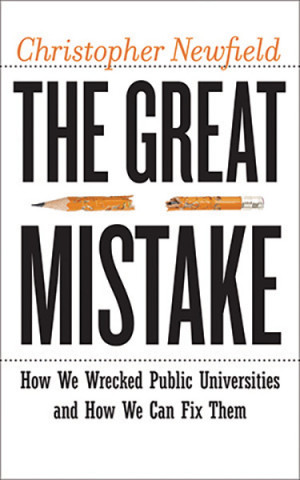
I'm going to use a lull in my travel for The Great Mistake
to start clearing my post backlog, starting with a response to the most recent review, by the sociologist Andrew Perrin. His piece is at the public sociology blog Scatterplot, and, among its other virtues, it offers the most sustained engagement on research costs (Stage 2 of the book's decline cycle) that I've received. I posted a comment on his post and crosspost it here. His skeptical analysis of the emphasis I place on research costs is essential reading. It advances the kind of debate whose general absence has helped dumb down university policy. I'm very grateful to him for the intelligence and energy that went into his analysis.
This blog has covered research costs many times ("How Can Public Universities Pay for Research?" "UCLA Loses LONI: Why Budget Silence is Bad for Science," "UCSD and the Crisis in Public University Research Funding," etc.) In The Great Mistake I go into the problem in detail, and also, in the final chapter, suggest a way of solving the core research cost problem without needing new money.
After one talk this winter, someone asked me, "are you arguing that the way we fund research is the public research university's Achilles' heel"? "I wish," I replied. "That was just one small though important body part that didn't get protected in the River Styx, so you could armor it and be ok. Our research funding model is more like a tragic flaw. It is a secret weakness that cannot be separated from a great strength--unless it stops being a secret and is brought to light." As I was later watching Toneelgroep Amsterdam's great 6 hour sequence of three Shakespeare plays, Roman Tragedies, I wondered, is the public university like Coriolanus, returned a military hero but unwilling to work with the newly empowered plebeians in the Senate, and so destroyed? Or like Marcus Junius Brutus the Younger, picking the wrong political allies, with the same result? Or Mark Anthony, losing the civil war to Octavian by ignoring his own strategists, who assured him he could not win at sea but must fight on land? Overkill, perhaps. Start by reading Andrew Perrin.
***
My response:
Many thanks for the thought and intelligence that went into
this review.
I agree with the criticism
of UC-centrism.
I’d like to assemble a
research group to do comparative state studies of university policies, or at
least work with other people on this.
We’re getting a better picture through a series of books that focus on
the systems the authors know from the inside.
Austerity Blues looks at New York, to take just one other
example. Jeff Williams and I would love to publish more work on various state
systems in our Critical University Studies series. As you say, North Carolina
is a crucial case.
On research funding, let me first take a step back.
The book argues that treating universities as
private goods has lowered their social value and hurt their finances. Many
defenders of any given instance of privatization either deny social or
educational costs or say they are less than the life-saving benefits of the new
revenue streams. My examples question these life-saving revenue benefits, which
in many cases are actually negative.
Universities
always generate value even when they lose money on something like extramural
research or small-scale teaching.
But
policymakers shouldn’t support a practice—privatization—that doesn’t correctly
do the one thing it is supposed to be good at, which is provide net financial
benefits (gains that aren’t created by losses elsewhere in the institution).
Research costs come where they do in the book’s decline
cycle because they are a core example of the university’s primary reaction to
abandoning the public-good model of the university (Stage 1), which is to
stop
saying public benefits justify monetary losses on research, and to
start
saying the university generates monetary benefits on research (the Bayh-Dole
Act in 1980 was one turning point).
The
latter statement has the double liability of obscuring research as a public
good and of being wrong. Research is a public good and a private
(institutional) loss, as it can be in the public good model, and as we disallow
in the (inappropriate) private good model.
(A lot of bad things are tied in to this error, like splitting STEM and
SASH research on phoney market grounds, hinging some portion of federal funding
on science’s (exaggerated) direct economic value, etc.)
Other broad points. Technically, the contrast I draw is
between high-research and high-teaching fields, where fields with lots of
extramural funding have high gross revenues but lose money when overhead costs
are netted out, and fields with essentially no extramural research but lots of
enrollments are able to run surpluses—surpluses that administrators must use to
cover losses elsewhere.
The fact that
these kinds of departments polarize into STEM and non-STEM is contingent on
other historical problems that I’m trying to help address.
Also, I am pro-STEM and hate the STEM/SASH divide.
I spent not the happiest years of my
professional life as a co-founder of an NSF center trying to overcome it.
I see the divide as an artifact of a
two-cultures ideology that has produced fundamentally different—even mutually
incomprehensible-- material conditions of research.
The grant scramble in STEM feels to me to be
inhumane and even anti-intellectual. I think it’s getting worse all the time,
and I have nothing but sympathy and admiration for the colleagues who work 80
hours every week while skipping weekends for months at a time to keep their
labs running and students funded.
I take
their plight as seriously as I take that of SASH scholars. And yet I also see
political inequality between STEM and SASH that is supported by budgetary
opacity.
Designated makers always beat
takers in America, and my hope is that showing the makers are also takers (we
all are both) will create a more open and less biased policy arena and fairer,
more effective outcomes.
A side benefit,
which I don’t do much with in the book, would be redress for the structural
poverty of qualitative and interpretative research, for which I don’t see any
ethical or intellectual justification.
Since I advocate a wholesale public good model for
universities, I am pro-subsidy.
I am also
pro cross-subsidy.
I don’t mind some Sociology
enrollment income winding up in Electrical Engineering to pay for accounting
staff.
In terms of what you call
external funds, my view, which goes beyond that of Walter McMahon and other
economists I cite, is that the general public should pay
all the costs
of public universities, in the full knowledge that some returns will go only to
the student they subsidized in the form of private market benefits (a salary
increment), while most returns are nonmarket, indirect, and social, and fan out
incalculably into the society, as we want them to.
In “internal” terms, we all need to help each
other out.
If running one chemistry hood
costs as much as running the lights and computers in 35 sociology offices, then
sociology coughs up for chemistry.
The
reverse should also be true.
The paragraph you call grudging (pp 94-95) reads as follows:
The problem with this situation is
not that these subsidies, which are called cross-subsidies, are inherently
wrong. To the contrary, these subsidies are commonplace and justified by the
public benefits of research results. They are also justified by the private
benefit to the student of attending research-intensive universities. At these
institutions, students work with faculty who are at the forefront of their part
of the knowledge world. They have access to the research process, which helps
them to develop creative capabilities sooner rather than later. One can argue
that the public and the student receive more benefit from an education in which
instructional funding subsidizes research in the same environment. Though the
costs can and should be separated so we can see who is paying for what and how
much, the cross-subsidy is completely legitimate in principle—as long as it is acknowledged
and shared in an equitable way.
The last sentence is the issue for me: not that we
have
cross-subsidies, but that we
hide them. This removes them from the realm
of policy and shared governance, and even correct accounting.
Here are my more specific
responses:
You write,
After a few silly anecdotes about
scientists prevented from buying printer paper on their grants (do English
professors not need printer paper?), Newfield then relies on
NSF
and university budget data to claim that between 9% and 20% of universities’
outlays for research are uncompensated by federal funders, so must be made up
by institutional funds. These funds, he claims, often amount to nearly 100% of
institutional research expenditures, which leaves 0% for institutional support
of SASH and other research that doesn’t attract extramural funding.
I agree the anecdotes are silly. The point is that research
accounting rules set up Catch-22s: some are silly, and others which blow holes
in universities budgets. I also break down the range of 9-20% into three models
all of which are justified by different sections of research funding reports
based on the same data.
The differences
reflect not only the ambiguity of semi-official interpretations of federal
data, but also unequal budgetary situations for different kinds of
universities. We need much more—and much more open—research to have a more
complete picture of what is going on.
Next:
There’s a lot of forensic
accounting going on here, and I think Newfield makes untenable assumptions to
reach those high numbers (20% unfunded, 100% of institutional outlays). Most
important here is the accounting for what universities pay for research that is
not extramurally funded. Lots of that is implicit; professors spend their time,
paid by university funds, on research and scholarly inquiry all the time. They
do it with computers, office supplies, and sometimes dedicated funds that don’t
count as research expenditures but are university resources spent on research
and scholarly activity.
I’m not sure what you mean by untenable assumptions, but I
assume you mean the omission of a portion of tenure-track faculty salaries and
benefits as university’s internal funding of research.
I mention this omission in a footnote (middle
of p 363, and also see the following note), and my reason is that this applies
to all research professors in all disciplines, and is part of what one must do
for one’s basic salary. Put differently, it would increase both the total
amount of institutional funds spent on research and the total amount of
research expenditure, so it wouldn’t change the share.
If anything, counting part of salary and
benefits would have helped my inequality case, since disciplines that expect extramural
grants for tenure, promotion, etc. generally require about half as much
teaching as those that don’t.
In any
case, I could better acknowledge that research universities do invest in all
faculty in this way, especially since I am personally very grateful for that.
Next you write, “Throughout the section on extramural
funding, Newfield implies that universities would not be doing the research if
it weren’t for that funding.”
I’m
agnostic on this. Your counterfactuals are interesting, but I don’t think they
affect my argument.
It’s true that
universities paying 20% of research is better than them paying 100%.
But paying 0% is better than paying 20% when
general operating money per student has never recovered to the levels that the
research enterprise assumed, and when students are progressively taking over
from taxpayers in supporting it.
20% or
50% fro institutional funds would be fine with me were research funded at
adequately high levels and as a public good, such that subsidies (including
those from students as private individuals) are no longer extracted, left
acknowledged, and not reimbursed.
Then, “That emphasis is puzzling because, unlike the rest of
the book, it’s really not necessary to the overall argument. Each other piece
of evidence goes directly to the devolutionary cycle (p. 36), but it’s not at
all clear to me why the external-funding claims support that argument at all.’’
I tried to address this point above.
And:
his greater claim that in fact the
English department is subsidizing STEM is based on treating institutional funds
in two conflicting ways. When they pay for English salaries and overhead, they
are treated as external income from tuition and state funds: fees paid for
English professors’ work. But when they pay for STEM salaries and overhead,
they are treated as internal funds. Newfield is right to call out the PR
machine’s implication that STEM pays for itself and English doesn’t, but he’s
wrong to interpret this as an internal subsidy.
The terms
external and
internal may be
confusing.
External funds become
internal funds, or what the federal accounts call
institution (or
institutional)
funds.
Student tuition and state
general funds, plus some other smaller streams, become the university’s
unrestricted funds that they distribute as they deem best.
It’s an “internal” subsidy in the sense that
the university is itself paying a share of research costs on top of what it
gets from the specific extramural research sponsor (DARPA, The Legacy
Foundation, etc.)
But the university
isn’t creating this money itself, and “profits” from other enterprises (like medical
clinics) don’t flow toward core campus operations like instruction and
research.
So I stick with calling this
an internal (or institutional) subsidy. But again, I don’t think subsidies are
bad. I just think hidden subsidies are bad.
(One practical reason that helps propel the
decline cycle is that they have convinced legislators that research makes money
rather than loses it, so they don’t understand why the state should pay more
money for university operations.)
Finally:
That account masks a much bigger
problem with reliance on external funding: its intellectual costs. Funding
rates are already very low, and today’s “skinny budget” contains draconian cuts
to those low budgets. All that means that scientists will be spending more of
their time trying in vain to attain funding instead of doing science. (Grant
applications are the beginnings of science, yes — but only when high-quality
applications are likely to be funded.) Furthermore, the bottleneck by which
such an enormous majority of science is funded by just a few agencies raises
the prospect of an intellectual monoculture; heterodox inquiry is unlikely to
flourish under such concentration. I think it would be better for science and
for SASH disciplines for universities to find ways to fund more research across
the disciplines internally.
I hope my account doesn’t
mask this problem, even if
it doesn’t analyze it.
I also hope my
account helps the discussion you call for by shining a light on how we spend
institutional funds now, precisely so we can imagine spending them differently.
In general, I agree with you that the agency funding
situation poses major intellectual problems.
These are important and longstanding.
Clark Kerr described federal granting agencies as having created a
“putting-out system” that made universities dependent subcontractors with
borderline sweatshop conditions, and that was during the golden age of federal
granting growth in the late 1950s and early 1960s. More internal funding would
help with this quite a bit.
Projects
could be developed in collaboration between faculty and their offices of
research, and consortia could be created bottom-up to share costs across
universities.
It would be helpful to
draw up some questions and projects that can’t get funded in the current system
but that could under this alternative.
The drawback of course is that universities would need to
quadruple their research funds to cover what we currently fund today, which still
wouldn’t be enough, either for STEM or for SASH disciplines.
I’d like to see a cultural shift that would
allow the public to trust universities and their associated professionals
enough to do that, but that’s a long road.
In any case, many thanks again for your very helpful and insightful
analysis.