In 2017, universities will be tempted to follow a dual strategy: resist the Trump administration's discriminatory agenda while adopting its underlying business model. In this case, they would oppose intensified hate crimes on campuses, exclusion of Dream Act students, explicit racial scapegoating, and government intimidation, balanced by periodic administrative crackdowns on faculty speech. At the same time, they would move the university further towards the status of a business, synchronizing with our businessman-president and his
nominated Secretary of Education, the privatizer-in-chief.
This hybrid policy is made more likely by the fact that it is what universities have been doing for decades. They long ago learned to follow Clintonism's fusion of social liberalism and fiscal conservatism, of public causes with public austerity. Donald J. Trump's election brought a quarter-century of Clintonism to an end when Trump convinced enough people that both halves of the double deal were bad--social liberalism had destroyed domestic security (crime, immigration, terrorism) while Obama's Clintonomics had wrecked the majority's economy.
So shouldn't higher ed keep its head down and muddle through? A look back at 2016 suggests this won't work. And it will help us think about what might work better in the new environment.
1. There's the university's weakening
status as a public good. Public status itself continued to poll well in 2016. One
major California poll found that 96% think the public higher ed system is important to "the quality of life and economic vitality" of the state over the next 20 years (77% said "very important"). These data are consistent with those of the Gallup-Lumina
national survey. And yet, as
more than one college president pointed out this year, the university has "gradually lost its spoken commitment to serve the public good. We
started representing our worth by using metrics such as research dollars
and publications, endowment size, exclusivity in admissions, and
national rankings."
University leaders have misread the popularity of public universities. They speak as though citizens want to hear about the private good of jobs and wages. This year, they intensified the claim that
college yields a high return on investment in terms of a wage premium over high school, and continued to neglect the non market, indirect, and social benefits of higher education. Since calculations have shown college's non market benefits are greater than the private market benefits (
Walter McMahon), universities continue to encourage society to underestimate the total value of higher ed and to under-invest in it.
Ironically, the general public understands this: in the November 2016 poll, a far higher proportion of Californians said higher ed is important to the state's future (96%) than said it is necessary for individual success (49%). Universities would
sell better to taxpayers as public than as private goods.
But if the audience is Trump, shouldn't universities double down on private good benefits? To the contrary, universities are and always will be bad private businesses, for they give their return on investment away to students and society. Conservatives like our businessman-president have known this from the start, and in fact the private-good
kludge stopped netting large public funding increases many years ago. Universities will now need to explain their public value as part of a new social contract.
2. The way we fund
research continued to hurt researchers, society, and university finances. This year, federal funding for science was
still below 2003 levels. Even Harvard University has seen a major decline in its gross overall research revenues, and its vice-provost for research took to the New York
Times to
plead for the public research funding on which basic research entirely depends. Grant application acceptance rates were so low that some universities contemplated
science without sponsorship. Yet as failure rates climbed for extramural grants, so did scientists' dependence on them. In a piece that was supposed to be about
"fresh funding structures" for "research with impact," one observer that we continue to "have a system where problems are prioritized based on
economic impact for the people who are going to do the studies." Researchers move towards funded problems, whether or not the funding reflects their interest, even as funding declines.
Administrators continued to push arts and humanities faculty onto the STEM extramural funding model, though arts and humanities together receive less that one percent of federal grant funding. This push will insure that much of that research never happens. When funding was okay, public universities could use institutional funds to support socially and intellectual valuable research that lacked external markets and sponsors. The failure of external sponsors to cover full costs now forces universities to spend an increasing share of these in subsidizing those sponsors, and 2016 brought no apparent relief. Calculations I did for
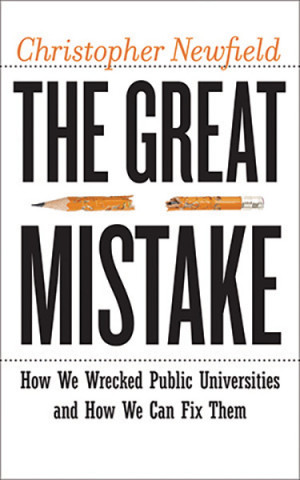
The Great Mistake suggest that the share of institutional funds going to
non-sponsored faculty research is heading toward zero at public universities (
Stage 2).
One of the biggest public science stories in 2016 was the verification of the toxicity of the Flint, Michigan water supply by an academic researcher from Virginia--Marc Edwards, a civil-engineering professor at Virginia Tech. He observed, "Normal people really appreciate good science done in their interest." He
continued,
I am very concerned about the culture of academia in this country and the perverse incentives that are given to young faculty. The pressures to get funding are just extraordinary. We’re all on this hedonistic treadmill — pursuing funding, pursuing fame, pursuing h-index — and the idea of science as a public good is being lost.
This is something that I’m upset about deeply. I’ve kind of dedicated my career to try to raise awareness about this. I’m losing a lot of friends. People don’t want to hear this. But we have to get this fixed, and fixed fast, or else we are going to lose this symbiotic relationship with the public. They will stop supporting us.
Universities might learn that they could increase funding for science by going straight to the public with explicit public-interest science. Maybe next year.
Regardless of where institutional funds wind up, public universities no longer have enough of them. A prominent example was UC Berkeley's
announcement of a
"structural deficit," which officials initially blamed on a funding equity scheme in the UC system known as rebenching. My
first pass analysis found that a major culprit was the institutional funds spent to cover research costs, which were themselves as large as the annual deficit, on top of the other growing costs, some research related, visible in UC Berkeley's financial reports.
I mentioned that the election of President Trump will encourage universities to spend even more money showing that they "mean business." These efforts will have no effect on the Trump administration, whose leader, more than any in recent memory, ties moneymaking to financial transactions rather than to research, and whose nominees have opposed the research, particularly on climate, that bears on their extractive industries.
Trump's deaf ears are an opportunity not to echo Trump's profit goals but to support what these suppress--public-good research, and new funding models that can enable it.
3. In 2016, politics got in the way of
traditional tuition hikes. "Free college" went from a fringe ideal in 2014 to official policy for both Democratic presidential candidates. State politicians rejected the University of California's call to raise tuition 5% a year for 5 years. UC came back at the end of the year with a 2.5% trial balloon increase, which got more abuse from these politicians (though it will probably go through in the form of a tuition "adjustment" coupled with a 5% increase in the Student Services Fee--now $1074 per year). Since the 2008 financial crisis, public universities have lost revenue Plan A (state funding that grows in step with state personal income)
and Plan B (tuition hikes above inflation).
2016 saw more of Plan C (fundraising) and Plan D (non-resident student tuition). Plan C doesn't help general operations like instruction. Plan D has been ramped up at UC to the point that NRST will add nearly a third again to regular tuition revenue next year, will increase at a higher rate than resident tuition, and will contribute 40-50 percent of all new tuition revenue every year (
Financial Sustainability Plan). Though UC has locked itself into Plan D, the public dislikes it. When the
PPIC poll I've mentioned asked whether more non-resident students should be admitted specifically so their high tuition could subsidize affordability for residents, 50 percent said flat out no, and another 25 percent said only if it doesn't reduce resident enrollments.
Public universities were also milking Plan E, higher housing and board charges, and Plan F, additional user fees of the kind California expanded in the wake of tax-capping Proposition 13. 2016 brought more of these down-list plans that offer back-channel (and often marginal) returns. Once people figure them out, there will be a political price for pursuing them.
Universities may think Trump politics will revive Plan B and let them hike tuition again. But state Republicans, who control the majority of state governments, are as hostile to tuition hikes as Democrats. Worse, universities haven't explained to the public the specifically good and unwasteful things they would do with more
public money. They haven't come up with simple, concrete goals like "we'd lower tuition 10%," or "we'd cut average class size 10%."
Instead of hoping for higher tuition, universities have to show that the current near-freeze on tuition (now averaging
under 3% per year), coupled with a near-freeze on state allocations, has been wrecking educational quality. They have to show specifically how this hurts present students and the future of their state. Instead of trying for new tuition revenues each and every year, they should build a new paradigm that doesn't need them. They should adopt "free college" by a particular year as the goal and work backwards to show the public revenues this will require--and then start submitting budget requests.
4.
State cuts to public funding reversed themselves somewhat. 8 years after the financial crisis, forty states increased funding in FY2015 by
an average of about 5 percent, and 2016 estimates were for another 4 percent. But these increases did not get public university funding back to previous levels: when measured per student, they are still 15 percent below that of 2008.
There was a bit more discussion this year of the damage defunding has done to state economies. In Washington state, where the state has cut university funding by nearly a third over a decade, even official priority fields are struggling to maintain basic access. "'
We’re turning away many, many, many good students,' said Greg Miller,
chair of UW's civil and environmental engineering. 'They want to do what we
teach. And we should be delivering.'” Writing from Wisconsin, a former regent summarized the problem as, "
Politics is cutting the heart out of public Ivies."
We've heard a lot about non-STEM job market problems. But cuts to public universities, with their large enrollments and academic departments, are wrecking the academic STEM market too. By 2016, o
nly 1/4th of biomedical PhDs are getting tenure track academic jobs. State cuts continued to damage the knowledge economy and the STEM specializations that policymakers say they want. Anyone who cares about academic labor--the resistable rise of non-tenure-track hiring to teach STEM and non-STEM alike--must care about rebuilding the public funding on which core academic payrolls depend.
2016 was the fourth year after the overall state funding bottom, and yet some states continue to cut. Some, like Wyoming, are just starting their cuts now. Coast to coast, the minor funding recovery has not allowed colleges to get back to where they were, much less get better to match the more demanding economy.
"The Dream Stalls at CUNY" was the year's most graphic mainstream media portrait of slow and steady public university decline, and "the engine of mobility sputters" remains the national story.
5.
Affordability remained a national crisis in 2016, as
total student debt continued to increase. Efforts to minimize the debt crisis continued--for example in two books,
Game of Loans and
Student Debt, by Brookings scholars--and universities continued to insist that high financial aid protects low-income students from the burdens of high tuition. This unfortunately is not the case. In fact, poor students are forced to borrow as much as middle class students, as I've been
shouting since at least 2014. Definitive evidence of the negative impact on students arrived with this fall's publication of Sara Goldrick-Rab's
Paying the Price. Based on an empirical study of 3000 Pell students, it not only confirmed that 9 of 10 Pell students graduate with debt, and that fewer than half graduate in 6 years, but chronicled the hardships and forced, restrictive choices that follow lower-income students through every day of their college lives. The subtitle of Stephen Burd's
New America report summed up the situation: "the news keeps getting worse for low income students." (See Ellen Wexler's
good summary.) When public universities become dependent on non-resident tuition, they replace need-based aid with "merit" aid to recruit affluent students from other states, which means increasing costs for low-income resident students. The proportion of Pell students who are charged more than $10,000 per year by their public universities has gone from one-third to one-half in just five years.
In her overview of her book, Goldrick-Rab noted that things will get better when colleges "listen to students and give them the benefit of the doubt" in their descriptions of how the financial aid system
actually works. The bigger cure would be free college, the advocating of which can insure you won't get invited to the summit meeting. But I estimated in
The Great Mistake that getting zero debt--buy buying annual cost of attendance down to $4000 for all eligible students--would cost $200 billion, or pretty much exactly what we pay every year for a financial aid system that keeps creating debt.
2016 put free college on the policy map. Colleges should work during the Trump administration to keep it there.
6. University officials still pondered how to
outsource their core instructional functions to tech companies. During ed-tech's peak hype of Fall 2012 through Summer 2013, MOOC vendors issued an instruction set to universities that ended, "halt and catch fire." Bad MOOC course results canceled that command, but the promise of disrupted higher ed continues, as Audrey Watters makes clear in
"The Best Way to Predict the Future is to Issue a Press Release." The MOOCs' educational failure was obvious, and their financial failure less obvious yet real--and yet the higher ed sector still waits for "software to eat the world," or at least eat the university.
Joshua Kim pointed out that a key 2016 book on the "platform revolution" imagined it would eliminate most colleges, echoing predictions by Clayton Christensen and Udacity's Sebastian Thrun during Peak Hype.
I actually want the hype to be true: I want mastery learning where most of the class learns as much as only the top tenth usually does, and creativity learning, where students learn to define problems, design research, and solve the horrible problems their elders are bequeathing to them. But ed-tech saying it made learning easy made it harder. Ed-tech ignoring funding problems made them worse.
One of this year's hopeful signs appeared in
a piece on adaptive learning by ed-tech analyst Michael Feldstein. Noting that a major study of it was inconclusive--"your mileage may vary"--he added,
the study does provide a reality check on the role of the learning sciences in the craft of education. We are learning more about how people learn all the time. But we are still at the basic research level, and we face daunting methodological challenges. . . .
In order to get an empirically valid apples-to-apples comparison of the effects of adaptive learning, which is specifically intended to help students in the same class with different learning needs, you have to start by making sure that the students you are studying are the same as one another.
Setting aside the head-spinning contradiction, how often are the students in any two course sections, even within the same course at the same institution, similar enough for a valid controlled experiment? The answer in the . . . study is "rarely."
My response to the current situation is yes, we should be doing as much as we can with instructional technology, but only where "we" means the instructors who know student variation directly. That means bringing faculty and staff together in ways we haven't figured out how to do.
Enhancing learning for all students is actually extremely hard, and this may be why ed-tech in 2016 seemed more focused than ever on selling to the back office. One example is enterprise software that might be able to run budget analyses of individual function costs in specific departments or courses. Over the course of the year, I heard from several people that these systems are starting to squeeze out budgets for academic computing.
Another use is surveillance: at UC we got a reminder in January when a faculty committee leaked the information that UC president Janet Napolitano had used a data breach at UCLA as a reason to install 3rd-party hardware
"to monitor and possibly record" all traffic with the outside world at all UC campuses. Nearly a year later, nobody outside confidential administrative committees knows how extensive these programs are. The suggestion that UC has its own bulk data collection program was rejected but not refuted, and the parameters of the actual program remain unknown. We have the odd situation in which nearly all of my university colleagues send sensitive material through gmail run through their local cable provider rather than through university servers.
Ed-tech's bigger horizon is "unbundling" the university, where it serves as means and pseudo-destiny. David Theo Goldberg pointed out
"The Dangers of the Uberization of Eduation," several of which deserve special mention. One is the secrecy of the algorithmic system, which makes the provider unaccountable. (The legitimacy of one-way governance in academia continues to be an understudied topic.)
A second is the sidelining of learning as such. In Goldberg's phrase, "The certification autogenerated by the platform, much like the Uber receipt on one’s smartphone, is more about customer service, liability and immunity from potential litigation than it is about the acquisition of consequential knowledge." A third is the decoupling of one discipline from another in the period in which we are supposed to be bringing them together, particularly across the qualitative-quantitative divide.
And fourth, unbundling will further weaken the status of the professions in the country--particularly the "liberal" professions devoted to human development"--as well as eliminate the vestiges of a faculty already fractured by the extramural grant system and adjuncting, and therefore less of a body tied to a specific institution and endowed with deliberative authority and political rights.
Universities are self-unbundling already, in part because it helps replace multilateral relationships with managerial authority. (On the latter theme, see John Warner's
"U of Chicago Asks for Safe Space-for Administrators"; also
Angus Johnston.) One group that suffers are its students, where a sense that administrators don't care about them will harm their alumni loyalty in the future and harms their learning now. (
Daily Cal columnist Chris Yamas
broached this topic in August.)
Any business that outsources its core functions is on the road to perdition. But with unbundling that's a feature not a bug. Though most people in ed-tech don't support the consolidation of universities to twenty or fifty in the world, ed-tech as such doesn't know whether it wants to transform consciousness with better learning or replace consciousness with automation. It also continues to coast on the "late-tech" Silicon Valley premise, "with this app you can fire a lot of people and keep their money." Until ed-tech can explain how we can enhance academic labor rather than shrink it--ed-tech will hurt instruction rather than help it. As
Kim pointed out, "To the extent that colleges focus on the centrality of the educator / learner relationship - a relationship that can’t be scaled or substituted by technology - will be the extent to which today’s postsecondary institutions continue to thrive."
7.
Unequal funding continued to cut attainment--and increase inequality. The 2016 presidential campaign was one long rampage about the inequality boom in many dimensions. The same problem afflicts higher ed, and this year saw no improvement. Although the Obama administration called for free community college, no one has called for massive reinvestment in the less selective four-year colleges that educate the majority of the country's students, and an even higher percentage of its students of color.
In California, UC campuses seem to operate in the
more unequal regions of the state; perhaps there is a national pattern. The grotesque inequality of higher ed resources was brought home again for me in February, where San Francisco State's historic College of Ethnic Studies was threatened with a 14 percent cut while Stanford was announcing a $750 million endowment for Rhodes Scholarship-style scholarships to Stanford for a handpicked global elite. My estimate was that the Stanford fellows would receive about
30 times more money apiece than an SF State Ethnic Studies student.
Much of the problem is ongoing racism: one study this year plumbed the depths of the American phobia about affirmative action, and found that people would r
ather see colleges admit legacy children of former graduates than consider race in admissions. In his
discussion of the limits of affirmative action debates, Matthew Clair denounced the relegation of the knowledges of identity to the status of non-knowledge, signaled by the Supreme Court Chief Justice's question, "“What unique perspective does a minority student bring to a physics class?” Three years ago, the Georgetown Center on Education and the Workforce issued
a landmark report, "Separate and Unequal," showing that new white enrollments mostly go to selective colleges and new African American and Latino enrollments mostly go to open enrollment colleges, where they receive lower funding. Nothing has been done in the meantime. Although Abigail Fisher lost her Supreme Court case against the University of Texas's affirmative action program, that
"massive blow against mediocre white people" was not a victory for equality or for the better graduation rates they would bring.
8.
Universities helped U.S. society stay on its post-middle class course. Breakdowns of the presidential vote suggested that non-college people don't see the "education party" as on their side. Pollster Nate Silver, atoning for his sins, found that
"education, not income, predicted who would vote for Trump." One conclusion is that
higher education has its economic limits But I would say this is really only true in its Clintonite mode. Clintonite higher education has not fought for the strong public funding that supports colleges that serve lower-income and rural communities, much less fought in the name of blue-collar and non-college people. It has not blasted the inequality boom--that was Bernie Sanders--which depends on
not rewarding people who increase their productivity with higher wages. Clintonite higher ed hasn't supported unionization or a high minimum wage as ways of supporting the society on which it depends for taxes. Higher ed has moved increasingly towards the donors and other elites who have benefited from if not actively engineered the inequality boom in the first place. Now it finds its middle class tax base eroded (the wealthy never wanted to be taxed for public colleges), and its constituency cynical about getting skills that American capitalism won't pay them for anyway.
The long siege against unions has lowered costs for companies, but it's part of a deeper and wider assault on the democratic prerogatives of knowledge communities. The most visible higher ed conflicts of 2016 fell in this category. I'm referring to the intersection of academic freedom, academic labor issues, and what we might call
professional civil rights: The downgrading of tenure in Wisconsin (see
Nick Fleisher's overview), the chronic overwork of 60 plus hour weeks for years on end, the absurd firing of assistant professor Melissa Click by the board in Missouri (and
faculty reaction against it), expanded unilateral budgetary authority and faculty attempts to claw some back (a
Yale example), the corrosive effects of two- and three-tier faculty employment systems (see
Gillian Steinberg's critique), administrative efforts to police faculty's extramural speech, as in the
Drexel case Michael just wrote about.
These are part of--and a growing reaction against--the withdrawal of the the university from setting standards for a truly desirable society. This desirable society has in the U.S. always included self-managed working conditions and economic entitlements for which faculty
and college graduate jobs have stood. We, in the university, have watched while the early versions of these democratic conditions were withdrawn from our blue-collar friends, relatives, and neighbors. We, in the university, have stood by while democratic conditions were withdrawn from the majority of our instructional staffs. We have stood by while policymakers in withdrew democratic conditions from our own political and economic base, college graduates. 2016 was the year when the Electoral College vote punished the yuppie scum Clintonite-knowledge-economy-university-symbolic analyst complex for its crimes of indifference.
* * *
2016 was also the year of growing dissent from this system. Here are a few favorite clips in the midst of a mini-renaissance of writing about higher ed:
The New York Times' Editorial Board on the National Labor Relations Board's
ruling that graduate students at private universities may unionize:
This week’s ruling allows graduate assistants to vote
on whether to unionize, and if they do, for the students and the
universities to bargain in good faith. . . .
There will
be plenty to discuss between the students and the administrations. In
recent decades, as tenure-track positions at universities have declined
precipitously, teaching and research — the mainstay of universities —
have increasingly been taken up by adjunct faculty members and graduate
assistants, without commensurate increase in pay, status or career
opportunities. On many campuses, teaching and research assistants are
essentially low-paid, white-collar workers, typically earning around
$30,000 a year, most of whom will never get tenure-track positions.
The question going forward is the extent to which those new unions will help improve working conditions in academic life.
Andrew Hoberek on the Melissa Click firing:
Click’s critics have painted themselves as defenders of the First Amendment and other freedoms against a privileged academic elite. But a world in which people’s main activity, vastly enhanced by the technologies of video recording and social media, is to discipline each other for infractions of civility, is hardly a model of universal freedom. It is in fact proto-totalitarian, in the old-school, Arendt and Orwell sense. All that is needed to flip it over into fascism is a strong leader who can symbolically embody all the freedom that ordinary people are denied, and spend their time denying others. A leader, perhaps, whose most admired quality among his followers is that he’s not afraid to say whatever he wants.
Dave Vanness's Open Letter on #faketenure in Wisconsin:
not a single member [of the Madison AAUP chapter] expressed that they are confident in President Cross
or the majority of the Board of Regents’ ability (or desire) to protect
UW System from continued budget cuts, program closures and faculty
layoffs for reasons unrelated to educational quality. In fact, nearly
all of us agree that they are at best complicit with our current state
government’s desire to redefine the Wisconsin Idea as primarily a
workforce training mission, and at worst actively engaged. . . .
This brings me to the second broad theme that has emerged. Despite
near-unanimous inability to express confidence in our leadership, many
of us are afraid that expressing that lack of confidence could bring
harm to the university. State legislators have already publicly
threatened us with further cuts and reforms after simply announcing the
upcoming vote.
Taken together, these themes lead me to ask a very important question. If
nearly all of us conclude that our leadership is failing, but we allow
fear of reprisal to suppress our expression of that finding, then
haven’t we already lost our academic freedom? If fear of the Board
of Regents, the Legislature and the Governor stops us from exercising
our responsibility in governance, then I am afraid we really have lost.
What’s next? Will we allow fear to change what we teach or research or
say in public?
Philip Nel on why faculty members work so much:
As I am writing this article, I should be writing something else: an
email to an editor, an email to an author, a letter of recommendation,
notes for tomorrow’s classes, comments on students’ papers, comments on
manuscripts, an abstract for an upcoming conference, notes for one of
the books I’m working on. I cannot remember the last time I ended a day
having crossed everything off my to-do list.
Why do academics work so much? . . .
My 60-plus-hour weeks have not led me to [ignoring a serious illness]. But I can see how it could happen. As [Kate] Bowles points out, “we don’t yet understand this as behavior that is harmful to others, not just to ourselves. We overwork like cyclists dope: because everyone does it, because it’s what you do to get by, because in the moment we argue to ourselves that it feels like health and freedom. But it isn’t.” To work long hours because everyone does it or because that’s how you get by is to live under stress. That’s not healthy. I often joke that I’m just barely keeping my head below water.
And that is one of my points: Time is all we have. One day, we’ll reach the last page of the calendar, the clock will stop, and our time will cease. While it is a privilege to pursue interesting work, we also need to make time to live.
My other point is that we need time to think. I mean this quite literally: thought requires time.
Robert Matz on
"the cultural implications of the myth that English majors end of working permanently at Starbucks"
To establish themselves in their careers, English majors need to show a bit more resourcefulness than do majors in narrowly preprofessional degrees. And year after year, that is exactly what real English majors do. They do not possess this resourcefulness in spite of their English degree or as a mere coincidence with it. Creative and independent thinkers are attracted to the English degree, and that course of study helps to develop their creativity and their initiative -- the same personal qualities that serve them so well in the working world after graduation.
So why the barista joke? It reflects negative attitudes about the English major itself rather than the realities of an English major’s likely employment. Since coffeehouses are places for reading, writing and talking, spending time in a coffeehouse is a lot like spending time in the study of English. Naturally enough, English majors like to hang out in them. STEM majors have their labs; English majors have their Starbucks. The joke about the English major barista implies, however, that unlike the science done in a lab, the study of English, whether pursued in coffeehouse or classroom, is without value. What better punishment for wasting this time than being sentenced to work at a coffeehouse rather than enjoying its pleasures, serving those who presumably chose some more valuable and lucrative major?
We will only really dispel the myth of the English major barista when we confront head-on the structural economic problems and the narrow market ideology that drive the fear behind it. Meanwhile, in their own refusal to succumb to this fear, English majors can be confident they'll do fine spending some time in coffeehouses -- whichever side of the bar they’re on.
Exactly. Higher ed for creativity, truth, beauty, love, pleasure, knowledge, literature, science, art, and the non-college brethren-- for the entire public.
Some good news in 2016: did I mention my book came out? You've just been through the eight stages of its doom loop--leading in to the recovery cycle I didn't discuss here.
Try the six-paragraph hometown version, by Santa Barbara school administrator Brian Tanguay. Above all, many many New Years eve thanks to all of you who have engaged.