Top Navbar

  • Home
  • About Us
  • Guest Posts
  • Liner Notes

Searchbar

Showing posts with label Graduates. Show all posts

Thursday, March 5, 2020

Thursday, March 5, 2020
The Executive Council approved the following statement in March 2020.
The Executive Council of the Modern Language Association condemns the termination of employment for graduate student strikers at the University of California, Santa Cruz, calls for their reinstatement, and urges the university to commence negotiations with the students as soon as possible. We consider that their demands for an appropriate augmentation of salary in line with the increased costs of living are legitimate and note that they now have the full support of the UAW, with whom the university is contracted. Graduate students are indispensable workers who cannot be expected to execute their teaching duties and to pursue their own research when housing and food costs are not affordable with their current wages. The Modern Language Association maintains that graduate students should be compensated at a level that makes it possible for them to flourish on campus as research assistants, teachers, and emerging scholars. A fair wage correlated with cost of living increases is a necessary precondition for their own work, essential to fulfilling the educational mandate of their departments, and essential for the dignity of all workers at the university. To punish students for exercising their rights to demand a decent wage is, in our view, unjust and unacceptable, and all penalties should be reversed immediately.
Posted by Michael Meranze | Comments: 1

Monday, February 24, 2020

Monday, February 24, 2020


February 13, 2020

Dear Chancellor Larive and Campus Provost and Executive Vice Chancellor Kletzer,

We, the California Scholars for Academic Freedom,* a group of over two hundred scholars throughout California, write with grave concern about the Google form “Notification of Class and Section Disruption” sent on February 7, 2020 to UCSC undergraduates in relation to the graduate student strike demanding a Cost of Living Adjustment (COLA).  This form asks students to surveil and report on conversations occurring in the course of instruction.  It sets a dangerous precedent of surveillance that undermines the core principles of academic freedom.

The university produces knowledge and practice critical to the operations of a democracy. The ideal of academic freedom is at the core of the university in a democratic society. 

Academic freedom is a cornerstone of education in a free society. Its definition includes such items as what are called ‘the four essential freedoms’ of a university, to determine, on academic grounds, who will teach, what they may teach, how they teach and who may study.

Academic freedom requires that faculty and students can participate in intellectual debate free of any censorship or retaliation. Central to academic freedom is that the political, religious, or philosophical beliefs of others, including politicians, administrators and members of the public shall not be imposed on students or faculty. 
California Scholars for Academic Freedom call on you rescind the link to the Google form and refuse to use any data collected through that mechanism as the grounds for disciplinary measures against faculty and students.

On behalf of California Scholars for Academic Freedom,

Susan Slyomovics
Distinguished Professor of Anthropology and Near Eastern Languages and Cultures

Walid Afifi
University of California - Santa Barbara
Professor, Dept of Communication
Director, Center for Middle East Studies

Craig Reinarman
Professor Emeritus of Sociology & Legal Studies
Rachel Carson College 338
University of California
Santa Cruz, CA 95064
831-459-2617

Sondra Hale, Professor Emerita
Anthropology and Gender Studies, UCLA. sonhale@ucla.edu

                                          
Posted by Chris Newfield | Comments: 1

Saturday, February 22, 2020

Saturday, February 22, 2020
By Ronnie Lipschutz (Political Science, UCSC))


February 20, 2020
To: Chancellor Cynthia Larive, Provost, and EVC Lori Kletzer
From: Ronnie Lipschutz


I write this letter as an individual faculty member who has been at UCSC since 1990.  I am not representing any faculty group, department or Academic Senate Committee.  It is my own assessment after 30 years at this campus.

I attended the Academic Senate meeting on Wednesday, February 19, and felt a growing sense of dismay as I listened to your presentations and your responses to questions from the floor.  I was especially dismayed by EVC Kletzer’s repeated statement that she did not know what would happen after the Friday midnight deadline issued to the striking TAs to turn in Fall grades.  Nor was I reassured by her stated position that, should a shortage of qualified TAs follow, departments and faculty are responsible for dealing with problems of enrollments, class capacity, teaching and workload. While I am aware that such decisions are generally made “locally,” this response is a rather disingenuous one and ignores the fact that the present situation is a consequence of Administration decisions and actions taken over the past decade. Over that time, the Administration has paid little heed to either Senate or faculty warnings about the lack of funding to support new initiatives, such as graduate growth, Silicon Valley and others.  Now the faculty is being asked to address the results of 20 years of poor administration, planning and judgement. 

I will not belabor this last point except to point out that the increase in undergraduate enrollments since 2000—which have greatly exacerbated the local housing crisis—have also required growing graduate student enrollment to teach them, without having in hand the necessary resources to support the latter.  Generally, the formula was something like the following: undergraduate growth would bring in the tuition required to fund teaching while graduate growth would facilitate research and recognition which, in turn, would provide the extramural research funds and private donations that would support such growth.

Moreover, so far as I can recall, during those two decades, a number of strategic academic plans were prepared explaining that such growth was necessary for the glory of UCSC, without any transparent, public explanation of how the necessary funding was to be procured. This hallucinatory vision became dogma ten years ago when UCOP offered “rebenching” funds in exchange for a new “graduate growth” initiative. These funds were accepted with in full recognition that they were insufficient to support the new FTEs and graduates students coming to campus. 

I will not repeat here the many assurances that were offered by the Administration about how such growth would be achieved—those are available in the many documents and studies, none of which clearly explained how this would be financed.  And, until the TA strike, the Administration continued to blithely assume continued undergraduate and graduate growth as necessary from both financial and branding perspectives. Needless to say, we are now reaping the whirlwind. The Administration appears poised to use the TA strike as a pretext for reducing graduate enrollments to levels that can be funded given available resources.  If this is the plan, it is an extremely cynical one. 

Furthermore, to put the onus on faculty for dealing with the resulting crisis is even more cynical.  I do not blame you for this situation; it is the result of two decades of administrative ineptness and opacity as mentioned above.  But to shift the burden of coping to faculty, who will have to scramble to adapt, and undergraduates, who will be shut out of necessary classes and receive a degraded education, is inexcusable.  

Finally, to announce that yet another committee will be established to consider the contradictions is simply kicking the can down the road.  We all know that such committees tend to make reasonable recommendations that cannot be funded, and that their reports end up on a (metaphorical) shelf somewhere, to be ignored the next time a similar problem arises.

Which leads to the fiction of “shared governance.”  Somehow, there is a wide (mis)perception that this means joint management between administration and faculty.  Of course, it means no such thing: the Administration decides what it wants to do and then consults with the Faculty Senate for comments (with objections routinely ignored). Over the past decade, there were ample warnings from faculty that the graduate growth initiative was unsupportable, but these were simply dismissed with the proviso that “we will take care of it.”  So, perhaps you should take care of this, rather than shifting the onus onto the faculty.

If this letter sounds bitter, it is—very bitter. For 30 years, I participated in what was a promising and exciting experiment and that has been transformed from gold to dross.  I am retiring at the end of June and so none of this matters very much to me in practical terms.  But it matters greatly to undergraduates, whose credentials may well be very tarnished by this fiasco, to the graduate students, who were made promises that have been broken repeatedly and many of whom have, at best, a future career of “freeway flying” in store, and to faculty and staff, who have to bear the burden of the Administration’s generally inept administration.  We have ethical obligations to our students and, if we cannot fulfill them, we would do better not to make empty promises to them in the first place.


Posted by Michael Meranze | Comments: 0

Monday, February 10, 2020

Monday, February 10, 2020
February 8, 2020

Dear Chancellor Larive and iCPEVC Kletzer:

We, the undersigned faculty members, are writing to express our unequivocal opposition to the practices and principles underlying the “Notification of Class and Section Disruption” Google form accessible through the notify the campus hotlink in the February 7, 2020, Public Affairs communication titled “Unsanctioned strike by some graduate students” (pasted below).  In addition to concerns about academic freedom, we are extremely alarmed by the culture of surveillance and reporting encouraged and facilitated by such an approach.

As you are well aware, the foundation of any research university is the creation and free exchange of knowledge, principles reflected in the tenure system and, in the University of California, through guarantees of academic freedom (APM 010). Additionally, the University of California has sought to reiterate these principles with the recent creation of a National Center for Free Speech and Civic Engagement. The free exchange of knowledge—the very cornerstone of the university—is compromised when everyone in our community is encouraged to survey and report on conversations occurring in the course of instruction. Indeed, we all—Senate faculty, lecturers, graduate student instructors, TAs, and students—work tremendously hard and conscientiously to create learning environments in which everyone can speak freely to discuss a wealth of subjects and to address a range of different perspectives. This is an increasingly challenging task in a social/cultural/political moment when discourse is highly fractured and fractious, and a mechanism for reporting “class and section disruption,” especially one haunted by the specter of McCarthyism, only exacerbates this trend of fractious and fractured rhetoric. Within such an environment, genuine dialogue and the free exchange of knowledge are nearly impossible. This inhibits academic freedom and ultimately undermines the core mission and values of the University of California and UCSC.

In addition to our fundamental opposition to these practices of surveillance and reporting, the Google form for reporting class and section disruptions raises a number of red flags in terms of academic freedom. Our reading of both APM 010 and the AAUP 1940 statement on academic freedom is that we have a basic right to teach our subjects as we see fit, which we understand to include changing the day’s activities to respond to immediate learning opportunities provided by current events or news of previously unknown research innovations. Moreover, even when AAUP notes the limits to such a right (i.e., that instructors should “be careful not to introduce into their teaching controversial matter which has no relation to their subject”), it nonetheless acknowledges that such a limit is primarily intended to “underscore the need for teachers to avoid persistently intruding material which has no relation to their subject.” Such rights and protections not only safeguard the ability to change the material and/or the sequence of activities in our courses in order to respond to emergent circumstances but they also allow for the introduction of new material not specified on the syllabus if related to the overall course, so long as we are able to articulate those connections.

Like you, we are concerned about the quality of our students’ education, and we want to hear from them about their educational experiences. That said, we believe that students already have processes for sharing their experiences, both positive and negative, including grievance procedures and student evaluations of teaching. In addition, we are certain that students make regular use of publicly available email addresses for campus administrators in order to register their concerns and complaints.

Given the gravity of our concerns about the free exchange of knowledge, we hope that you will disable the link to the Google form and refuse to use any data collected through that mechanism as the grounds for disciplinary measures against faculty and students.

Sincerely,
1. Kimberly Lau, Professor, Literature
2. Jessica Taft, Associate Professor, Latin American & Latino Studies
3. H. Marshall Leicester, Professor, Literature
4. Christine Hong, Associate Professor, Literature and CRES
5. Irene Lusztig, Professor, Film + Digital Media
6. Megan Thomas, Associate Professor, Politics
7. Muriam Haleh Davis, Assistant Professor, History
8. Josh Brahinsky, Lecturer, College 10
9. Hunter Bivens, Associate Professor, Literature
10. Rick Prelinger, Professor, Film + Digital Media
11. Dorian Bell, Associate Professor, Literature
12. Gail Hershatter, Distinguished Professor, History
13. Thomas Serres, Lecturer, Politics
14. B. Ruby Rich, Professor, Film + Digital Media
15. Peter Limbrick, Professor, Film and Digital Media
16. Neda Atanasoski, Professor, Feminist Studies and CRES
17. Grace Pena Delgado, Associate Professor, History
18. Matthew Lasar, Lecturer, History
19. Catherine Jones, Associate Professor, History
20. Christine King, Lecturer, Kresge & Porter Colleges
21. Leslie Lopez, Continuing Lecturer, Community Studies and Oakes College
22. Boreth Ly, Associate Professor, HAVC
23. Christie McCullen, Lecturer, Sociology & Oakes College
24. Hillary Angelo, Assistant Professor, Sociology
25. Edmund Burke III, Research Professor of History Emeritus
26. Deborah Gould, Associate Professor, Sociology
27. David H Anthony, Associate Professor, History
28. David Brundage, Professor, History
29. Edward Kehler, Lecturer, History & Stevenson College
30. Regina Day Langhout, Professor, Psychology
31. Vanita Seth, Associate Professor, Politics
32. Ben Leeds Carson, Associate Professor of Music and Kresge College Provost
33. Alma Heckman, Assistant Professor, History
34. Jody Greene, Professor of Literature and Associate Vice Provost for Teaching and Learning
35. Chris Chen, Assistant Professor, Literature
36. Fernando Leiva, Associate Professor, Latin American & Latino Studies
37. Daniel L. Selden, Professor of Literature
38. Megan McDrew, Lecturer, Sociology
39. Amanda M. Smith, Assistant Professor, Literature
40. Sylvanna M. FalcĂ³n, Associate Professor, Latin American & Latino Studies
41. Eric Porter, Professor, History of Consciousness, History, and CRES
42. T. J. Demos, Professor, History of Art and Visual Culture
43. Nicolas Davidenko, Associate Professor, Psychology
44. Shelly Grabe, Professor, Psychology
45. Zac Zimmer, Assistant Professor, Literature
46. Irene Gustafson, Associate Professor, Film and Digital Media
47. Jason Samaha, assistant professor, psychology.
48. Martin Devecka, Assistant Professor, Literature
49. Heather Bullock, Professor, Psychology
50. Margarita Azmitia, Professor, Psychology
51. Jeff Erbig, Assistant Professor, Latin American & Latino Studies
52. Jackie Gehring, Associate Teaching Professor, Politics and Legal Studies
53. Kyle Parry, Assistant Professor, History of Art and Visual Culture
54. Marcia Ochoa, Associate Professor, Feminist Studies and Interim Provost of Oakes College
55. Carla Freccero, Distinguished Professor, Literature & History of Consciousness
56. Amy Mihyang Ginther, Assistant Professor, Theater Arts
57. A.M. Darke, Assistant Professor, Digital Arts and New Media, Games and Playable Media
58. Anjuli Verma, Assistant Professor, Politics Department & Legal Studies Program
59. Dard Neuman, Associate Professor, Music
60. Maureen Callanan, Professor, Psychology
61. Karlton Hester, Professor, Music
62. A.Laurie Palmer, Professor, Art
63. Felicity Amaya Schaeffer, Feminist Studies and CRES
64. Julie Guthman, Professor of Social Sciences and Community Studies Program
65. Rob Wilson, Professor, Literature
66. Cynthia Lewis, Professor, Education
67. Madhavi Murty, Assistant Professor, Feminist Studies
68. Juned Shaikh, Assistant Professor, History
69. Carolyn Dean, Professor, History of Art & Visual Culture
70. Warren Sack, Professor, Film & Digital Media
71. Amy Lonetree, Associate Professor, History
72. Amy Beal, Professor, Music
73. Dee Hibbert-Jones, Professor, Art
74. Ron Glass, Professor, Education
75. Phillip Hammack, Professor and Chair, Psychology
76. Noriko Aso, Associate Professor, History
77. Christina Ravelo, Professor and Chair, Ocean Sciences
78. Larry Polansky, Emeritus Professor, Music
79. Russell C. RodrĂ­guez, Assistant Professor, Music
80. Kent Eaton, Professor and Chair, Politics
81. Sara Niedzwiecki, Assistant Professor, Politics
82. Vilashini Cooppan, Professor, Literature
83. Lindsey Dillon, Assistant Professor, Sociology
84. Donna Haraway, Distinguished Professor Emerita, History of Consciousness
85. Elizabeth Stephens, Professor of Art lee valley
86. Marcelo D. Viana Neto, Visiting Assistant Professor, Art & Design: Games and Playable Media
87. Elisabeth Cameron, Professor, HAVC
88. Anjali Arondekar, Associate Professor, Feminist Studies
89. Saskias Casanova, Assistant Professor, Psychology
90. Kim Cardilla, Lecturer, Psychology
91. Susan Strome, Distinguished Professor & Chair of MCD Biology
92. Mark Anderson, Associate Professor, Anthropology
93. Elliot Anderson, Associate Professor, Art
94. Martha ZĂºĂ±iga, Professor, MCD Biology
95. Miriam Greenberg, Professor, Sociology
96. Massimiliano Tomba, History of Consciousness
97. Nathaniel Deutsch, Professor, History
98. Andrew Mathews, Anthropology
99. Jerry Zee, Assistant Professor, Anthropology
100. Lars Fehren-Schmitz, Associate Professor of Anthropology
101. Mayanthi Fernando, Associate Professor of Anthropology
102. Jon Daehnke, Associate Professor, Anthropology
103. Matt O’Hara, Professor, History
104. Jeremy Lee, Teaching Professor, MCD Biology
105. Lindsay Hinck, Professor, MCD Biology
106. Peter Weiss, Continuing Lecturer, Chemistry and Biochemistry
107. James Clifford, Professor Emeritus, History of Consciousness
108. Alan Kawamoto, Professor, Psychology
109. Don Brenneis, Distinguished Professor Emeritus of Anthropology
110. Mathis Hain, Assistant Professor, Earth and Planetary Sciences
111. Nirvikar Singh, Distinguished Professor of Economics
112. Nidhi Mahajan, Assistant Professor, Anthropology
113. Anna Friz, Assistant Professor, Film & Digital Media
114. Nina Treadwell, Professor, Music
115. Catherine RamĂ­rez, Associate Professor, Latin American & Latino Studies
116. Flora Lu, Professor of Environmental Studies
117. Barbara Rogoff, UCSC Foundation Distinguished Professor of Psychology
118. Campbell Leaper, Professor, Psychology
119. Chris Benner, Professor, Environmental Studies and Sociology, Dorothy E. Everett Chair of Global Information and Social Entrepreneurship.
120. Tanya Merchant, Associate Professor, Music
121. Julie Bettie, Associate Professor, Sociology
122. Eva Bertram, Associate Professor, Politics
123. Robert Majzler, Lecturer, Psychology and College 10
124. Abel Rodriguez, Professor, Statistics
125. Kevin MacClaren, Lecturer, Stevenson College
126. Lindsey Kuper, Assistant Professor, Computer Science and Engineering
127. Owen Arden, Assistant Professor, Computer Science and Engineering
128. micha cĂ¡rdenas, Assistant Professor, Art and Design: Games and Playable Media, Critical Race and Ethnic Studies
129. Noah Wardrip-Fruin, Professor, Computational Media
130. Benjamin Storm, Associate Professor, Psychology
131. Noel Smyth, Lecturer, History
132. Karen Bassi, Professor, Literature and Classics
133. Alice Yang, Associate Professor, History & CRES and Stevenson Provost
134. Eileen Zurbriggen, Professor, Psychology
135. Manuel Ares, Jr. Distinguished Research Professor, MCD Biology
136. Joshua Arribere, Assistant Professor, MCD Biology
137. Sheeva Sabati, Lecturer, Feminist Studies, Oakes, Colleges 9/10
138. Micah Perks, Professor, Literature
139. Cynthia Polecritti, Associate Professor, History
140. Upasna Sharma, Assistant Professor, MCD Biology
141. Hiroshi Fukurai, Professor, Sociology and Legal Studies
142. Brij Lunine, Lecturer, Writing
143. Gerald Casel, Associate Professor, Theater Arts
144. Dean Mathiowetz, Associate Professor, Politics
145. Melissa Gwyn, Associate Professor, Art
146. Christopher Connery, Professor, Literature
147. Rebecca Covarrubias, Associate Professor, Psychology
148. Peter Alvaro, Computer Science and Engineering
149. Diane Gifford-Gonzalez, Distinguished Research Professor, Anthropology
150. Elizabeth Beaumont, Associate Professor of Politics and Legal Studies
151. Mark Baker, Continuing Lecturer, Writing Program and Oakes College
152. Bryan Holbrook, Lecturer, Psychology
153. Janette Dinishak, Associate Professor, Philosophy
154. Lisa Rofel, Professor Emeritus and Research Professor, Anthropology
155. Seshadhri Comandur, Associate Professor, Computer Science and Engineering
156. Kirsten Silva Gruesz, Professor and Graduate Director, Literature
157. Dion Farquhar, Continuing Lecturer, Crown College
158. Camilla Hawthorne, Assistant Professor, Sociology
159. Banu Bargu, Associate Professor, History of Consciousness
160. Caren Camblin, Continuing Lecturer, Stevenson College & College Ten
161. Ronnie D. Lipschutz, Professor of Politics
162. Susan Gillman, Distinguished Professor of Literature
163. Kiva Silver, Continuing Lecturer, Stevenson, Writing & History
164. Ellen Newberry, Continuing Lecturer, Writing Program
165. Sandy Archimedes, Continuing Lecturer, Writing Program
166. Luca de Alfaro, Professor, Computer Science and Engineering
167. Zeb Rifaqat, lecturer, Stevenson College
168. Erica Halk, Continuing Lecturer, Writing Program
169. Patty Gallagher, Professor, Theater Arts
170. Phokion G. Kolaitis, Distinguished Professor, Computer Science and Engineering
171. Martine Schlag, Professor and Chair, Computer Science and Engineering
172. Megan Moodie, Associate Professor, Anthropology
173. Gabriela Arredondo, Associate Professor, Latin American & Latino Studies
174. Judith Scott, Professor, Education
175. James Davis, Professor, Computer Science and Engineering
176. Katia Obraczka, Professor, Computer Science and Engineering
177. Maywa Montenegro, Assistant Professor, Environmental Studies
178. Constance Rockosi, Professor and Co-Chair, Astronomy and Astrophysics
179. Sarah-Hope Parmeter, Lecturer in Writing
180. Robin King, Continuing Lecturer, Writing Program and Oakes College
181. Jeremy Gauger, Lecturer, Kresge College
182. Alan Christy, Associate Professor, History and Provost of Cowell College
183. Enrico Ramirez-Ruiz, Professor, Astronomy and Astrophysics
184. Nico Orlandi, Associate Professor, Philosophy
185. Raja GuhaThakurta, Professor and Co-Chair, Astronomy and Astrophysics
186. Ruth Murray-Clay, Associate Professor, Astronomy and Astrophysics
187. Megan McNamara, Lecturer, Sociology
188. Nameera Akhtar, Professor, Psychology
189. Maria Elena Diaz, Assoc Prof. History Dept.
190. George Bunch, Professor, Education
191. Robbie Kubala, Assistant Professor, Philosophy
192. Enrique Martinez Leal, Assistant Professor, Art Department
193. Patricia Pinho, Associate Professor, Latin American & Latino Studies
194. Maya Peterson, Associate Professor, History
195. Jenny Reardon, Professor, Sociology
196. Nicol Hammond, Assistant Professor, Music
197. Emily Honig
198. Noah Finnegan, Professor, Earth and Planetary Sciences
199. Claudie Beaulieu, Assistant Professor, Ocean Sciences
200. Andy Skemer, Associate Professor, Astronomy & Astrophysics
201. Melanie Springer, Associate Professor, Politics
202. Judith Aissen, Professor Emerita, Linguistics
203. Mark Nash, Professor, Arts
204. Isaac Julien, Distinguished Professor, Arts
205. Jennifer Derr, Associate Professor of History
206. Juan Poblete, Professor, Literature
207. Greg O’Malley, Associate Professor, History
208. Robert Boltje, Professor of Mathematics
209. Jeremy Hourigan, Associate Professor, Earth and Planetary Sciences
210. Camilo GĂ³mez-Rivas, associate professor, Literature
211. Alex Pang, Professor, Computer Science and Engineering
212. Faisal Nawab, Assistant Professor, Computer Science and Engineering
213. Catherine Carlstroem, Lecturer in Humanities
214. Ronaldo V. Wilson, Professor, Literature and Creative Writing, and CRES
215. Hinrich Boeger, Professor of Molecular, Cell and Developmental Biology
216. Heiner Litz, Assistant Professor, Computer Science and Engineering


Below is a copy of the form referred to above:
Notification of class and section disruption
Students who wish to notify the campus about a class or section disruption are able to do so with this form. The form can be used multiple times.


Your email address (ucsc e-mail address is automatically inserted here) will be recorded when you submit this form. Not you? Switch account

What class would you like to provide information about (e.g., MATH 1)?


Did this disruption concern....
o   Primary Lecture or Seminar
o   Required Section, Laboratory, or Studio
o   Optional Section, Laboratory, or Studio
o   Office Hours


What type of disruption occurred?
o   Cancelled
o   Moved to an alternative location or delivery method
o   Held, but the topic was not as described in the syllabus
o   Examination or major assignment cancelled
o   Grades withheld
o   Other:


What day did the disruption happen?


What was the scheduled meeting time?


Who was the teaching assistant or instructor?


Please provide any additional comments, including letting us know if you need additional support so that we can connect you with resources.


Posted by Michael Meranze | Comments: 0

Monday, December 8, 2014

Monday, December 8, 2014
 by Matthew Dennis, Professor of History and Environmental Studies, University of Oregon

After a year of negotiations, the Graduate Teaching Fellowship Federation (GTFF) at the University of Oregon went on strike last week over the University's refusal to grant two weeks of automatically granted sick leave for illness or childbirth.  Kaitlin Mulhere has a good overview at "Inside Higher Ed." UO's faculty senate passed a resolution criticizing the administration's handling of the strike, focusing in part on admin's plan to bypass TA grading   in a way that would weaken academic standards "by administrative fiat."  The UO faculty senate is now investigating this issue. The grad strike coincides with a conflict between UO faculty and its Board of Trustees (pictured above) over faculty governance. The Board is planning to change 70 policies at its meeting this week, and some major changes in the UO Constitution have been proposed by the Board chair.  These and other issues are well-covered by the UO Matters blog, where their scanner processes official documents 24 hours a day.

UO professor Matt Dennis wrote an op-ed for the Eugene newspaper that lays out the issues. His letter to his students is below, in which he makes institutional issues part of his students' overall education.

Dear Students,

The Graduate Teaching Fellows union (GTFF) has declared its intention to go out on strike next week, on Tuesday December 2. I’m writing to you now to explain how this will affect History 201. The GTFF and the UO administration’s labor representatives have been in negotiations since last November (2013) and have hit an impasse. The GFTF has made a number of reasonable demands, which the administration seems unwilling to grant. As a result the GTFs have chosen to use the only real leverage they possess—to withhold their labor. Strikes are disruptive—that’s their point. We notice the critical contribution that the strikers—our GTFs—make to our educational lives, and we hope that the administration quickly realizes that as well and settles their conflict with the GTFF. It’s impossible to predict, however, how long the strike will continue.

Some will blame the GTFF for this disruption in undergraduate teaching, but the administration bears considerable blame for its unwillingness to compromise. They have likely spent more in their prolonged negotiations with the GTFF than it would have cost to fund the GTFF’s requested two-week sick leave policy. And it will cost much more to hire replacement workers to circumvent the strike. My personal opinion is that this approach is ill advised, counterproductive, irresponsible, and needlessly expensive. Though the central administration represents itself as “the university,” in fact the heart of the university is its students (undergraduate and graduate), faculty, and staff—most of whom have not had any say in the negotiations, even though we have the most at stake.

The administration seems willing to compromise the academic integrity of the university in the interest of “continuity.” I am not. It has recommended a number of “options” to work around the strike, including hiring others to grade your work, even suggesting advanced undergraduates, canceling exams and other assignments, transforming exams into multiple choice tests, or simply grading students on the work already performed. In History 201 this would entail abandoning the syllabus (my contract with you), and awarding final grades based on some 55 percent of the graded work completed so far. Because this course is designed to reach a large number of students—over 100—and because my other responsibilities already demand 100 percent of my time, I am not able to grade your work myself. But, on professional and moral grounds, I would not do so in any case. Your GTFs have done a terrific job, worked with you closely, and know you and are in a position to judiciously evaluate your performance. Under present circumstances I cannot do as well--as well as you deserve. Nor will I undermine their efforts to get a just contract. I will not work as a strikebreaker or “scab.”

Where does that leave us in History 201? The exam you took last Tuesday, November 25 (20 percent of your grade) is not yet graded, but it should be evaluated, and your grade on it should be counted in the calculation of your final grade. As should your final exam. Next
week, during the strike, I will deliver my final two lectures in the course as scheduled. The
discussion section meetings taught normally by GTFs, scheduled for week 10, will be
cancelled. The final exam (25 percent of your grade) will occur as scheduled on Tuesday,
December 9 at 8:00 a.m. I will proctor the exam myself and collect your examination books,
but the exams will remain ungraded until the strike is settled and the GTFs are able to grade them. Thus, if the strike extends into finals week or beyond, you will not receive a grade in History 201. Under these circumstances, with so much of your work ungraded, I am unable to file any grades ethically, responsibly, or fairly.

It’s possible that a representative of the administration might decide that filing grades—even indiscriminate ones—is more important than insuring the integrity and justness of such grades. Communications from the administration have suggested that in some cases it might usurp the role of “instructor of record” and file grades themselves. Such a move would be arbitrary and capricious, and a fundamental violation of academic freedom, but it could occur nonetheless. I certainly hope that this does not happen, and that the strike is quickly settled, that the administration treats you equitably and with the respect you merit, and that this mishandling of negotiations with the GTFFs doesn’t damage the integrity and reputation of the University of Oregon we have worked so hard to sustain.

You may be concerned about how all this will affect your academic progress or financial aid. I am empathetic. These are important administrative matters, requiring administrative fixes in these extraordinary circumstances. I encourage you to contact the administration, which should be able to find workable administrative solutions that do not compromise the
academic integrity of the university. It’s their responsibility—and it’s in their interest as well as yours—to ensure your ongoing eligibility for financial aid.

I will see you all next week and answer any questions you have then. I hope in the meantime that you have a nice Thanksgiving holiday and that somehow the strike is averted.

best wishes,

Matthew Dennis,
Professor of History and Environmental Studies
History 201

***
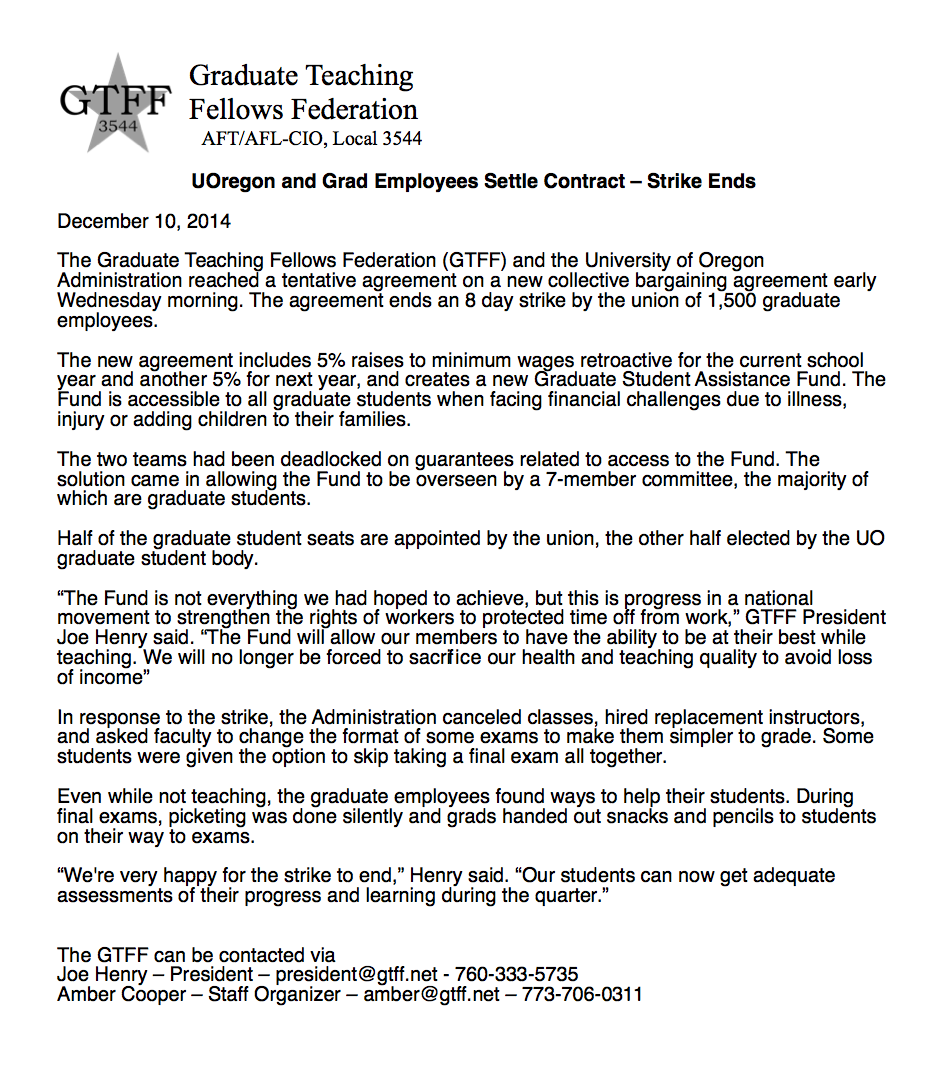
Chris here: this is the strike resolution letter, posted at UO Matters

Posted by Chris Newfield | Comments: 8

Tuesday, March 25, 2014

Tuesday, March 25, 2014
By Earl Perez-Foust, Comparative Literature, UCSB

Dear UC Faculty,

I am a graduate student at UCSB and a rank-and-file member of the UC Student-Workers Union (UAW 2865).  As you may have heard, my union has declared a strike for April 3rd with some campuses striking April 2 as well.  This is the first Thursday of the Spring quarter and it will likely add further disruption to what is already a chaotic time of the year.  The strike is over an Unfair Labor Practice (ULP) charge that the UC has intimidated members of the union with respect to their participation in the November 20th sympathy strike with AFSCME 3299.  In a recent statement, the Berkeley Faculty Association called on the UC to “respect the protected rights of union workers to take collective actions free of undue managerial interference.”  I would like to echo this and call upon all UC faculty to take stock of their stakes in this conflict, which at the very heart of it deals with the misuse of power dynamics within the University, and show solidarity with their graduate students.

This letter, however, is not meant to be an announcement of the strike nor a detailed breakdown on the charges within the ULPs – I have attached a link to these materials if you're interested in finding out more.  Instead, this letter is concerned with what it means – and what it feels like – to be a graduate student who is invested in the quality of their, and their colleagues', working conditions but who may feel intimidated by the prospect of approaching faculty with these investments.  Some of this may come as a surprise to you, a lot of student-faculty relationships are bracketed by an implied camaraderie and friendship.  However, perhaps especially when it's an issue of work stoppage, students may feel as if any disruption might be registered as a personal affront to this relationship.

To be sure, a strike is a legally protected concerted activity and any managerial intimidation with respect to one's participation in a strike is a violation of the law.  However, there are hidden mechanisms of intimidation and we all know what these may be: the infamous things which “just happen” (ie, TA appointments which “just happen” to go to someone else, a fellowship competition you “just happen” to lose, letters of recommendation which “just happen” to be poor ones).  These things, the “just happens,” are terrifying and can make the prospect of approaching our faculty daunting.  

No doubt some of you are thinking that you would never do this to your students and I'm not calling this into question.  You need to understand, however, that this isn't completely apparent to us – there is just so little room to talk explicitly about the workplace in these relationships.  We simply don't know what the response is going to be.  This strike gives us an opportunity to redefine the terms of our relationships within the University.  It gives us an opportunity to rethink what labor within the University means and what an ethical relationship within it could look like.  Navigating this is dizzying and can be confusing or difficult to situate.

For these reasons, starting the conversation may be the hardest step – we are unequipped with a language with which to speak about these issues.  If you are approached by one of your students or hear about the strike through another means, your unequivocal support is necessary.  The details and the context of the strike are important, but there is at least one other question in this conflict: what sort of working conditions are faculty endorsing?  We need to change the lexicon of our student-faculty relationships, which is to say that we need to be able to talk about the conditions in which we live and work.  Your expressed support of our collective action is an incontrovertible part of this.

I hope to see you on the picket line and that you will offer your support to myself and my fellow academic workers.

 
Posted by Michael Meranze | Comments: 11

Thursday, November 14, 2013

Thursday, November 14, 2013
By Colleen Lye and James Vernon (Co-Chairs, Berkeley Faculty Association)


At the end of September, the current 3 year-contract of UAW 2865 representing UC Academic Student Employees (GSIs, readers and tutors) expired and ASEs are now working without a contract. UCOP Labor Relations and UAW 2865 have not yet reached an official “impasse.” But the Berkeley Faculty Association is concerned that UCOP’s last offer of a 2% rise doesn’t come close to eliminating the gap with our comparator institutions, based on a 2010 UCOP survey.  Currently the 10-month (49.5%) GSI stipend is $17,655 for an incoming student, though our campus financial aid office estimates that $21,608 is required to cover the cost of living for 9 months while the campus desired target for doctoral students is $26,000. The Report of the Taskforce on Competitiveness in Academic Graduate Student Support, adopted by UC Academic Council in June 2012, declared “rising tuition and uncompetitive stipends threaten to seriously undermine program quality” and asks that additional resources be allocated for net stipends for academic doctoral support.  On the discussion agenda of the Regents meeting this week, a report from the Committee on Educational Policy restates the situation: “It has become more difficult for UC departments and faculty to offer competitive financial support for their doctoral students.

In letters sent up to UCOP on September 16 and October 3, 33Department Chairs at Berkeley and 21 Chairs at San Diego asked the University to raise the GSI base wage so as to enable our PhD programs to stay competitive, citing the unsustainable practice of having to top up students' support from scarce and unpredictable resources.
.
Please lend your voice as a UC faculty member by signing this petition, which will be sent to Director of UCOP Labor Relations Peter Chester.

Posted by Michael Meranze | Comments: 0

Wednesday, November 13, 2013

Wednesday, November 13, 2013
Undergraduate student debt has become a well-publicized national problem, but graduate student debt has ramped up with much less attention. UC began to increase its professional school fees in the last downturn that began over ten years ago, and debt loads for those degrees have increased rapidly.  The thinking was that medical, business, and law degrees endow their possessors with the high incomes that can cover high debt. Whatever one thinks of this logic in those cases, it doesn't apply at all to doctoral students, who experience long degree times, protracted periods of reduced income, and moderately good rather than high incomes afterwards, assuming they avoid many years of postdocs and adjunct teaching.

The materials for the UC Regents' meeting on doctoral education have some good graphics for the University of California version of the problem. The first of these is above.

The percentage of indebted students in each category hasn't increased that much in 10 years. The amount of debt for those who borrowed has increased by 23% in the Physical Sciences, Math, and Engineering (inflation adjusted), and by exactly twice as much in the Arts and Humanities -- by 46%.   Average total debt is 50% higher in the humanities than in the life sciences.

Studies suggest that a college generation graduating into a recession takes decades to catch up economically, if it ever does. The same might be said of humanities PhDs.  Their funding structure graduates them to the rear, and most will never catch up.

The next figure shows the median number of years it takes to finish a doctoral degree at UC and some comparator groups.
The median is nearly six years, or twice that of a law degree.  UC isn't worse than these other research universities, but the Arts and Humanities are worse than other fields.

The higher debt of humanities PhDs probably reflects the extra years required for degree completion.  So why do humanities doctorates take longer and therefore cost degree-holders more?

There are many pieces to this puzzle, but some big ones are easy to name. One is that humanities doctoral students spend several years in postbaccalaureate coursework: coverage happens all over again at the doctoral level before specialization begins.  Books have been written to critique this practice, but given the integrative nature of humanities research--which is not well understood in other fields--not all streamlining will be good.

A second piece is that humanities PhDs teach too much, and are too consistently responsible for the quality of the large lecture experience for undergraduates at research universities.  Most I know work beyond their formal limits, out of conscientiousness, and it's easy to see how one could work 70 hours a week for 5.7 years and still not be finished with a humanities dissertation.

A third piece is that humanities faculty have next-to-no extramural sponsors to provide large grants with which to hire graduate students who can spend those 70 weekly hours doing research related to their PhD, as opposed to spending half of them prepping, teaching, advising, and grading undergraduates. The structure of humanities funding spreads rather than concentrates humanities graduate students' attention.  They become good at understanding and teaching all sorts of things, but this in itself doesn't help them finish their dissertation.

There's much more to say about this, but my main reaction to this report is not only that UC needs to do quite a bit more to improve funding for grads overall (see Display 8), which the Academic Senate has documented in a series of reports over the last 10 years, but that the system can improve humanities PhD graduation time only by increasing research funding for these disciplines.  Hanging onto the status quo won't rectify the inequitable time-and-money hardship of humanities graduate study, which, in spite of our obvious fiscal problems, needs to be fixed.

Posted by Chris Newfield | Comments: 4

Monday, March 26, 2012

Monday, March 26, 2012
By Joel Norris, UCSD

If UC is to continue to be a system of research universities, it is essential to maintain robust graduate programs. Sadly, the Regents and UCOP are making choices that undermine Ph.D. education, often with little financial benefit to UC. One particularly detrimental factor is the practice of raising graduate tuition in tandem with undergraduate tuition.

Very few Ph.D. students pay tuition out of their own resources. Some have their tuition paid out of departmental block grants, and more have their tuition remitted because they work as teaching assistants. In these cases, increased graduate tuition simply means UC is picking its own pocket. All is not equal, though, because the total number of students who can be supported by institutional funding necessarily declines as per student costs rise.

Posted by Michael Meranze | Comments: 7

Monday, January 1, 2007

Monday, January 1, 2007
Posted by Alysse | Comments: 0