Top Navbar

  • Home
  • About Us
  • Guest Posts
  • Liner Notes

Searchbar

Showing posts with label Public Funding. Show all posts

Friday, June 12, 2026

Friday, June 12, 2026

From Tunnel Mtn, Banff on June 6, 2026
By Asheesh Kapur Siddique, Associate Professor of History, UMass Amherst


This is the second of the talks from the CHCI panel, "The Humanities We Can Build Right Now" in Banff, Alberta. Chris Nealon’s is here, my introduction to the panel is here.


Society needs the cultural knowledge that the humanities produces in its research and disseminates in its scholarship and pedagogy to make sense of the crises of the present. Chris has written about this need and convincingly argued for it, so I don’t have to. Instead, today I want to talk about politics: how do we make this happen?


Society has a need for humanistic knowledge. But there is no political movement in support of the academic humanities. There is a political movement about the humanities in the US-- on the political Right and it is deeply destructive to the project of democracy. While the Right over the last decade has built institutions and invested in undermining us by stealing our resources, destroying humanities programs and departments, and sowing doubt in our scholarship, the Resistance has not responded with anything near the militancy required. We need something different.  I want to begin a discussion about what building a political movement looks like. The political structure of democracies is partisan: parties are the central vehicle through which politics happens. In the US, the ideologies of “Right” and “Left” are not exact correlates to “Republican” and “Democrat.’ These parties are, however, the only way that ideological visions get enacted in public institutions through legislation and bureaucracy.


My remarks will proceed in three parts. First, I will describe the political Right’s movement to supplant the academic humanities and why it is threatening to the work we do. Second, I will turn to the political Left in the United States and explain why it, in its own way, is anti-humanistic in important respects. The point of the first two parts is to argue that there is currently no meaningful political support for building the present we want. Third, and finally, I want to end on a hopeful note, by thinking about what it would take to build political support on the Left for robust publicly funded humanities research.


So to begin: the political Right has a project for the present and future of the humanities in higher education – the creation of parallel institutions to traditional academic departments that teach courses and sponsor research in humanities fields, though especially political and economic thought, that aligns with various center-right policy objectives. In the US, while there were early predecessors, like the Institute for Humane Studies at George Mason University (founded 1961; part of GMU since mid-1980s), and the James Madison Program in American Ideals and Institutions (2000) at Princeton University, these are so-called ‘civic centers’ that began to proliferate around 2015, often funded by right-wing state legislatures and/or right-wing billionaires like the Koch brothers. Their creation was co-extensive with a renewed assault on higher ed’s institutional autonomy.


These civic centers, such as the Hamilton School at the University of Florida (initially funded by $3 million in taxpayer dollars by the Florida legislature), the Chase Center at Ohio State University (initially funded by $24 million in taxpayer dollars by the Ohio legislature), and the Civitas Institute (now School of Civic Leadership) at UT-Austin (funded both by the state and private donors), work within universities in the same way that tobacco and tech companies work to subvert publicly accountable, democratic knowledge structures and institutions.  As Alondra Nelson pointed out in her keynote lecture, they do this by casting doubt on the humanistic knowledge produced in universities, attacking it as “woke,” “political,” invalid, and unserious. They create parallel institutions that exist to produce politicized ideology disguised as “objective” scholarship and often cast in the rhetoric of “civics” that is squarely aimed at destroying the departments and cultures of teaching and scholarship in the humanities and the very idea of public funding for what we do.


Through civic centers, the right-wing is seizing on the crisis of funding and adjunctification in our universities for counter-majoritarian ends. As the historian Lauren Lassabe Shepherd has written of these centers, “The right’s approach to higher education has been three-pronged: it has sought to create competing and parallel institutions, to wrest control from existing colleges, and ultimately, to defund public education entirely.”


None of the rhetoric is new, of course; if the ‘culture wars’ of the late 20th century was the ‘new McCarthyism,’ this is the Red Scare 3.0 - the political right has not had a new idea about universities since Joe McCarthy. It  is the political right’s fixed vision of the future of the humanities in higher education go at least since Ronald Reagan became governor of California in 1967. You may know that, during a press conference in 1967 after being elected governor of California, and in the context of his push to introduce tuition into public higher ed in California, Reagan stated “we do believe that there are certain intellectual luxuries that perhaps we could do without for a year or two without hurting the cause of education.” Pressed to define these “intellectual luxuries,” Reagan pointed to only two examples: first, he referred to a course at UC Davis “where they teach you to hang the Governor in effigy.” Second, Reagan referred to “a state back in the Midwest where they discovered that a state university was offering a master's degree in the repair of band instruments, and I thought that this was sort of subsidizing intellectual curiosity.” We cannot give any concession or quarter to this continuing tradition of blanket hostility: it is completely dangerous and invalid. It is actually worse to have right-wing humanities than no humanities at all.


So far so retro culture war. Turning from the right’s attacks, I note that we have increasingly lost the center-left, the professional-managerial class (PMC) that once embraced what we do in public higher education.


As bad as the right has continued to be since 2020, I would argue that their attacks are not actually the politically worst for us: the center-left attacks have been far more damaging. Since the racist backlash to Black Lives Matter, followed by the backlash to campus protests opposing Netanyahu’s genocide in Gaza, the center-left has joined this campaign. Deeply influential institutions within American political liberalism like The New York Times and The Atlantic have peddled a version of the right-wing narrative aimed at casting doubt on the project of the university and indicting the humanities in particular as the source of the university’s now-dubious project. They are reshaping PMC opinion against the idea of publicly-funded humanities teaching and scholarship.


There is so much to say about this; I can talk more about how this is happening in the Q & A. As for higher-ed media, an event earlier this week encapsulated everything wrong with it: the Chronicle of Higher Education just re-published an essay that originally appeared at the right wing outlet Persuasion, arguing, and I am not making this up, that humanists should stop doing and publishing research because what we produce is trash. The literal title of the article is “Most Humanities Research Should Stop.” I’ll say it again: this is in the Chronicle of Higher Education.  Maybe we need a panel at the next CHCI about why the media coverage of humanities research and teaching is so bad and destructive.


So the center-left has, in its own way, abandoned the idea of robust public support for curiosity-driven humanistic education and scholarship and has fully embraced neoliberalism. Where do they think the humanities fit in our educational landscape? The center-left has decided that the purpose of public higher education is to supply workers for the economy, not citizens to participate in democracy. The value of any public investment in public education – whether from the teaching side or the research side – must be justified in terms of “return on investment” where “return” is defined in purely monetary terms, with all the non-monetary returns rendered illegible according to neoliberal reason. According to this vision, the humanities are fine in private institutions but their role in public education is less clear. This is important: Democrats do not have any problem with, and indeed support, the teaching of the humanities in private colleges and universities.  This points to the center-left having no problem, per se, with adjunctification and contingency in humanities instruction in private institutions, and especially highly selective ones – look at the reliance on contingent faculty in core curriculum programs at UChicago and Columbia, or in History & Literature and Social Studies at Harvard; look, perhaps most egregiously, at contingent faculty in college writing programs, again, especially private ones. Do any private college or university writing programs have tenure-line appointments?


Whether the center-left supports research for the humanities in private colleges and universities is a more muddled question.  What is clear is that in public education, the Democrats post-Reagan have emphasized STEM above all. The Clinton administration began this with its pivot to STEM education as the focus of its priorities and public investment. Barack Obama famously quipped in 2014 that “folks can make a lot more potentially with skilled manufacturing or the trades than they might with an art history degree.” The Obama administration proposed reductions to NEH and NEA funding in 2011 and 2012. Joe Biden was better, but still, annual NEH funding even under Democratic administrations has never been anywhere near $1 billion. Prior to DOGE, the NSF spent 17.5 times more on undergraduate research than the Congressional funds available to the NEH for individual fellowships to scholars.


In 2022, Obama’s Secretary of Education, Miguel Cardonna, tweeted, “Every student should have access to an education that aligns with industry demands and evolves to meet the demands of tomorrow’s global workforce.” Note the language here: the purpose of the public education system is to train workers for industry. Whatever industry demands, the taxpayer should supply. An echo of this came again in the context of the debate over student loan forgiveness during the Biden administration. In 2023, when the US House of Representatives voted to overturn Biden’s student debt relief program, the Democratic congresswoman and Reed College graduate Marie Gluesenkamp Perez, explained why she supported overturning the Biden student loan forgiveness program:


Expansions of student debt forgiveness need to be matched dollar-for-dollar with investments in career & technical education. I can’t support the first without the other. The severe shortage of trades workers needs to be seen & treated as a national priority. It’s about respect.

I’m all for repairing what’s busted but the higher education system is totaled. College costs too much & the credentials produced get unwarranted social status, justifying more cost increases by our country’s elite. They need to snap out of it & the system needs a total overhaul.


Let me underscore again that Congresswoman Perez went to Reed. She had the humanities experience we want students to have. But that experience does not seem to have led her to believe in the value of publicly-funded intellectual curiosity. There is no necessary correlation between classroom exposure to what we do and the willingness of either the college-educated public or college-educated politicians to then go out and support the university we want to build.


This is not because pedagogy is not important; far from it. It is because pedagogy in itself is not enough: we need politics – and we need politicians – to make political change happen. 


Now for a very brief part three. The construction of a robust public infrastructure for funding humanities research depends in the United States on winning political support. We don’t have that now. But I strongly believe we have a chance right now, even though things are so bad, to build this political support: the next Democratic administration will need to rebuild the federal government knowledge infrastructure, completely and totally. It’s time for us, as humanists, to lay out what we need in terms of public support.


We need to be talking to the administration in exile. Media is a huge part of this: the turn by center-left media outlets that influential Democrats read, like the New York Times and The Atlantic, against humanistic scholarship and teaching, is a big problem. The retreat of private funding for university-based humanities research is also a big problem, one that I have written about, but of course in electoral democracies, private foundations are not accountable to publics in the same way as state institutions are, and while we can and should say things about the retreat of private funding (and I have) we actually have an opportunity right now to articulate what a reconstructed NEH should look like and how much it should be funded. The center-right will not let this serious crisis go to waste; neither should we.


Posted by Chris Newfield | Comments: 0

Monday, February 16, 2026

Monday, February 16, 2026


East Village on October 31, 2022   
Looks like it.  

There’s some good stuff in Tyler Austin Harper’s Atlantic article, “The Multibillion-Dollar Foundation That Controls the Humanities,” but the piece unravels into a tool of the thing people actually hate about the humanities, which is not its implications for social justice but its civil wars. It blames the increasingly desperate struggles of the academic humanities not on right-wing enemies but on liberal humanists—a woke Mellon Foundation and its president Elizabeth Alexander.

I was one of the people that Harper interviewed for this article.  (Here, “Harper” always refers to the author, Tyler Austin Harper). He was fun to talk with, is a serious person, and worked hard on this piece, all of which I respect.  When we spoke, I emphasized our terrible money problems, which I argued tower over our manageable and ordinary methodological debates.  


I said that the real issue is our lack of the funding to produce and disseminate our knowledge at the scale that would get the kind of social attention allotted to medicine and computer science. We may think this is intrinsic to their topics and status but it is mainly the result of their vast organizational labor, labor of a kind that the humanities establishment, Mellon included, refuses to try. 


Harper cites my Public Humanities piece on funding—“Humanities Decline in Darkness”-- for a statistic in which federal humanities funding rounds to zero. But you have to get to his third-to-last paragraph before he makes his best causal claim about the current situation: 

The humanities are in the mess they’re in because of federal budget cuts, and because of administrators who care more about the football team than about William Faulkner, and because of the toxic pragmatism of an American culture that has a hard time valuing anything that is not immediately, aggressively useful. But the humanities are also in this mess because those of us who care about them have often preferred hunkering down in a defensive crouch . . . 


I would have finished that last sentence by writing, “and so we don’t build the data and resource infrastructure that would make our needs visible to politicians and the public.”  But that’s not where Harper goes.


Harper’s other most effective moment comes from Phillip Brian Harper, the Mellon program director for higher learning: 

“The sector needs to be taken by the collar and shaken very hard until resources that are adequate to the support of humanities doctoral students are jarred loose from higher-ed institutions themselves. . . . The role of the Mellon Foundation is to catalyze that sort of change. It’s not to serve in perpetuity as the piggy bank for research.” Mellon, he said, was never supposed to be a panacea for the humanities.


Great, but who will do the shaking of university management? Mellon? Phil Harper says its role is to catalyze. On this topic, it’s not.  


He is of course right that the situation is completely appalling. To repeat, even though sociocultural knowledge is essential to solving any of the world’s epic problems, the rich universities listed below spend almost none of their institutional funds for R&D on non-STEM fields.


Figure 1. Institutional Expenditues on R&D, Selected Universities


SOURCE: NSF Higher Education R&D Survey (HERD) FY2024, Tables 14, 23, 29.

Yes, these figures likely exclude individual faculty research funds via outside grants, named chairs, and other department-managed funds.  But as indicators of institutional investment in humanities infrastructure, they are shocking. Universities’ own refusal to fund humanities research is also one cause of our society’s inability to deal with its core problems.


Yet Harper comes not to bury funding failure but to chastise social justice. The fault for him lies not in Trump’s destruction of the National Endowment for the Humanities or 40 years of right-wing culture wars, but in Mellon’s interest in a better society.


∞∞∞


Harper makes two main claims. The first is that “classical” and “social justice” scholarship aren’t complementary approaches but rivals. They compete bitterly for scarce and dwindling funds. 


The solution to this is obviously an alliance between rivals to fight for massively better funding for all, at least ten times more funding than socio-cultural scholarship has today.  


But Harper diverts attention from funding with his second argument: “social justice” research is a betrayal of humanities scholarship, a kind of negation of it. This increase in “the decidedly sublunary work of furnishing political propaganda” makes Harper wonder whether the academic humanities are worth saving at all.  And Mellon, he writes, has shifted to funding this political propaganda since the arrival of Elizabeth Alexander as president.


Let’s try to understand this claim. Harper’s evidence for a policy shift is a Foundation announcement dated June 30, 2020. Mellon declared a new focus on “just communities enriched by meaning and empowered by critical thinking where ideas and imagination can thrive.” Board chair Kathryn A. Hall explained that “our reinvigorated mission and strategic direction . . . not only builds on our historic commitment to the arts and humanities, but rightly emphasizes a desire to make the ‘beauty, transcendence, and freedom’ found there accessible and empowering to all members of society.”  


The new direction assumes the complementarity of what we might call “basic” and “applied” humanities research, and not that applied research—addressing social questions—debases basic scholarship.  Complementarity—with awareness of different modes, aims, and questions--is assumed in every STEM field and social science of which I’m aware, so Harper has a special burden to show that the humanities are unlike all other forms of academic research in this way.


Alexander confirms complementarity in the announcement by adding, “We are a problem-solving foundation looking to address historical inequities in the fields we fund.” This also expresses reflexivity about Mellon’s own role in knowledge creation, which includes a past of supporting the kind of epistemic biases and limits that need constant correction in every field.


The new Mellon direction also seemed to aim at the democratization of humanities knowledge—at taking the results of humanities research outside of a small elite while also learning from communities about their existing knowledges and practices.


Harper presumably approves of problem-solving, and he definitely opposes the perpetuation of historical inequities which he agrees exist.  He sounds fine with humanities for the people, which is the official policy of the state humanities councils and the National Endowment for the Humanities (NEH) whose origin story he affirms. He writes,

[U]nder Alexander, the foundation deserves credit for working to create a more economically just landscape within higher education. Before Alexander’s arrival, Mellon tended to disburse lavish funding to institutions that were already rich. Now, as part of Mellon’s commitment to equity, it is making a conscious effort to provide funding to public and less selective institutions. It has also increased funding for university-led prison education programs


All true, good, and important.  So what is so bad about Mellon’s new direction?  


Nothing, actually. (Its inaction on overall funding is a separate question to which I’ll return)  But to save what must have been the original idea for the story, Harper spends most of the piece making the false argument that “applied” humanities scholarship (not his term) is political propaganda.


How does he show this?  First there’s his prior, the false legacy dualism in criticism and some related humanities fields in which the criticism of texts and historical materials (basic) is denatured and corrupted by engaging in criticism of society (applied). It’s this dualism that turns “social justice” into “political propaganda” that ruins scholarship. 


This dualism may encourage him to search his anecdotes for polarity. For example, he spoke with a scholar who “confessed that . . .he had reimagined his work to focus more squarely on race; he did win a grant. I suspect that this may not be a rare occurrence.”  Harper’s assumed incompatibility between the first and more race-focused version of this scholar’s work makes this a problem rather than progress. 


Second is Harper’s assumption that it’s bad to get steered or shaped by a call’s language or a program officers. There seems to be a tacit idealization of “classical” humanities scholarship as pre-social and not in any good way developed by thinking about problems it might solve, or by being asked to change emphases in a proposal by an agency official.  


I see this as a humanities provincialism about sponsored research, which always involves calls, program officers, public pressures, institutional forces and so on.  This is not epistemically less valid than idealized autonomous scholarship. Remember actor-network theory and dozens of related ways of discussing the collaborative nature of thinking.  So the scholar who “reimagined his work to focus more squarely on race” likely improved his project. Program officers at NIH, NSF, and other STEM agencies do this advising routinely.  Agency shaping can be good or bad. 

Harper doesn’t have the evidence to rule out good shaping in that more-race-oriented project or the others. (Gabriella Coleman’s valuable commentary on Harper, “The ExposĂ© that Wasn’t,” is really good on this point.)


So it’s not that “social justice” aims are inherently anti-intellectual and ruin scholarship. Better knowledge in many areas can come from working like Pasteur rather than like Einstein, to reference a classic study of the (complicated) relation between basic and applied research.  And it’s also not true that agency shaping is bad per se.   


So Harper falls back on a third way of making his claim that woke Mellon is ruining the humanities. That is to scorn sample program language as self-evidently non-scholarly.

Mellon’s newer Dissertation Innovation Fellowship focuses on “supporting scholars who can build a more diverse, inclusive, and equitable academy.” The guidelines list “thoughtful engagement with communities that are historically underrepresented in higher education” as one of the primary criteria used to evaluate the strength of an application; by my count, all 45 of the 2025 awardees work on issues of identity or social or environmental justice.

I assume Harper means this program, run by the American Council of Learned Societies (ACLS).  Awarded titles include the following: 


·      The Dam, the Road, the Port: The Transformation of the Brazilian Northeast during the Long Twentieth-Century

·      State of Mine(Mind): Affective Geographies of California's Rural North

·      Urban Tropics: Dwelling under South and Southeast Asian Urban Microclimates

·      Uneasy Intimacies: Seeing Irei and Aesthetic Ambiguity Through Fukunosuke Kusumi's Art

·      Black Anti-settler Placemaking: Cooperation Jackson's Eco-villages from Mississippi to Vermont

·      Fiber Optics: HenequĂ©n Classification and its Consequences

·      Troubled Waters : Natural Disaster, Space, and the State in Precolonial Panjab (1707-1849)


Check these and the others out for yourself.  They all analyze major issues and strike me as likely to make original contributions to knowledge.  I don’t at all see Harper’s justification for assimilating all the projects to “identity” and “justice” studies. To do this, he needs to stereotype everyone on the basis of the appearance of words like “settler,” “queer,” “colonial” etc. I don’t even see how they’re all applied rather than basic research. He offers no evidence (just the legacy assumption) that these are not intensely scholarly, deeply intellectual projects.


At breakfast before drafting this post, I read an interesting review of The Deformation: Attention and Discernment in Catholic Reformation Art and Architecture by Susanna Berger (Princeton University Press, 2025).  “Central to The Deformation,” the reviewer writes, “is the question of how religious elites wielded anamorphosis as a means of gatekeeping the divine.”  I love this kind of stuff. But is a book about the relations among perspective in drawing, theology, and institutional power in 17th century Europe clearly epistemically “classical”—pure, basic research-- and thus intellectually superior to work on “Affective Geographies of California's Rural North”?  The answer is no. Mellon / ACLS funded research simply cannot and should not be delegitimated with superficial separating of the sheep from the goats.


The same goes for Harper’s disdain for a grant to Colorado College.

In the summer of 2023, Colorado College hosted a conference based on this prompt: “How do the humanities contribute to anti-oppressive work, and how can humanities methods—from inquiry and critique to creative production and performance—dismantle systems of oppression, create and sustain community and solidarity, and advance liberation?” It does not seem to occur to those asking such questions that the humanities may not be especially well equipped to “dismantle systems of oppression.” Nor do they seem to consider that what might in fact be most valuable about fields like English, history, and philosophy is that they aspire to stand above the flotsam and jetsam of our immediate circumstances, and instead set their sights on what the classicist Leo Strauss called the “permanent problems” that have troubled human beings from time immemorial.

Harper doesn’t actually know what the conference organizers did and did not consider, but in any case, “how to dismantle systems of oppression” is one of the ‘permanent problems” of human beings. It is also a running theme of literature, history, and philosophy for thousands of years.  One might find the Colorado College formulations a bit plodding and yet not try to discredit the program through a false distinction between intellectual work and its social contributions.


I can imagine Harper doing a different kind of research that leads to a different article about the humanities.  He would go to Colorado College, interview the students, staff, and faculty involved in the program, and sit in on its courses for a few weeks while also visiting classes that aren’t part of the program.  He could then compare and contrast and identify the actual cognitive and other effects of the program on the participants. We would all learn something about what actually happens through humanities funding on college campuses to (and by) students and their teachers—for better and worse.  This is the real void in public understanding, and Harper’s dismissal of a program on the basis of its terminology doesn’t help fill it in.


So, Mellon’s new direction is less elitist. It puts greater emphasis on “applied” over “basic” research (“Pasteur’s Quadrant”) while insisting on their complementarity (and equal intellectuality). It funds some research on white supremacy and overcoming it--along with funding many other things, and really this funding is a drop in the bucket of overall social need for knowledge about racial nationalism, the authoritarian personality, etc.  Mellon program directors shape applications, as they always have.  They may now fund a higher proportion of outreach and communication programs compared to applied or basic research, but Harper doesn’t get into this important issue.  Finally, Mellon is the last big national funder in research-starved humanities field.  Only the last of these strikes me as a scandal.


∞∞∞


Daylight does appear when Harper takes the other side of his own argument. 

It is hard to argue that the tens of millions of dollars that Mellon is putting toward internships for working-class kids at public colleges and universities would be better spent financing dusty archival research on 16th-century France. But this calculus also says something about the deeper structural problems of a model that pits various social goods—programs for humanities undergrads, resources for Ph.D. students, traditional humanities research, support for emerging fields and endowment-poor universities—against one another.

Yes, absolutely: we must address with the intent of solving “the deeper structural problems of a model that pits various social goods against one another.”  We must at the same time argue for “financing dusty archival research on 16th-century France.” But it isn’t Elizabeth Alexander or Mellon that set up the zero-sum game. This happens when critics pit different kinds of humanities scholarship against each other.  


Mellon et al. didn’t set up the zero-sum funding game.  But what are they doing about fixing it? 


I’d trace some of Harper’s completely valid distress about the system to having grown up in this barren funding world where one’s work is always losing out to someone else’s.  The real issue with the humanities’ national leadership isn’t that they politicize scholarship, but that they don’t fight openly and systematically to fund a great deal more of it.  


This gets us back to Phil Harper’s statement: 

“The sector needs to be taken by the collar and shaken very hard until resources that are adequate to the support of humanities doctoral students are jarred loose from higher-ed institutions themselves. . . . The role of the Mellon Foundation is to catalyze that sort of change.”


But Mellon is not doing that. 


I can find reports galore about the crisis in STEM funding—everything from the cuts to indirect cost recovery to the losses of whole areas of research (like racial disparity in public health outcomes that NIH had funded for years) and of scientific personnel. I can find nothing from the humanities associations about their research funding problems.  


NEH has been gutted, yet MLA, which did indeed help sue the government over NEH, has joined NHA, AHA, APA et al. in neither collecting data to show the funding problem nor developing a systematic plan for building such funding. 


Similarly, the ACLS’s Strategic Framework 2025-2030 doesn’t have a sentence about tracking humanities research funding or expanding it. I see all these great scholars on the board. What are they doing?  What are we actually doing?  Why isn’t something like Figure 1 above on Mellon’s website as part of a large, structural analysis, rather than on the blog of an obscure professor? Universities need to be “taken by the collar.” But who will take the humanities agencies by the collar?


None of the solutions are really so abstract anymore.  People here and there have sketched out plans. I outlined one version in a long discussion paper for the MLA Executive Council in 2022, and ended my presidential address in January 2023 with a sketch of the steps we need to take, somewhat expanded in the print version (“Criticism After This Crisis”).  Also in 2022, a sub-committee of the Executive Council developed a reporting structure on cuts (or growth) across the country, planning to use the Association’s large, elected Delegate Assembly to feed information to headquarters for analysis and reporting. The Association never set this up. 


Two years went by, and the MLA then set up a panel explicitly about funding at the Convention in January 2025. 


Figure 2. MLA Convention Program 2023, Panel 139


The panel was an excellent (re)start on the topic, and the panelists had a good planning meeting afterwards.  We outlined NEH, Mellon, MLA, ACLS working together on research data, reporting, development. Then Trump took office and started his attacks. My colleagues bailed on the plan, which as far as I know, is dead.


With some discipline, we can replace our historic humanities pastime, discrediting each other’s research, with the project of building a material base for all of it.  If we can’t show basic mutual respect for divergent (and radical) research within the profession, then we are doomed.  But actually we can do this, and many, many of us already are.


I again invite both Harpers and everyone else into the effort of building the material base. 


Posted by Chris Newfield | Comments: 3

Wednesday, January 22, 2025

Wednesday, January 22, 2025

Washington, D.C. on any given day in the 21st Century
As Trump kicks off his campaign of nonstop harms, universities and humanities programs will need to look to themselves for the resources to help the people that count on them and advance the ideas, cultures, and practices we need. 

Neither universities nor humanities organizations can do this now and will need to do much better over the next few years.

This post is the final part of my talk at the New Orleans MLA Convention, "The Humanities Die in Darkness." The first part is posted here, and the underlying paper is in the first issue of Public Humanities.

The humanities' first funding scandal is that the country’s main source of basic research funding spends essentially no money on humanities scholarship. Using NSF data, of the $54 billion or so in research that the federal government funds in U.S. higher education, $69 million goes to the humanities. That is, the humanities receive 0.13% of the federal total.  This is a tiny slice of the overall federal research pie, and rounds essentially to zero.  See the figure above.


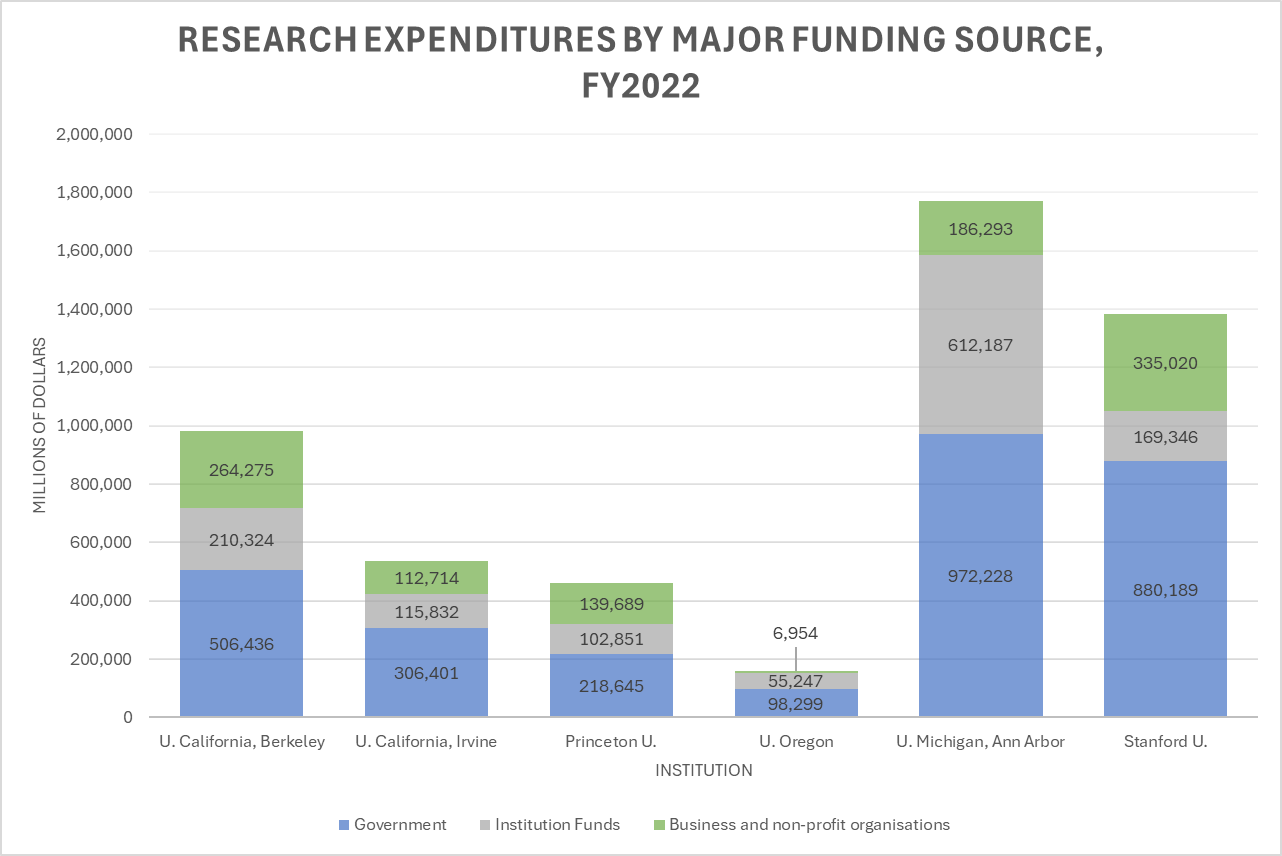
The second funding scandal is what happens when we move from extramural to internal or institutional funds. Of the nearly $100 billion that universities spent on research in FY2022, $25 billion came from the universities themselves. That’s a lot of research, especially outside of STEM.  In a epistemically just or epistemically neutral world, universities would try to even out external shortfalls for the humanities by increasing the humanities’ share of internal funding.  


But this is not what happens.  Here are some sample universities.

I’ve simplified the NSF data categories into government, corporate or foundation funding, and internal funds (“institution funds” in the NSF tables).  Watch institutional funds, the grey band. It represents the universities' own money spent on research.  Research universities take a quarter or even a third of research expenditures from their own pockets.


So if STEM research is profitable, and makes money, maybe all this internal money is available for the arts, humanities, social sciences, education, law, and so on?


In reality, no! Here’s the breakdown of internal expenditures for these universities —the grey bar of total institutional funds is broken out with a separate bar for all non-STEM expenditures next to it.


The short bars are all of non-STEM funding.  The yellow band is all humanities disciplines together.  A few elite university humanities programs do well. Princeton at 10.6% of institutional funds for humanities is the highest I’ve found. Penn, however, is under 2% -- it spends less than 2% of its own research funds on humanities research. The University of Arizona is about 2%. Iowa is about two and a half percent, Kansas back under 2 percent. 


Not pictured here, the University of California spent a half a percent of its total research expenditures on the arts and humanities together in 2018-19. The University of Oregon and Stanford University spent a fifth of one percent of their internal research funds on humanities research (in 2022). 


Clearly, interest in or respect for humanities research is not a function of whether or not you can afford it.  With a few exceptions, universities just don’t use their internal funds to compensate for extramural funding injustice towards the humanities but use these internal funds to perpetuate this injustice.


One way to remember this is in round numbers. 


Universities spend $100 billion on research (from all sources). 


One tenth of that goes to all non-STEM fields as a group, social sciences included.  


And then one-tenth of these non-STEM funds goes to humanities disciplines. There’s a tacit One Percent Rule for the humanities—some universitis are above, most are around one percent or below.


But where does all that other internal research money go?    


It goes to subsidizing STEM research, because STEM research in reality loses money for its universities. I can’t go into this here, except to say yes, you have been gaslighted about this by your own administrators. Universities use the vast majority of their internal funds to make up for the failure of external STEM research sponsors to pay the full costs of STEM research.  Bear in mind, too, that Project 2025 has a plan for the Trump administration to make this problem much, much worse (see page 355).


This gets us to the third scandal, which is entirely of the humanities’ own making.  I’ll cast it as a series of questions. Why are you hearing about the research funding scandals from me? Why are you looking at my homemade figures made through my individual readings of NSF survey data? Where are the large scale reports from the humanities disciplines? Where is the humanities equivalent of these very large research funding surveys and analyses that are required of the NSF by law? Where are the NEH, ACLS, MLA, AHA, APA, NHA, and Mellon reports on research underfunding, coupled with policy demands for more funding? Since this would be a large undertaking, where are the collaborations among the leading humanities associations and between them and the NSF? Where is the humanities research infrastructure to study the very damaging lack of humanities research infrastructure? 


The answers to these questions are the same: nowhere.  I have found no sustained institutional effort to understand the state of humanities research funding.  A key reason why we have no meaningful research funding on the scale of the profession is that we have no data and no public discourse about such funding.  


STEM, in contrast, has been forced to have data and discourse since the 1950s.  They have made a virtue of necessity—and also made a nonstop, militant advocacy program.  Our failure here has inflicted damage on humanities scholarship and on its public reputation. This is damage that we have never tried to define, much less systemically oppose.


Our main strategies for survival have been as follows: stressing teaching, expanding public engagement,  and shrinking graduate programs, which make the problem of underpowered research even worse. These false solutions are also driving students away and damaging academic employment. Students and the wider public are attracted to fields that generate visible, useful knowledge about problems in their lives. 2023’s infamous New Yorker article by Nathan Heller, “The End of the English Major?” rested on interview evidence that students follow research investments, not quasi-educational activities.  10 years ago I published a piece in the MLA journal Profession, called “The Humanities as Service Departments.”  That is where ignoring research funding has been taking us.  Students do not major in service courses.


The natural and social sciences work under a social contract to generate public knowledge, and so do the humanities. The equation is Research + funding=public benefits=have a future.


I am sorry to say that this third scandal of our own making mixes two modes. One is gaslighting—we allow ourselves to be gaslighted about university funding; we then gaslight each other about how this doesn’t really matter.  


The other is the practice I mentioned at the start: anticipatory obedience, a reflex on a matter of world crisis like Israel’s destruction of Gaza as well as on matters closer to home, like our own professional survival. 


I’ve laid out the alternative elsewhere: surveys, data, analysis, publication, dissemination, advocacy, howling into the void until the void listens. The void does eventually listen.  


The void needs to hear us say that extramural funding must by doubled, tripled, quadrupled until the 166,000 college and university humanities instructors have research support in the ballpark of their needs as identified in the surveys we must conduct. 


The void needs to hear us say that STEM disciplines must move towards full coverage of their overheads so that much more institutional funding can be used to give humanities scholars appropriate research support.  We need a 10 year plan, and we need it now!


My thought about 2025 has been that Trumpism is likely the end of this fifty-year political cycle and not its resurgence.  But we are the ones who have to work to make that true. It is not up to us alone, but it is also up to us.  And we need the money and the infrastructure to have the power so our research can make this difference.


Posted by Chris Newfield | Comments: 1

Saturday, January 11, 2025

Saturday, January 11, 2025

MLA New Orleans on January 11, 2025
This is the first section of my talk at the MLA Convention, "Humanities Dies in Darkness," an extension of a theme.  It's paired with the Public Humanities paper.  I go into more detail in another section about why I think anticipatory obedience is the right term for the profession's relation to its funding masters. I'll elaborate in a later post.

**

In spite of its very bad start, the thought of our new year 2025 leaves me somewhat optimistic, or at least determined. 

The first reason for this is that Israel’s war of annihilation in Gaza has generated the strongest anti-war movement of the past 50 years. This movement has changed public discourse, so that recently unsayable terms—genocide, apartheid—have become central terms of public discussion of Israeli policy.  The movement has opened up new possibilities for peace, for Palestine, for the Middle East, even as these possibilities face new waves of repression and nasty uphill battles. Many of us in the room have been active in this struggle, including in the struggle to allow debate of a resolution in the MLA’s Delegate Assembly. Please join me in thanking them for their work. I’ll say more about this in the talk.

The second reason for my determination is that our scholarship has never been better. So much work keeps opening our eyes to new things. I can barely keep up with the podcast version of literary books on the New Books Network. I’d also mention Matt Seybold’s American Vandal podcast series, which has become the decade’s more or less best genealogy and critique of the profession’s current institutional conditions. It is another reminder of how our intellectual lives thrive in spite of material conditions that do not.

The third reason for optimism is that the elements are in place to make Trump Part 2 the end of our current long political cycle rather than its revitalization.  This ending won’t be pleasant, and I obviously can’t time it. But I can talk about what our profession needs to do with the elements that are in place—emphasis on the word do.  

This is not the first time that we confront a Western government in the grip of authoritarian populism, as Stuart Hall named it in 1978. This term refers to a socio-political and cultural condition in which leaders build authoritarian state power with the consent of a voting bloc that believes these leaders will uniquely address their genuine needs. Hall saw that the power of Thatcherism lay in its insight that cultural power would decide its fate, not just state power or economic policy.

Now in 2025, the second Trump administration will again try to remake society from above while alleging that this expresses the national will. Trump and Musk seem to be trying to create steampunk 19th century American imperial expansionism for a world to be run by a League of Extraordinary Dictators. At home and abroad, culture war will remain central: smearing the identities of migrants and trans people, exclusionary definitions of normative values—these are not by-products of Trumpism but Trumpism as such. 

One thing that has changed since 1978, or 2008, or 2016 is the destabilizing crisis in the culture industries of which the academic humanities are a part.  Authoritarian populism has always targeted rival cultural producers for destruction. As it continues to do so, it can take advantage of a materially weakened opposition that is also not well organized institutionally. 

I’m talking about us of course--cultural producers whose employment base has been under attack from various directions for 30 to 50 years. Language instructors, journalists, screenwriters, poets, musicians, playwrights—all of our colleagues in culture have been facing steadily increasing levels of precarity, inadequate salaries, unemployment, or replacement, and also few organizational tools to establish basic parity. 

Trump’s return will deepen the well-structured assault on all non-reactionary cultural knowledge production and on their institutions, especially the news media and the university. In addition, Trump’s Big Tech brigades will use so-called artificial intelligence to make this even worse.  We are facing a unique conjuncture within a system that has been under construction for 50 years.

At this point in this system’s cycle, we must confront and reject the humanities fields’ standard response to adversity. Our response has been, in my view, accommodation, coupled with a passive-aggressive reluctance to engage the external demands for positive public knowledge that the university’s social contract involves.   It’s submissive individualism, inherited from Emerson among many others.  

A related term that emerged thirty years ago to describe such a response to authoritarian systems, and now popularized by the historian Timothy Snyder, is anticipatory obedience.  I  want to pose the following question in the context of the MLA Executive Council’s recent decision to block debate of a valid resolution about boycotting Israel: if we cannot debate BDS, how can we demand that others—Congress, university presidents--debate the unacceptable material conditions of our own cultural and academic labor? Without confrontational courage, across the full range of justice issues, how, regarding my topic here, can literary study avoid further budgetary defeat?

Obedience damages the state of others, and also of ourselves.  Overcoming our long-running financial defeat now requires building a countermodel for an alternative culture and society, using elements of both dominant and emergent cultures, in Raymond Williams’ terms. Building a United States not dominated by Trumpism—a minimal but difficult step-- will not happen without the kind of discursive and cultural analysis that defines the work of most of the members of the MLA. I believe that the study of literature, language, writing, and culture will either be central to the next historical cycle or that next positive cycle will occur too late.

I have four points to make about this today. The first is that MLA disciplines cannot be bystanders to building the countermodel.  

The second is that when critics like Hall, Williams, and also Said, Ferguson, Butler, and many others called for the conceptual tools that would build away from authoritarian-democratic and white-nationalist societies in what Williams called the long revolution—literary study successfully answered the call.  Our fields have developed the forms of knowledge that can enable this transition. This development has not slowed down but sped up over the past twenty years.  I only assert this now—perhaps we can discuss a bit later.

Third, we have the intellectual means to attain meaningful public significance as producers of knowledge. But we lack the institutional and financial means.  We are not too slow or too radical to sit at the research table. We are too poor. What this means is that we are unable to fulfill the tacit social contract under which all academic disciplines labor, which is to produce knowledge that ordinary people can use to solve problems in their lives—intellectual problems, not just problems of employment.  I will lay out our financial poverty in the humanities and define it as a social problem and enormous intellectual block.

Fourth, on top the funding scandal is the scandal of our lack of will and failure to confront the funding crisis over a period of decades.  When I say we are intellectually ready but not ready with the required infrastructure, it is partly our own fault. I’ll end by calling for us to transform our relation to funding politics, which must include transforming our structure of feeling about research capital and its institutions. 

We will need a new level of militance if the profession is to survive to fight another day, to say nothing of contributing to the long revolution in democratic affects and practices on which peace and ultimately human survival depend. 


Posted by Chris Newfield | Comments: 0

Tuesday, January 7, 2025

Tuesday, January 7, 2025

Santa Barbara, CA on December 29, 2024
I have a new paper out at the inaugural issue of Public Humanities.  I thought a bit of summary might be useful, and here's the thread version of that.

I'll be talking about the need for a whole new militance about funding humanities research at the MLA convention in New Orleans on Thursday, January 9th, 5:15 pm. The panel is number 139, "Humanities Funding, Visibility, and the Future of Research," with very good people from ACLS, MLA, NEH, and Mellon. 

**

This new paper on how humanities research funding works was posted as part of the first issue of the new journal *Public Humanities* for the Christmas Eve market in budget analysis.   So a few new year’s thoughts. 

I called it “Humanities Decline in Darkness” because deliberate darkness shrouds university research funding patterns. This reduces humanities research, lowers its public value, causes doubts about its quality

And drives away undergraduate majors while undermining tenure-track jobs for early-career scholars. 

My premise is that the humanities should not adopt scientific norms—obvs—but “should have the *financial means* to complement, contest, or rival science in explaining people, societies, and cultures.”

“to do this properly today, they need a step-function increase in funding.”  How? The first step is to understand how research funding works. 

I start the piece by talking about why it took me 8 years to turn my dissertation into a book. The good reason: a new grounding of Emerson’s texts in a cultural psychology I called submissive individualism

Which meant years of solo reading in other people’s fields. The bad reason for the delay: there was no research infrastructure to collaborate so as to accelerate learning and ¬also link the results ¬directly to those other disciplines (like economic history)

Modern STEM depends on collaborative infrastructure.  Where is that for the humanities? Nowhere. I was not only studying C19 but, academically speaking, living in it. 

In the paper I outline university research funding structures. There is extramural funding, both federal and private (foundations), and internal funds (“Institutional”) from universities themselves.

The federal picture is dismal. In FY2022, the federal government spent $54 billion on higher ed research, of which $69 million went to the humanities. That’s 0.13% to history, literature, etc.

Very bad. But what about private foundations? There’s no aggregate data, and the biggest hum player, Mellon, spent $48.6 million in 2017 on “Higher Education and Scholarship in the Humanities,” decreasing to $35.4 million in 2018. 

The pattern here is that a few elite universities do have solid research programs funded by Mellon or NEH, and some others. The overall disciplines—166,070 college hum instructors-- have nearly nothing. 

Nearly, but not nothing. The NSF survey I use shows that higher ed “spent $713,685,000 on humanities R&D across the 547 surveyed institutions.” That’s about $4300 per instructor per year—say 1% of a STEM prof’s $ but not zero.

A memory aid: “universities spend $100 billion on research (from all sources). One tenth of that goes to all non-STEM fields as a group, social sciences included….  

“And then one-tenth of these non-STEM funds go to humanities disciplines. There’s a tacit One Percent Rule for the humanities—with the one percent as a ceiling not a floor.”

What fraction of this overall hum money winds up in scholars’ direct research? We have no data on this. 

The other big funding category is institutional funds.  “Of the nearly $100 billion that universities spent on research in FY2022, $25 billion came from the universities themselves.”  (That’s a major financial problem for STEM research too.) But hum fields have another chance here. 

Here are some examples of research revenue sources (simplified categories). I also go into the student subsidy for research a bit in the paper. Watch the grey--the universities' own money


And here’s what the humanities fields get at those same universities from the institutional/ internal funds. Fractional amounts to the humanities even of internal funds.

A few elite university humanities programs do well. Princeton at 10.6% of institutional funds for humanities is the highest I’ve found.

On the other hand, U of Oregon and Stanford spent 0.2% of their internal research funds on humanities research. Clearly, interest in or respect for humanities research is not a function of whether or not you can afford it. 

In 2018-19, the University of California spent 0.5% of its total research expenditures on the arts and humanities--and then 2 years later A&H disappears from the record.

In other words, with a few exceptions, universities do not compensate for extramural funding injustice towards the humanities but perpetuate it.

Where does the vast majority of the university’s own research money go? It goes to subsidizing STEM research, which loses money for their universities (yes you have been gaslighted about this by your own administrators). I explain this in brief.

What strategies do we have to address the humanities funding crisis, one which I claim is the core threat to these fields’ future? So far, bad ones.

The humanities establishment has tried to address humanities decline by stressing teaching and public engagement. These will fail to build interest and confidence—or jobs--since these depend on cutting-edge research for their value and impact.

The same goes for alternative careers.  Other cultural knowledge jobs—curation, journalism, publishing, etc.—are also shrinking (and are not better paid). Most “alt-ac” is actually an admin job back on campus.

Students and the wider public are attracted to fields that generate visible, useful knowledge about problems in their lives. 2023’s famous New Yorker article by Nathan Heller, “The End of the English Major?” produced evidence that students follow research investments.

Science works under this social contract to generate knowledge, and so do we. The equation is Research—funding—future.

Right now, this future is in the hands of humanities deans and the directors of major humanities institutions like the MLA, ACLS, NEH, and also Mellon.  I’m speaking about this with reps from those institutions at the MLA Convention in New Orleans.

If you’re there, please come. We need new strategies—I outlined  one path in my presidential address. Please make building the humanities research future more participatory, which is our best chance and the knowledge future we deserve.


Posted by Chris Newfield | Comments: 0