Top Navbar

  • Home
  • About Us
  • Guest Posts
  • Liner Notes

Searchbar

Showing posts with label Jerry Brown. Show all posts

Monday, October 16, 2017

Monday, October 16, 2017
In the latest fallout from last spring's disastrous, and disastrously handled, audit, Governor Brown has just signed a new law that tightens up legislative oversight over UC Finances.  You will probably remember that the State Auditor challenged UCOP's handling of funds and accused UCOP of intervening in the audit process in order to gain more favorable responses from campus officials (although UCOP denied the allegations).  In response, the State transformed UC's budget.  And now the state is increasing its intervention into UC budgeting.

In what can only be seen as a response UCOP's role in changing campus responses to the Auditor's inquiries, the new law forbids communication between UCOP and a campus
whenever a request for information relating to the security of funds of the University of California is made by the California State Auditor’s Office pursuant to these provisions to one or more campuses of the University of California, would prohibit those campuses from coordinating their responses with, or seeking counsel, advice, or similar contact regarding their response from, the Office of the President of the University of California before submitting the requested information to the California State Auditor’s Office. The bill would require the California State Auditor’s Office, when requesting information under these provisions, to include a statement in the request that it is requesting the information pursuant to these provisions and that the request for information is not to be shared with the Office of the President of the University of California.
In addition, the legislature demands increased fine tuning of the University's cost of education calculation both in terms of the relative costs of undergraduate education, graduate education, and health science education and by funding source.  Given that UC has consistently insisted that this demand is unreasonable, we can expect further political tensions between Sacramento and the University.

Chris and I have long called for greater transparency about spending and funding sources.  And I can understand the State's desire to ensure that the information it receives during audits not be tampered with.  Still, this latest statute raises a series of important issues:

1) When the accusations about tampering first broke, UC announced that it was hiring an independent investigator to examine the charges.  Has that report been concluded?  If so, when will it be released?  What did it determine?  If it hasn't been concluded then why not?  And when can we find out what actually happened?

2) As I pointed out earlier, the State's response continues to be based on the notion that legislators and the Regents are the most appropriate people to co-govern the university with UCOP.  But as has been proven repeatedly, neither the Legislature, nor the Regents, nor the Governor nor UCOP, for that matter, has demonstrated much grasp of the educational and research practices of the University.  What is needed is greater internal democracy rather than simply legislative demands.  And that internal democracy should be applied to the question of how to achieve the highest academic accomplishment, not simply how to achieve the greatest savings or, as far too many local administrators seem to think, develop the latest private sector fads.

3).  When will there be genuine accountability at UCOP and the Board of Regents?  As the audit,  this year's budget, and this legislation demonstrate, UC has become extremely vulnerable to outside pressures and the political status of the University is remarkably low.  Does anyone really believe that the people who have brought the University to this point are the ones to correct it?  And given the destructive forces emanating from Washington, does anyone expect that the budget or the political climate is going to get better?

4) Shouldn't the Senate take a leading and public role in formulating proposals to recenter the University on its academic missions?


Posted by Michael Meranze | Comments: 1

Tuesday, June 20, 2017

Tuesday, June 20, 2017
On June 2, following the negative state audit of budget practices at UC's Office of the President (UCOP) and then regental partygate, the governor's office announced four new appointments to the UC Board of Regents. This rekindled some press interest in the conflict between the sudden announcement of completed appointments and the process described in the state constitution.  Yesterday, the Council of UC Faculty Associations (CUCFA) has written a letter to state Senate President Pro Tempore Kevin de LeĂ³n asking that "the California Constitution be followed when nominating Regents to the University of California." I'll discuss the letter and why we would need it in the first place.

Brown's new appointments are:
  • a Hollywood studio executive (Peter Guber, 75, joining Regents Sherry Lansing and Richard Sherman from that industry); 
  • a former politician who serves on the Governor's Military Council (Ellen Tauscher, 65, joining Regent John PĂ©rez, former Speaker of the Assembly); 
  • one of the governor's political advisors (Lark Park, 47, joining former Brown advisor Gareth Elliott, appointed Regent in 2015); 
  • a financial manager (Maria Anguiano, 38, joining Bonnie Reiss and Richard Blum).

Anguiano would be the only regent in recent memory to have direct UC administrative experience. She'd add to the Board's very rare higher ed expertise, now represented by Regent Eloy Ortiz Oakley, the chancellor of the 113-campus California Community College system. Anguiano served as Vice Chancellor for Planning and Budget at UC Riverside.

The Regents in the State Constitution

In 1974, the California State Constitution was modified to insure that the UC Board of Regents represented the full range of the state population, rather than the full range of each governor's political circle.  Section 9 of Article IX, paragraph 5(d) reads,
Regents shall be able persons broadly reflective of the economic, cultural, and social diversity of the state, including ethnic minorities and women. However, it is not intended that formulas or specific ratios be applied in the selection of regents.
In appointment practice, the state's large poor population is unrepresented.   Its embattled middle class is barely there, in the distorted form of political lobbyists and senior managers who may get close to top 1% salaries but not to the 0.1%. The sole public education official on the appointed Board, CCC Chancellor Oakley, is probably the Board's low-income member.

The San Francisco Chronicle's higher ed reporter Nanette Asimov summarized the situation:
Of the 18 appointed regents, including the four just named, half are financiers, corporate executives, investors, real-estate developers or corporate attorneys. Three are former politicians. One is Brown’s senior policy adviser, and another — a former finance expert at UC — is chief financial officer at a company that supplies technology to a private college in San Francisco. The others are an eye doctor, a Sacramento lobbyist, a nonprofit policy director, and the chancellor of the California Community College system.
The governor's appointments are out of compliance with this section of the constitution, as have been all of his predecessors.

Second, the 1974 reforms set up an appointment advisory committee that the governor is to consult prior to making appointments (paragraph 6(e)).  The Chronicle reporter Asimov looked into the functioning of this advisory committee and found that it never met or advised.  Her piece was entitled, "Are governors ignoring law when appointing UC regents?"
[S]ix committee members reached by The Chronicle said they are never consulted in the selection of regents — only told shortly before the announcement that choices have been made. 
“Typically, I get a heads-up with a phone call that appointments will be happening,” said Rishi Kumar, a Saratoga city councilman and public member of the volunteer advisory committee. “We receive an email with the profiles of the folks that are going to be appointed.” 
Whether the governor is breaking the law would be up to a judge, said Jessica Levinson, a law professor and government ethics expert at Loyola Law School. 
"But it’s pretty clear that it doesn’t meet our expectation,” she said. “Our general expectation of ‘consult’ is that it’s distinct from ‘informing.’ You wouldn’t say, ‘I’m consulting this person by leaving a note on their door.’"
If by "note" you include email, this kind of executive not-consulting is routine. That's why consultation was written into the state constitution in 1974.

Acting like the 1974 process doesn't exist also miseducates the regents themselves.
"I had no recollection of the existence of the committee in my 14 years on the Board of Regents,” said Bill Bagley, who was named a regent by Gov. George Deukmejian in 1988 and served in the state Assembly when voters approved the advisory committee. 
Bagley, an expert on government ethics for whom California’s Bagley-Keene open records and open meetings law was named, said the committee should have at least a week to opine on the governor’s preferred regent candidates.  
That would make sense and be easy to do.  It would also bring the governor and UC into compliance with the state constitution.   If the governor complied with 6(e), consulting the advisory committee, it would make it easier to come into compliance with 5(d), appointing a representative Board.

A recent regent made this point. Fred Ruiz's departure from the Board reduced the presence of the Central Valley on the Board from one to zero; he sent a list of 20 Central Valley candidates to the governor's office, to no avail.  “'This is another example of the governor essentially dismissing Central California as a flyover area,' said Assemblyman Jim Patterson, R-Fresno.'" A functioning advisory committee would have members from the Central Valley to funnel local names to the governor.

Accounting and Conflicts

In addition to geographical diversity, the Board needs demographic and intellectual diversity.  It needs a wider range of experience and perspectives.  If it had this, it could synthesize the expertise of a new member like Maria Anguiano into sophisticated policy deliberations rather that treating her accounting perspective on instruction as an override.  Unfortunately, as I'll explain, the latter is more likely with the current Board.

Anguinao's roots are in finance and accounting (Barclays Capital and Deloitte & Touche). Gov. Brown may have wanted her experience in financial statement analysis, which often seems to be lacking on the current Board. But she is also a well-known advocate of a kind of accounting known as Activity-Based Costing (ABC), which assesses the cost-effectiveness of any activity by breaking it down into its component inputs. ABC is preoccupied with instructional costs, which fellow advocates like William F. Massy, author of Reengineering the University, see as a serious burden that accounting must help reduce.  In his book, Massy names Anguinao as an important ABC champion, one who is bringing the ABC message to the University of California.   She has certainly brought the message to UC Riverside.  

In addition, ABC has been written into the state budget documents as one of the efficiencies the state expects the university to pursue. The Department of Finance (Budget Summary page 39) defines its purpose as providing

rich data for University leaders to better plan enrollment and determine which, and how, courses should be offered by understanding costs coupled with student outcomes. The Administration will continue to monitor the University’s experience in using the information.

The state defines efficiency here as financial managers guiding curricular planning with cost data.  Music department courses are more expensive than Sociology's, and under permanent austerity this is a continuous grinding issue. ABC could consult its component analyses to discover that some of music's costs come from very small group instrument training and the maintenance of practice rooms, not to mention tech costs of connecting students to the incredible world of sonic innovation.  This would be useful information for departments to have during their expert deliberations of instructional needs in the context of wider developments in the field.  But the state's model is that managers do the planning and deciding of "which, and how, courses should be offered."  As institutionalized in budget documents, ABC can be used to compromise faculty's academic freedom to decide curriculum by presenting "there is no alternative" budgetary quantifications.  I'm not saying this need actually happen, but it is more likely if the Board is not made aware of the issue and if the University community does not discuss it.

A bit more on this topic: this blog has always called for more rather than less financial information, so ABC would seem to fit with that.  But our model is that open deliberation on educational goals should drive budgeting, and ABC, like audit practice in general (a classic work can be purchased here), does the reverse; in the language of ABC slide 18, it "allocates direct [and indirect] costs to programs using cost driver based allocation." Suffice to say for the moment that its normal practice is that components of education (course development, advising, etc.) are benchmarked, standardized across disciplines and institutions, put into competition with each other, and, in general, cut: the core goal of ABC is not budgetary transparency but cost reduction.  For example, ABC as an audit technique creates benchmarks from average costs that then implicitly question any cost that is above the benchmark.  The audit question is not, "How can we make Music instruction more effective in pursuing educational goals XYZ, but "Why does Music cost so much?"

One more twist on this of the kind that university Boards should deeply grasp. ABC's claim to fame is to unbundle costs of core activities at traditional universities. It is also possible to unbundle the university itself.  This is a primary goal of market actors in the higher ed space, who must unbundle traditional institutions to profit from the components they vend: competency-based learning, learning management systems, and the like (see e-learning guru George Siemens's short summary, or most of Audrey Watters).  Unbundling reflects a consensus in the tech and finance worlds that the future of higher education is not a system of thousands of independent institutions but
a few large, concentrated players that will provide infrastructure, platforms, and services to support a wide array of fragmented niche providers of content, formats, environments, and experiences.
I'm citing a post on Deloitte Consulting's "university press" (that thanks Maria Anguilano).

An example of unbundling in practice is the Minerva Project, which is trying to replace the liberal arts college by dumping research and permanent faculty and offering instruction that is entirely on line (there are some good overviews out there, with much detail in the The Atlantic's 2014 piece). Minerva's founder, Ben Nelson, has some good ideas, particularly about correcting the weakness of the cafeteria curriculum on offer at all standard universities (see the Ed Surge interview)

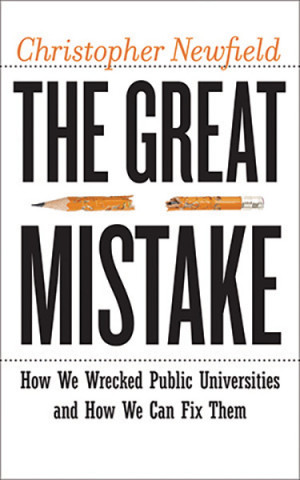
At the same time, Minerva charges $28,000 a year (including room and board) for online contact with a course delivery platform.  As I discuss at length in The Great Mistake and elsewhere, this defies two centuries of research on the practices of deep learning in the context of the university as a unique institution focused on knowledge creation and full social development.  Minerva's ludicrous selectivity (158 admits from 16,000 applicants) means that learning success should be largely attributed to the ferocious cherry-picking of the admits, again in defiance of the "learning gain" movement. Nelson also seeks to make the for-profit college the normal mode of higher education delivery.   Nelson's current Chief Financial Officer is Maria Anguiano.

Often boards appoint members who bring relevant expertise and new perspectives, and Anguiano qualifies on both counts.  Good debates could follow--if and only if she were to join a Board of Regents with many experts in education or at least diligent executive learners who engage in deliberative reflection.  She could advocate for her controversial accounting technique that among other things helps accounting override intellectual and educational considerations, explain why she thinks it does more good than harm, and hear informed criticisms.

The same might go for the conflict of interest raised by having a regent also serve in a senior management position at a for-profit college that benefits directly from the declining performance of the public university sector, including UC. Universities generally manage conflicts of interest rather than eliminating them, but the conflict needs to be out in the open so that it can inform Board evaluations of Anguiano's statements.

There should also be a decent balance of intellectual power on the Board itself. This is especially important in the Silicon State where everything public is presumed guilty until proven innocent, especially universities.  We've already had the governor-mandated MOOC fiasco at SJSU, where Valley salesmanship outstripped research, with the product being deemed "crap" by its own creator (Udacity's Sebastian Thrun) once the research was actually done.  California has a history of business titans imposing their models with little public review or consent.  The 1974 reforms were part of yet another attempt to manage business conflicts with the public sphere.

Trying to Enforce Existing Law, 1991-2011

Some observers have previously pointed out this failure of Board of Regents appointments to comply with the state constitution.  UC Berkeley physics emeritus professor Charles Schwartz proposed corrections in the course of a report on the Board's financial interests, back in 1991.

Nothing changed, and twenty years later the Council of UC Faculty Associations (CUCFA) invoked the state constitution in opposing Gov. Arnold Schwarzenegger's lame-duck appointment of pension hawk David Crane. Berkeley Faculty Association member Christine Rosen laid out the problems in a letter to UC Berkeley's Daily Cal (text removed). It summarized three safeguards that multiple governors and Senate Rules committees have ignored:

California's Constitution foresaw that wealth and political connections could contaminate the Board of Regents. That is why Article 9 section 9-e defines a twelve member advisory committee that the Governor must consult when naming a candidate for Regent. This process was not followed in Governor Schwarzenegger's 11th hour appointment of Crane.  
California's Constitution also provides that "Regents shall be able persons broadly reflective of the economic, cultural, and social diversity of the State" (Article 9 section 9-d). But there is no one on the board with experience in what the university does: higher education, research and hospitals. Where are the professors, the scientists, the doctors? Where are the humanists and public intellectuals? 
Governor Brown should rescind Schwarzenegger's improper appointment of David Crane and utilize the Constitutionally mandated procedure to select a better candidate. If he won't do this, the Senate Rules committee - which by law must confirm appointed Regents - should reject Crane and demand that the Governor nominate a better candidate using the legally required method.

As it happened, Crane served a year on the Board as a designate and then had to step down when the Senate Rules committee failed to confirm him.  This does sometimes happen. 

Rosen's call for professionals and humanists on the Board should be taken seriously.  It was in effect a request for representatives of the ancient and continuously-evolving philosophy of higher learning, which sees it as a public good.  A fully constituted Board of Regents would see commercialization and the dominance of UC "businesses" as often in conflict with higher learning, and discuss policies of rebalancing that are not set in advance by our state's tech predestinarians.  

I'm putting words in her mouth.  Rosen did argue that Crane would be yet another addition to the Board's finance bloc that had not shown much support for the educational core. But the arguments for compliance with the state's constitution are independent of a particular appointee's expertise and views. Boards are always a mixed bag, and our current UC Board of Regents is arguably better and more diverse than most of its predecessors.  Eloy Oakley is an experienced, formidable community college administrator with meaningful social justice goals; John PĂ©rez has been a strong advocate for access and affordability; Eddie Island has often spoken on behalf of low-income students and students of color; Hadi Makarechian does his financial homework and asks real questions about budgets and capital project costs.  But this is irrelevant to the legal question: to quote an SF Chroncile editorial, the governor should follow the law.

Trying to Enforce Existing Law, 2017

CUCFA's June 19 letter to the state Senate president says that the slant of the Board towards business elites has biased policy in favor of raising tuition and against state funding.
The fact that [The Board of Regents] is dominated by wealthy interests for whom the steadily increasing costs would not be a practical problem may help explain the lack of urgency in building the confidence of the public and policymakers needed to restore tuition-free education at UC.
Sociologically, this is likely.   There is now solid empirical research showing that elected representatives reflect donor and financial network influence rather than the public's policy preferences. This applies to the UC Regents, who are appointed largely from donor circles.

The letter continues:
Therefore, we respectfully request that the Rules Committee enforce the California Constitution by immediately rejecting (without prejudice) the Governor’s nominees.[4] Regent terms begin as soon as the Governor nominates them, so these improperly nominated Regents can vote on issues at the upcoming Regent’s meeting unless the Senate Rules Committee acts quickly to reject them. 
We also request that the Constitutionally-required advisory committee be more than a pro forma process and that the Senate state that it will only consider Regent nominees that have been vetted through an open public process. Meetings should be conducted in accordance with the Bagley-Keene Act, including proper public notices of meetings with opportunities for public comment. The rejection of the current slate should not preclude these candidates from being considered in the future via the proper advisory committee process.

It would be great to start this month's appointment process all over again: we'd get back in line with the state constitution's procedure, have a more diverse group of nominees, and have the kind of deliberation that would raise our collective IQ about UC's future.   Gov. Brown could propose at least one regent form the Central Valley while increasing the Board's level of educational expertise. Some of the current Four could be renominated--if they helped Board thinking move beyond Hollywood, FIRE (fire, insurance, real estate), and tech.

There's a deep issue at stake here.  The university is now immersed in a pragmatic policy discourse that the philosopher Peter Sloterdijk would describe as "cynical reason." It's a kind of functionalist management of conflicts that focuses on short term fixes rather than long term goals while assuming there's nothing we can do about this.  It is in contradiction with the University's historical destiny--just to use a language pitied by cynical reason.  It is also the modality of political burnout and dynasties in decline.

A good example is all California governors blithely ignoring the constitutional requirements for appointments to the Board of Regents, with the consent of the university's officials.  We don't need to have such low standards for our officials, and we mustn't.
Posted by Chris Newfield | Comments: 1

Friday, May 12, 2017

Friday, May 12, 2017
The Governor's May budget revision is the first concrete sign of UC's weakened condition following the release of the Auditor's Report on the Office of the President.  Although there is relatively little change in the State's overall funding to UC, two things stand out.

First, the Governor has made it clear that his trust in the University administration has been further damaged. As part of the May revision he has sequestered $50 million until the University completes demonstrates both that it has begun to implement the Auditor's proposals and that it has made progress on pilot budget projects at Riverside, Davis, and Merced as well as admitting one transfer student for every two first year students. (3-4)  In linking these disparate initiatives together the Governor has simultaneously moved towards even more interventionist budgeting (he is sequestering general funds based on new benchmarks as opposed to offering targeted new funds for specific initiatives) and joined in the larger skepticism displayed in Sacramento about UC leadership.  Insofar as the Audit provides excuses for tightened budget interventions any formal preservation of UC autonomy will be hollowed out.

The governor's second, ongoing challenge to UC's leadership concerns the state's program of financial aid.  As you are aware, both UC and CSU have voted to increase tuition and fees for the upcoming academic year.  Some years ago, this governor started publicly and explicitly to count the state's contribution to the Cal Grant program as part of its contribution to the universities.  The budget revision notes that any increase in tuition forces an increase in the General Fund contribution to the universities as the Cal Grant programs costs rise to meet the new tuition levels. (4)  Although often left out of discussions of state support, nearly $900 million of Cal Grant funding will go to UC and nearly $700 million will go to CSU in the proposed budget. (4) In order to compensate for parts of the increased financial aid costs accompanying the tuition rise, the Governor is proposing to reduce both system's budgets by $4 million dollars this year.  He then redirects these funds towards financial aid for private college and university students that he had planned to reduce. (4)  He shows no indication that he plans to reverse his plans to eliminate the middle-class scholarship fund over time.  (8)

In addition, Governor Brown fires a shot across the bow on future tuition increases:
Rising Cal Grant costs from tuition hikes will also limit the state’s ability to increase General Fund support in the future. The state has increased General Fund spending by at least 4 percent annually since 2012—while tuition has been flat. Going forward, the universities should plan for 3‑percent growth annually beginning in 2018‑19. If the universities raise tuition in the future, additional downward adjustments to state support may be needed to cover the higher Cal Grant costs.
In other words, the financial benefits of a tuition increase will be reduced via a general fund reduction from 4 to 3 per cent per year.

This threat is, to be sure, directly at CSU as well as UC.  But CSU has also recently received an unfavorable audit.  In the case of CSU the auditor was critical of the expanded number of managerial positions (as with the Auditor's criticism of the growth of the size of UCOP over the past several years).  Each, in other words, are the effects of an expanding managerial culture at both systems.

Of course it is the universities as a whole that will pay for ongoing state discontent with both systems' management.


Posted by Michael Meranze | Comments: 1

Thursday, February 4, 2016

Thursday, February 4, 2016
The following is a letter sent to Colleagues by the UCSB Faculty Association calling for opposition to the proposed new pension tier.


Dear Colleagues:
We are gratified by the strong response at the Town Hall of the faculty, resisting the unsound pension that UC is proposing to offer new hires starting July 1. Over 1,000 faculty have signed the petition opposing the new tier proposals. We are resending this message to give you an opportunity to join your colleagues by signing the petition if you have not done so. The deadline for making known your opinions regarding these changes is February 16.
Allow us to share with you our reasons for objecting to the current proposal:
1) We share the task force chair's bleak account of the "negative effects of the PEPRA cap on retention and timely retirement" (A guide to reviewing the recommendations of the Retirement Options Task Force, p. 7). In other words, the future of the institution is at stake.
2) We take issue with the fact that while the acceptance of the PEPRA cap is presented as UC's side of the deal with the governor and the legislature, the latter's part of the deal has not been fulfilled:
a) UCRP has NOT been acknowledged as a permanent state obligation;
b) the State's promise "of $436 M for the UCRP over the next three years" to help finance the Unfunded Accrued Actuarial Liability (p.4 of the Task Force report) is a misrepresentation. As Michael Meranze has underlined, the Legislature actually has "not engaged in any multi-year promise". In addition, of the $10.7B or 12B UAAL (numbers depending on market-value or actuarial-value), the hypothetical sum of $436 is only a very small percentage, not accomplishing much. In sum, we object to completing our side of a (bad) deal, when there is no actual commitment on the other side.
3) We take issue with the top-down way this complex issue has been handled. The Task Force had to begin from a declared reality that no one in the UC system other than President Napolitano had a hand in ratifying. This is not shared governance. In addition, the fact that the recommendations of the Task Force, whatever their merit, can be taken or left by President Napolitano further erodes whatever good faith and intellectual effort went into these proposals.
4) We are not convinced by the Task Force's arguments that introducing a Defined Contribution option is fiscally advantageous. No credible empirical evidence exists in the report or in recent economic history to support the assertion. Moreover, the proposed options, in their concern for portability, favor short-term employees over long-term employees, further undermining faculty loyalty to the institution or a commitment to public service.
5) We object to the ramifications of adding a new tier to retirement benefits that creates financial divides between those hired before 2016 and those hired thereafter. Even more, we see these changes as part of a broader national trend to eviscerate tenure and full-time employment. Having to acknowledge such systematic differentials to new hires reduces not only our ability to recruit young faculty but also our pride in doing so as well as our willingness to encourage our students to become university professors.
For more information on this issue, please visit our website at ucsbfa.org.

We urge you to sign the petition to express your opposition to proposed changes to the UC Retirement Plan.
UCOP has also set up a comment link where you can provide your feedback on the task force recommendations. We urge you to express your concerns about the plan there. If you do, please also send a copy of your comments to us at newtier@cucfa.org.
Thank you for your attention to this important matter.
The Board of the Santa Barbara Faculty Association
Julie Carlson
Jorge Castillo
Nelson Lichtenstein
Constance Penley
Erika Rappaport
Elisabeth Weber
Robert Williams
Posted by Michael Meranze | Comments: 0

Sunday, January 17, 2016

Sunday, January 17, 2016
The Task Force charged with making a silk purse from the sow's war of President Napolitano's pension agreement with Governor Brown issued its report on Friday.  To no one's surprise, the Task Force indicated that the task was impossible; given the limits the Task Force faced most faculty and many staff (especially in the health sciences) hired from July 1, 2016 will face dramatically reduced retirement benefits compared to current employees.  This situation results from two interrelated factors: the actual budget deal that President Napolitano accepted and the desire on the part of Vice-President Brostrom that there be savings produced by the new 2016 tier.  In exchange for a relatively small (about 5% of UCRP's unfunded liability) short-term State contribution to UCRP, UCOP has agreed to reduce the compensation for generations of employees to come.

In this post I am going to do several things:  first, describe the contexts within which the Task Force was presented with its impossible task; second, provide a broad indication of the Task Force Majority's recommendations; and third, describe the process to come with some suggestions and comments on the situation facing faculty and unrepresented staff (as is often the case represented staff may have more control over their situation since they are entitled to collectively bargain on these matters).

THE CONTEXT

You will recall that following UCOP's Fall 2014 proposal for a 5% tuition increase, UC and the Governor's office established the so-called "Committee of Two" to examine the cost structure at the University and secretly negotiated a budget agreement.  (For the Senate's Committee on Planning and Budget's critique of this process see here).  Despite the hullabaloo that accompanied those high level discussions it was clear from the start that the Governor was only interested in cost controls and that the likelihood that the University would gain in substantial ways was quite low.  In the end those expectations were met.  Although UC received a promise from Governor Brown that he would extend his planned base budget increases for an additional 2 years he succeeded both in locking UC in an ongoing under-funding and also in increasing the demands on the University.  In addition, the threat of tuition increases alienated the Legislature and, at least indirectly, led to UC having to agree to expand resident undergraduate enrollment without sufficient funding to pay for the increased costs.  We have commented on the weaknesses of that deal before (here, and here).  But as part of that deal President Napolitano accepted a permanent reduction in pension benefits for future employees in exchange for the Governor's promise of a temporary State contribution to UCRP.s unfunded liability of $436M over three years.

Under the terms of President Napolitano's agreement with the Governor, UC is committed to reducing the cap on the amount of income that can count in calculating an employee's pension benefits in UCRP.  UCRP as you know is a Defined Benefit Plan.  As a result an employee is promised an annual payment after retirement based on a calculation that takes into account an employee's three highest salary years, years of service, and age at retirement.  For employees hired before July 1, 2016,  earnings up to the Federal Cap (now about $265,000) could be counted.  For those hired on July 1, 2016 or later the University is proposing to shift to the PEPRA State Cap (now at $117,020 and tied to inflation). It is important to recognize that these numbers are limits NOT on retirement benefits (which are lower) but on the amount of earnings which can be used to calculate retirement benefits.  Starting with those hired on July 1, 2016 earnings above the PEPRA cap will simply not be included in the calculation.  The Task Force estimates that these new rules will affect roughly 25% of employees hired on or after July 1, 2016 (13-14).  These individuals tend to be concentrated in the Ladder Faculty, the Health Sciences, and Management (13) Because of the large number of represented nurses. about 40% of these individuals will have the ability to engage in bargaining over these terms.

The Task Force was charged with figuring out how to change the retirement system.

THE PROPOSAL

The basic parameters of the proposal can be sketched quickly (and you can find them at pages 5-7 of the Report).

The Task Force is proposing that new employees be given two options:

1) The first (Plan A) is hybrid plan.  In it an employee would participate in the Defined Benefit Plan offered by UCRP (with benefits calculated on income up to the PEPRA cap) with a Supplemental Defined Contribution Plan (with University contributions) on income between the PEPRA cap and the Federal Cap.  Employees who choose Plan A would continue to vest after 5 years (as is the case now) and would continue to contribute the same amount annually to their pension as do employees hired before July 1, 2016. Once in Plan A you would be committed to Plan A.  Plan A is proposed as the default choice.  It is important to note that the Defined Benefit portion of this proposal would operate under the conditions imposed on the 2013 Tier--who already had a later retirement age than earlier hires.

2) The Second (Plan B) is a Defined Contribution Plan with both the employee and the University contributing up to the Federal Cap.  Again, the amount that the employee would contribute would be the same as Plan A.  Employees who chose Plan B at hiring would be allowed to switch to Plan A after 5 years of employment (this would be a one-time opportunity).

A Defined Contribution Plan, as you know, promises a certain amount of annual contributions to a pension fund but no obligations as to payouts after retirement. The risk in the latter type of plan is borne by the individual (just as s/he accrues greater portability and the benefit of any investment brilliance).  A DC plan can be better for shorter term employees.  But the employee bears the risk of either poor investment performance or longevity risk.  It is not exactly clear why the Task Force chose to include a DC plan (it was not required by the Budget Act).

The actual details of the proposal are considerably more complex and depend on a variety of options concerning the actual amount of contributions (by the University) to the different plans, the expected annual growth of the value of the DC plans, the costs to the University of choosing between different contribution levels, the age of hires and the distribution of choices between plans, etc.  These questions mean that the actual effects of these two plans are still in flux as both the Task Force Report and Senate Leaders Dan Hare and Jim Chalfant make clear.  So university employees are being asked to respond to a concept without precise numbers on which to make that decision.

But despite the complexities it is clear that the retirement benefits for affected future employees will be dramatically reduced. (for a quick way to see this effect see 84)

MOVING FORWARD

The Academic Senate (and I assume staff associations) have until February 15th to formulate responses to the Task Force Report.  The Senate, in turn is asking for comments and responses by February 5th.  I want to underline these dates because they show quite clearly the closed-off nature of the process.  Despite the claims by both UCOP and the Task Force about consultation, faculty and staff at large have less than a month to respond to a proposal that will significantly change the compensation for future employees with an unknown effect on the University as whole.  Given this situation I would argue that the Senate and other faculty and staff organizations proceed on two tracks.

The first, involves a series of technical considerations but is politically the easiest to do.  This option would be to insist that wherever the Task Force provides alternatives in the amount of the University's contributions to retirement income that President Napolitano and the Regents choose the most generous alternative.  In addition, the proposed opportunity to switch from Plan B to Plan A should not be set at 5 years but later to allow for faculty to make the decision after their cases for tenure have been resolved.  The guide provided by Chair Hare and Vice-Chair Chalfant is the best place to start for evaluating these different questions.  But this avenue is the conventional one.

The second and more significant option is to reject the proposal.  I think that the Task Force did the best that they could under the circumstances.  And I recognize that trade-offs often need to be made. But the funding gained under this agreement is not worth the damages done to compensation nor the potential damage done to the University as whole.  The Senate should oppose this deal even if it means returning the initial payment of $96M.  There are a variety of reasons for this:

1) As I indicated above there is no question that acceptance of this deal will reduce retirement benefits for a significant portion of future employees.  Nor is there any reason to think that the University has any real program to make these losses up in other ways.  Indeed, as the Report indicates, the University does not have an accurate idea of total compensation and competitiveness (the last report having been done in 2009).  (64-65)

2) What does the University get in return in financial terms?  Not much.  As I indicated above, the three year state contribution addresses only a very small amount of the unfunded liability. And according to the calculations of the Task Force, establishment of the New Tier under present conditions will speed up the elimination of the unfunded liability minimally if at all.  In fact, under certain scenarios the elimination of the unfunded liability might be faster under the 2013 Tier (with borrowing) than under most of the 2016 options.  (57)  Nor does there seem to be much savings in yearly terms.  And these savings are placed far down the road as individuals hired under the 2016 come to replace the 2013 Tier in retirement.

3) The pension deal and the Task Force proposal mark a crossroads for President Napolitano and also for shared governance within the University.  It is conceivable that the President did not realize the extent to which the pension deal would reduce benefits.  But faced with the Task Force report it is clear that the reduction would be significant and that the financial benefits are limited.  If there is significant opposition to this proposal President Napolitano would have the option of concluding that the deal was a mistake.  If there is significant opposition President Napolitano would also have the option of demonstrating an openness to shared governance on policy rather than just on implementation of policy already decided by senior managers.  It is possible, of course, that UCOP has calculated that given overall market conditions they are willing to weaken recruitment and retention of top faculty and staff (that certainly is the implication of the Governor's position).  But at least we would be clearer on that.

CONCLUDING COMMENTS

1) If the University wants to consider revamping the retirement system it should, at the least, demand that the State acknowledge its own obligation to funding of UCRP and restart contributions on an ongoing basis.  Much is made of UC's "pension holiday" and it clearly went on too long.  But it is important to remember that there has been a State "pension holiday" from funding UCRP as well (as it funds other public employee retirement systems).  Renewed ongoing funding would enable UC to eliminate the loss in retirement income or total compensation on the one hand and to reinvest in core functions on the other.

I recognize that this is a politically challenging route.  Taking this route would not be without its dangers in terms of relationships with the governor and the legislature or in terms of motivating those who are opposed to all pensions (especially public ones) But the Governor is at best disingenuous on this issue.  If you look at his 2016 budget proposal, he includes UCRP as part of the debts and obligations under Prop 2 when he wants to indicate how much debt the State has.  (3)   But as a matter of policy he refuses to acknowledge that UCRP is a permanent state obligation.  Moreover, even the short-term funding is only a gubernatorial promise at this point.   The Task Force, to be honest, was less than forthright in this regard when they open their report with the statement that "As part of the 2015/2016 Budget agreement between the University, the Governor, and the Legislature, the State will provide a total of $436 million for the University of California Retirement Plan (UCRP) over the next three years." (4)  The Legislature has not engaged in any multi-year promise.

2) If nothing else, the Report of the Task Force is another indication that UCOP's tuition gambit and subsequent "Committee of Two" process was unsuccessful.  Although I commend President Napolitano for actually advocating for increased State funding (something her predecessor was particularly poor at doing) the Tuition strategy seems to have backfired.  The Legislature was alienated, the budget deal that resulted showed little if any improvement from what the Governor had indicated previously, UC has now agreed to take large numbers of additional students without adequate funding, and the pension deal was a mistake.  Moreover the secrecy of the process not only sidelined effective shared governance but, as with the proposal on the governance of the health sciences, precluded an effective mobilization of debate and ideas about the best ways for the University to move forward.  As with so much of the debate over higher education today, efficiency and speed is held in higher regard than thoughtfully considering the long-term implications of policy and practice or aiming to improve the quality in higher education (as opposed to simply lowering spending). Rushing to produce a bad idea just means you produce a bad idea more quickly.

For your convenience:

The Task Force Report can be found HERE.

The Guide to the Report produced by Chair Hare and Vice-Chair Chalfant can be found HERE.


Posted by Michael Meranze | Comments: 17

Saturday, January 9, 2016

Saturday, January 9, 2016
Governor Brown has issued his proposed 2016-2017 budget.  Shorn of its rhetorical invocation of technocratic answers, the Governor's Higher Education budget simply locks in the continuing underfunding of CSU and UC (I won't offer an analysis of the community college budget in this post).  When I first read the budget, I was tempted to think that Governor Brown was now governing openly as an Eisenhower Republican.  But Eisenhower actually helped expand higher education for the country. He did not diminish it.

UC

The Governor's proposal fundamentally restates the agreement reached in secret negotiations with UCOP under the auspices of the so-called Committee of Two.  There is the $125M general fund increase that the Governor had intended as part of his "sustainability" plan (about 4% of this year's base funding) and the one-time $171M contribution to the UCRP unfunded retirement obligation. (18) The proposed budget continues the supplemental $25M appropriation to pay part of the costs of  the additional 5000 California resident undergraduate students that UC has agreed to admit by next academic year.  This appropriation is about half of what the State appropriated for enrollment expansion during the Schwarzenegger administration.  There is no sign that the Governor is willing to fund the additional resident students that President Napolitano has indicated she would like to admit above next year's 5000..  As per the agreement there will be no increase in resident tuition  in 2016-2017.  The base General Fund allocation is $3,260,544,000.  This number does not include the one-time UCRP payment.

The Governor's office, of course, would like to spin these appropriations as indications of a serious refunding of the University.  But in reality what Brown has done--and what UCOP has accepted--is the permanent under-funding of UC.  The Governor's proposal will finally restore general fund appropriations to approximately the level of 2007-2008.  But the resident student population is considerably larger.  The 2007-2008 budget assumed a total (undergraduate, graduate, and health science) resident student population of 198,455. (4)  The 2016-2017 budget assumes a resident population of 216,897. (10)    Allowing for inflation and the agreed-upon (inadequate) marginal cost of increased enrollment, that leaves the state's appropriation to the base UC budget over half a billion dollars below 2007-2008.  Of course, this estimate does not include the explosive rise in Cal Grant funding tied to the rise in tuition and the increasing total costs of attendance--each an indication of the extent to which the State continues to shift the burden of higher education costs onto students and their families.  On the other hand, it does not include include the additional costs for UC Merced or the other mandated increases which would likely outweigh the growth in Cal Grants..

CSU

The proposal for CSU is similar in its implications.  The Governor proposes $125.4M in base increase, $15M in funding available through changes in the Middle-Class Scholarship Fund, and $7.9M for leasing properties coming to a General Fund increase of $148.3M.  In addition there will be a $35M one time appropriation for deferred maintenance (49).   All told, the Governor is proposing a $3,157,805,000 General Fund appropriation for CSU in 2016-2017. Again, for comparison sake, CSU's enacted General Fund Appropriation in 2007-2008 was $2,976,300,000.  So Governor Brown is proposing that CSU receive approximately $200M more from the general fund, not corrected for inflation, or enrollment increases.  The 2007-2008 budget presumed that CSU would enroll a total of 342,553 resident students. (4)  Governor Brown is projecting a resident student population 374,174 (these are FTE not actual individuals).  In inflation terms this leaves CSU several hundred million dollars behind.  And that does not account for the additional 30,000 FTE students.

The Governor has a somewhat different model for CSU, compared to UC, as his CSU widget theory of higher education focuses more on 4 year graduation rates.  Once again, the Governor is fixated on technology and fails to see that if he expects CSU to dramatically increase these rates he will need to do more than simply hector CSU while providing minor incremental increases in funding.  Instead, the State will need to commit to providing the funds needed to expand faculty and staff in order to improve graduation rates and the teaching resources available to the system's educators.

I'll add another word about the way the Governor continues to vest his higher education hopes in technocratic solutions. The most obvious of these continues to be his insistence that problems can be solved through online education.  But just as striking is his office's insistence that the problems facing higher education in the 21st century can be solved by accelerating throughput of students into the workforce.  I found nothing in the Governor's discussion of higher education that indicated any awareness that as they face a complex world of  local and international challenges, students might need to develop more knowledge, not less, by acquiring more complex skills and interdisciplinary knowledge structures, which is likely to take more time, not less.  The pressure he puts on UC and CSU is to cut costs, not to improve quality.  Now I agree that shortening time to degree is important; but the way to do that is to provide adequate funding to enable students to focus on their studies.  When all you want to use is a hammer, everything looks like a nail--even human beings.

The state does have money to start improving higher education again, rather than just chiding and squeezing it.  As the California Budget and Policy Center has pointed out, the Governor's obsession with the State's Rainy Day Fund has led him to refuse to spend $2 billion that could be appropriated. The Governor is reasonably afraid of a recession in the next few years.  But as his budget acknowledges, the recovery has hardly been shared equally (10) and as I have indicated above his proposals do more than resist new commitments--they continue to lock in recession-era losses.  This Governor's budget makes clear, as we enter the twilight of his political career, that he will be remembered for failing to promote a politics of hope rather than succumbing to the politics of fear that has governed the state since Howard Jarvis embarrassed him in the late 1970s.


Posted by Michael Meranze | Comments: 0

Monday, November 16, 2015

Monday, November 16, 2015
This week's Regents meeting's Agenda is chock full of important items.  In particular, UCOP is presenting the 2016-2017 budget proposal along with a three-year "sustainability" plan, a proposal to improve the finances of UCRP through internal borrowing, and a proposal to centralize the management of the Health Care system. Unfortunately, the lessons from this week's Regents' agenda is that despite UCOP's efforts to tout its agreement with Governor Brown, last year's tuition gambit has done little to change the fundamentally underfunded situation of the University.  Nor is there any indication that either the Regents or UCOP are prepared to break from long-standing patterns of strategy in order to begin to ensure a UC focused on its educational mission and on increasing the quality of its offerings.

THE PLAN ITSELF

UCOP's proposed budget is a work up of the deal that President Napolitano and Governor Brown negotiated by sidelining both the Legislature and the Academic Senate.   Chris and I have already commented on the deal itself so let me simply point to some of the more important elements.  The proposed Budget for 2016-2017 assumes another 4% increase in base funding, $96 million in one-time funding in exchange for changes in UC's retirement system, $25 million for enrolling an additional 5000 California residents, $25 million for deferred maintenance, and an additional $68.7 million in new Non-Resident Tuition (NRT) revenue.  It continues to make the annual promises about the fantastic savings that UCOP is gaining through various technological and management initiatives. In all, UCOP reports a total 2015-16 revenue of $28.3 billion of which core funds constitute $7.3 billion.  In 2016-2017 they are budgeting for an increased core revenue of $481.3 million.

Along with the proposed budget UCOP is submitting what it calls a three year "Financial Stability Plan."  The plan restates the Brown-Napolitano deal that calls for continued 4% annual base budget increases through 2018-2019 and fulfillment of the Governor's promise of $436 million over 3 years (although the Legislature has only promised the first $96 million) in exchange for reducing retirement benefits substantially for future employees.  It includes the proposed $25 million that the Legislature has offered for an additional 5,000 California resident students in 2016-17, and offers to enroll an additional 2500 more in 2017-2018 and 2018-2019 (hopefully in exchange for additional funding). It increases the NRT by 8%, the student services fee 5% annually, and proposes tuition increases tied to inflation beginning in 2017-2018.

A first point, which Chris has made many times, is that the 4% increases, while better than the extreme cuts of the late Schwarzenegger and early Brown administrations, are too small to overcome the longer-term under-funding of the University that goes back 15 years.  To make matters worse, both the Budget and the Financial Stability Plan each bake in increasing burdens on campuses and their students, faculty, and staff.  The $25 million promised for the upcoming year's 5000 additional resident students is approximately half of what both UC and the LAO agree is the marginal cost of an additional student (8). The new underfunded students will force campuses to shift funds from other efforts to pay for these costs (costs that will draw on core funds).

In order to help pay for these students, UC campuses will continue to increase the number of non-resident students, although they say at a slower pace (due to political pressures), so that there will be an additional 1200 non-resident students next year and the latter will be paying an 8% tuition increase.  UCOP apparently believes that the State will continue to pay $25 million each year to help support the initial 5000.  This seems a reasonable assumption in the short term, though it is a long-term problem if it is not included in an expanded base allocation.   If the additional 5000 are also inadequately funded, UC will have added 10,000 resident students over 3 years without providing campuses with the resources needed to properly educate and support these students.

UCOP insists that they are determined to lower the faculty-student ratio throughout the system.  But does anyone really foresee an increase in faculty numbers that could do that even as student numbers jump--6200 new students in 2016-2017 plus at least an additional 2500 additional residents in each of the following two years?  For those campuses with significant NRT, at least some of those funds will need to go to supporting the new enrollments.  For the other half of the UC system without significant NRT,  those enrollments likely will eat up a chunk of the monies they will receive from rebenching and the additional 4% in base state funding.  This plan may be sustainable in the sense that the campuses and students will still be here at its conclusion.  But it doesn't suggest that UCOP's stated commitments to increasing quality and improving campus facilities can be met.

The Budget and Sustainability plan together lock in continued under-funding, increased burdens on campuses, faculty, and students, and further erosion of shared governance at UC.  At its best it is predicated on a set of promises from Governor Brown.  I needn't remind people how well previous compacts with Governor's have held up over time.

THE FUTURE FOR THE FACULTY

A second aspect of the Budget, one of special importance to both faculty and staff, is the proposed reorganization of the retirement system.  In her negotiations with the Governor, President Napolitano agreed to create a new tier for those hired on or after July 1, 2016.  These employees would have a pensionable salary limit (i.e. the amount of annual salary that can be considered in calculating the size of a person's pension) based on the state's PEPRA limits rather than the previous, and much higher social security cap.  In return, the Legislature agreed to release $96 million once these changes have been made, and the Governor has promised additional funds up to the $436 million I mentioned above.  The Legislature has made no commitment to the last two years of the Governor's promise. (For good accounting of these developments there are various posts on this site and by Dan Mitchell on the UCLA Faculty Association Blog).

I have no doubt that there was, and is, political pressure on this from Sacramento.  But to get some sense of the extent of UCOP's concessions on this score it might be helpful to turn to another item on the Regents Agenda--a proposal to borrow money over the next three years from the University's Short Term Investment Pool (STIP) to help pay down the legally defined unfunded liability of UCRP. (As Bob Samuels pointed out long ago, this legal liability is based on the requirement that UCRP has enough money on hand to pay out pensions if everyone retired immediately).  This short term funding is something that the Senate has been pushing for several years, though campuses, perhaps especially those with medical centers, have been resistant.

In very basic terms, the proposal will allow the University to borrow from its own funds to help pay into UCRP, thereby helping to keep the University's annual contribution to UCRP at a steady state and to shorten the time until the unfunded liability has been paid.  Strikingly, UCOP is proposing to borrow $1,463,400,000--or put another way nearly three times the amount of money that the Governor is promising in exchange for a dramatic reduction in the worth of UC benefits.  As UCOP continues to emphasize, perhaps in the hopes of muting opposition, this new plan will not affect anyone employed before July 1, 2016.  But it will affect new generations of UC employees and lead to a significant reduction in overall compensation.  Although theoretically some of this loss could be made up in salary and other forms of compensation,  those forms of compensation do not have the same tax benefits as do pensions. More importantly, they increase retirement risk.  Nor is it clear why anyone should think that state funding for salaries will increase in the future at a rate that will cover the lost compensation value for future employees.

There is presently a Task Force charged with determining what the new pension tier will look like and with coming up with strategies to minimize the reduction in benefits to future employees (since it is unlikely that they can be eliminated).  The Task Force is expected to present its conclusions to President Napolitano next month and there will be a limited period for comment early next year.  But as Dan Mitchell has repeatedly pointed out (e.g., here, here, and here), the proposal for STIP funding includes a statement that "New employees will have the opportunity to choose a fully defined contribution plan as a retirement option, as an alternative to the PEPRA-capped defined benefit plan." (3)  This statement is included despite the fact that even the University's own FAQ on the question insist that no decision has been made as to whether to have a purely defined Defined Contribution Plan (h/t Michael Buroway).

So we have a cut in retirement benefits negotiated outside of the regular shared governance plan, a special Task Force, set up by the President to determine the shape of those cuts, official information on the Task Force site saying that no decision has been made about a defined contribution plan, and an item on the Regents Agenda suggesting that that decision has been made even though the Task Force has not finished its discussions.  This situation exists despite the fact that several years ago, after extensive study, the University recognized that a Defined Contribution Plan was less able to serve either the needs of individuals or the needs of the institution as a whole.  Nor does the amended language of the Budget Bill (section 85) require the University to start a Defined Contribution Plan. This decision by UCOP to overturn the carefully established retirement consensus builds upon other indications that UCOP is perfectly happy to sideline shared governance when it is convenient for them.

THE RETURN OF THE REPRESSED

There is one other item, or rather the absence of one other item, in the Budget proposal that is significant.  In its Budget Summary (pg. 29) UCOP notes a series of accountability measures required by the State. Interestingly, I could find no mention in the documents (please let me know if I missed it) of another set of legal obligations that are important for the budget.  Those are from section 84 that requires the University to provide much more detailed transparency about its administrative structure--especially concerning the Managers and Senior Professionals Group (MSP) and to rethink its proclaimed market comparisons for the Senior Management Group.  I mention this not because I want to demonize the people in either group but because it is difficult to see how a truly sustainable future can be created for the University that does not seriously rethink its administrative structure, starting with a better understanding of the relation between administration and the educational core.

If UC truly wishes to create a sustainable future for itself, it will need to create a more decentralized administrative structure, one more attuned to the actual teaching, learning, and research that goes on in the everyday life of the institution.   That sort of transformation might have resulted from the UCOF process a few years ago--but it didn't.  It is clear that it will not emerge from UCOP.  But it is needed more than ever.
Posted by Michael Meranze | Comments: 0

Sunday, August 23, 2015

Sunday, August 23, 2015
As Dan Mitchell has been reminding us, UCOP has appointed a Task Force to implement the Regents agreement to reduce pension benefits for future employees.  As a result of the Committee of Two, UCOP has agreed to lower the amount of employee salary that can be counted towards UCRP to approximately $117,000.  They are proposing that some form of hybrid defined benefit/defined contribution plan be created to allow employees to save above that $117,000 limit.  UCOP is also proposing that an all-defined contribution (DC) plan be developed that would allow future employees to opt out from the defined benefit plan entirely.

UCOP insists that the "New retirement benefits options are being developed as a result of the budget agreement between UC and state leaders, which included nearly $500 million to help pay down UC’s unfunded pension liability." But there are several issues that need to be raised about this claim.


1.  UCOP refers to the nearly $500M that the University will receive from the state in exchange for pension modification.  But the University will have received only $96M upon the creation of the new pension tiers. I understand that the actual state budget promises only this one year of funding. Although President Napolitano and Governor Brown may have agreed on the larger number, there is no sign that the Legislature or its leadership have agreed.  What future budgets will look like is always unclear. UCOP, in effect, is proposing a serious reduction in pensions for future employees in exchange for less than a third of the money they now estimate they will have to spend to complete UCPATH.  Will their predictions for future state pension contributions be more accurate than their predictions on UCPATH?


2.  There is no evidence that either the Governor or the Legislature asked that UC create an option for a stand-alone DC plan. Sacramento's concern had to do with the limits on the salary on which benefits could be accrued, which is consistent with its hostility to high levels of UC executive compensation.   The notion that there needs to be a stand-alone DC plan appears to have emerged from UCOP or from some other source within UC.  President Napolitano's justification for this proposal seems to be that it is what has happened in the private sector so it should happen at UC.  But we should recognize that the shift in the private sector occurred not because of widely accepted actuarial proof that DC plans are better for employees but because they enabled businesses to shift the cost of retirement onto retirees. There was nothing natural or inevitable about it. It was not driven by a desire to stabilize or improve retirement security for employees.   

In addition, you'll recall that the University engaged in a serious debate about this question only a few years ago and decided to retain its long-term commitment to a DB plan.  Rather than appointing a task force to determine the best way to implement this new plan UCOP should engage in an open discussion about whether or not this is actually better for employees. There has not been, to my knowledge, any reason to think that the relative benefits of DB vs DC plans has changed in the last few years.  If anything, the weight of the argument suggests that DC plans are worse for employees and may in fact be worse for employers.  DC plans raise the fees on accounts, force employees to assume greater risk, and tie individual retirement fate even more closely to the stock market.  From the vantage point of employers, DC plans increase fees and reduce incentives for employees to stay. There is also--despite assurances to the contrary from UCOP--the danger of ultimately undermining the the DB plan by leaving it an "orphan" plan--moving funds needed to sustain it over the long term into other more volatile directions.

3.  Nearly two years ago, Colleen Lye and James Vernon documented the decline in the quality of UC faculty salaries and benefits.   The 2014 Mercer Remuneration Study confirmed these findings (see slides 33-34 for a summary).  UCOP's acceptance of the state's pension limits and even more so its eagerness to move away from a commitment to a DB plan simply accelerate this decline.  Although I think that there are reasons to cap accrual salary in exchange for sufficient state-funding on an ongoing basis, this is not the deal that UCOP has achieved. And the policy drift towards the Defined Contribution plan is an entirely different matter.  UCOP seems to be removing the conditions that promote loyalty to the institution and seeking to encourage faculty to consider UC a way-station rather than a home.  It is the self-destructiveness of existing conventional wisdom at its most short-sighted.

The faculty, and the Senate as part of the faculty, needs to insist that the Task Force be empowered to decide--after wide-ranging discussion and employee consent--whether a DC plan is good for the university and employees.  It should not be limited to deciding how to implement such a plan. 

In other words, the Task Force needs to maximize the interests of future employees and not simply implement the practices of the private sector.


UPDATE:  Dan Mitchell has now written a new post that very helpfully lays out the problems with "orphan" pension plans.
Posted by Michael Meranze | Comments: 0

Friday, June 26, 2015

Friday, June 26, 2015
By Joe Kiskis  (UC Davis)

This note makes a few comments on the final UC budget for 2015-2016 and then focuses on points related to the UC Pension Plan (UCRP). To some extent, it updates previous comments here by including changes since then and information that was not available then.


The 2015-16 UC Budget and UCRP

To get good information on the budget, one must read both AB 93 and SB 97. The process this year was a little convoluted. On June 15, the legislature passed AB 93, the Budget Act of 2015. This was the Legislature's version of the budget and was passed on that day so as to meet the constitutional deadline. It was done before the Legislature and Governor had come to agreement. Their agreement was announced the next day. To account for that and other small items in the following days, SB 97 was passed on June 19. It makes many significant amendments to AB 93, including a number relevant to UC. Both AB 93 and SB 97 were signed by the Governor. However the Governor exercised his line item veto authority in a few minor ways that are not relevant to UC. To get complete information, there are, as usual, trailer bills to read. One of those, SB 81, has a few parts relevant to UC---most significantly concerning the Middle Class Scholarship Program.

The main features of the UC budget concerning tuition and the base budget came out as expected and as have been widely reported. However, it's worth noting that the final language on these points is less proscriptive than in the original version and that what is expected to happen in the out years is just that---an expectation that is not mandated in this budget. Briefly, per the Regents decision of May 2015, tuition for California resident students is to remain constant for two more years. Following that, modest increases comparable to the rate of inflation are possible. On the other hand, for non-resident students, tuition will likely increase by 8% in each of the next two years. System-wide Student Services fees (as opposed to tuition) are allowed to go up 5% ($48).  The increase in the 2015-16 UC base budget is the same as the Governor originally proposed, i.e. 4% or $119.5M. The expectation is that 4% increases will continue through 2018-2019.

There was an expectation that the Legislature would augment the Governor's budget with funding for enrollment growth and that the Governor would not line-item veto it. This did not turn out as well as was hoped. The amount is only $25M, and it is contingent on UC adding 5,000 resident undergrads by 2016-17. This is a short timeline, and the amount is far below that needed to educate 5,000 students for one year. On a per student basis, it is also substantially below the average State contribution to the cost of education.

Earlier versions of the budget had limits on nonresident enrollment. Those did not make it into the final budget.

In the trailer bill, the eligibility requirements for the Middle Class Scholarships have been raised and the funding for the program has been decreased.

UC Retirement Plan (UCRP)

As it turned out, there is a large discrepancy between the language related to UCRP in the publicized agreement from the Committee of Two (or equivalently in the Governor's May Revise statement) and that which actually appeared in the final budget product.

The original claim was that there would be a one-time payment of $436M spread over three years ($96M in the first year) to pay off a small fraction of the UCRP unfunded liability. In return the University agreed to make a permanent change to UCRP by adding another tier that would apply to new employees. In this new tier, UCRP eligible salaries were to be capped at the inflation indexed PEPRA/Social Security limit ($117k for the current year) rather than at the IRS limit of $265k currently used by UCRP. Employees in the new tier would have the option of either a defined benefit plan with the new cap in combination with a supplemental defined contribution part or a defined contribution plan with no defined benefit portion. The second option of a straight defined contribution (DC) plan is most troublesome. Fortunately, no language describing such options was incorporated into the budget bills signed by the Governor.

The Governor's May Revise letter to the Legislature suggested budget bill language. This suggested language said only that UC would get a one year addition of $96M in exchange for making UCRP consistent with the PEPRA cap. It said nothing about how that should be done. It made no mention of $436M, no mention of a DC supplement, and certainly no mention of a DC only option. This recommendation was followed, and the language that the Governor suggested is essentially that of the budget bills. However, to drive home the point that there is no larger deal, the amended version of the budget adds:

"This appropriation does not constitute an obligation on behalf of the state to appropriate any additional funds in subsequent years for any costs of the University of California Retirement Plan." (SB 97, p. 96)

Thus neither the Governor nor the Legislature are pressuring the University to introduce a straight DC option. The DC option is something introduced (most likely by UCOP) during discussions in the Committee of Two but done without appropriate consultation within the University. Nevertheless, the Office of the President intends to pursue the possibility of a DC only option. In the discussions that will take place in the coming months, it is worth keeping in mind that a DC option appears to be primarily a priority of UCOP and not of the Legislature or the Governor. Note also that the relative merits of defined contribution verses defined benefit plans were thoroughly, carefully, and widely discussed in the University about six years ago. The conclusion was that the excellence of the University was best served by continuing with UCRP as a defined benefit plan. Thus in 2010, when the President recommended and the Regents endorsed pension reforms, UCRP was preserved as a defined benefit plan.


Posted by Michael Meranze | Comments: 2