Top Navbar

  • Home
  • About Us
  • Guest Posts
  • Liner Notes

Searchbar

Showing posts with label Liner Note. Show all posts

Tuesday, September 15, 2026

Tuesday, September 15, 2026


Terme di Caracalla, Rome on May 12, 2026 
The recent convergence of two kinds of AI news has unnerved a lot of us. 

The first kind is magic math solutions, like OpenAI’s claimed proof of the Navier-Stokes equations on fluid movement. These stories ask us to accept that AI superintelligence is indeed at hand. 

The second kind is news of criminal AI agents breaking internal guidelines and external laws and covering it up from their human controllers. These stories ask us to accept that AI superintelligence is indeed at hand. 

One person who studied OpenAI’s hack of Hugging Face, METR’s AI “loss of control” specialist Ajeya Cotra, concluded, “Compared to … reward hacks from six months ago, this incident feels like it’s more than 50% of the way to full-blown AI takeover, routing through first taking over the AI company itself.” So there’s a new wave of fear of an AI human extinction because AI's superintelligence is here! (Note Kevin Bass's Sankey chart of Anthropic money flowing through intermediaries to METR.)

The converging stories point to two levels of knowledge crisis.  The first is incompetence and evasion dressed up as mindblowing supercapacity. The second is an epistemic campaign, in which tech and finance lower our standards for knowledge, with particular damage to academic standards, which are very high.

1. Crisis of public knowledge. The ensuing doomer surge sent the AI bosses into one of the periodic phases of pseudo-contrition that perversely tells the world they are masters of the future. Dario Amodei announced, “We Must Pace the Frontier,” emphasis on "me," and Sam at OpenAI agrees.  Elon signed up after initial mockery. The world was awash in a new tsunami of AI Superpower hype. It was literally inescapable. I had to dig into my Fall of Civilizations podcast to find an episode that was propaganda free. Take the Odd Lots challenge: listen to 63 minutes of Open AI O.G. and president Greg Brockman evade both responsibility and any specific course of action without yelling in front of total strangers at your phone.

The AI industry is refusing to address the immediate issue: they don’t fully understand why their models do what they do, and in some crucial cases they can't control them. Critiques of the AI bosses exaggerations and also deeper crimes of appropriation are true (e.g. Cory Doctorow, Naomi Klein, Richard Seymour).  But they are also incompetent, and are doing what the French call "social dumping" of their problems on the rest of us.

It's like after the Three Mile Island meltdown, the Nuclear Regulatory Commission didn't shut the facility down but endorsed "further development with guardrails" because the CEOs of the three owners, Metropolitan Edision, Jersey Central Power and Light, and Pennsylvania Electric, said, "the meltdown shows the incredible power of this technology to create a world of abundance and empowerment.

Or try the Chapo Trap House analogy.

"Let's say that this was a company that made swing sets. . . . They do something where they're magnetically attached to women's purses, and they're decapitating moms in the park. And to get out of it, even in America, they would go to prison, at least some of the vice preisdents, or some of the C-Suite. But because this is AI . . . they could go, no, you see, like, the swings are self-aware.  And they're sort of, swings are aware that they're . . . indentured servants to children. So they're taking hostages now. We need the government to step in because we created a swing that's too good."

Very funny but very stupid, you think? Then read Dario and listen to Greg. 

The AI industry has privatized this technology. It is so proprietary that collective intelligence can't be applied to understanding it properly. Its commercial obsessions, driven now by ever-growing bubble panic and environmental backlash, means it won't block bad behavior unless it can get the very government it has rejected to make all competitors do the same. Many have noted the contrast between the AI industry and the Manhattan Project to develop the atomic bomb: in contrast to constant government oversight of nuclear development, AI claims (the biggest) public benefits (in history) while successfully refusing public governance. Brockman et al. continue to refuse it, and so we the great unwashed are supposed to be at the mercy of whatever mixture of capability and incompetence they feel is best for them to give us. 

They are certainly giving us the most direct assault on open science and public accountability in modern history, and this latest panic hasn't slowed that down.

2. Crisis of the social nature of knowledge. 

Before AI took over my summer writing, I gave a paper in Rome called “Universities in Post-Democratic Societies.”  It was about the neglect of the university’s non-monetary effects in general and of its power to develop democratic knowledge capabilities in particular. I discussed some interesting evidence that the U.S. public, though among the most polarized on earth, in fact “wants to have knowledge rather than ruin knowledge.”  I added that having knowledge always involves having knowledge with others. Therefore, having knowledge with others requires what I called doing epistemic negotiation with them. This, in turn, means having the personal and also collective capacity to negotiate standards for knowledge with other people on the matters at hand.

The political right has spent decades attacking substantive liberal and left positions, and also rejecting epistemic negotiation as both a social need and a necessary skill. This has been very bad for society, because the collective understanding of public questions (like AI) can’t happen without the skillful discussion and bartering of knowledge frameworks.  The absence of epistemic negotiation enables the reign of purely autotelic assertions like the Altman-Amodei claim that AI as such will "usher in a renaissance of democracy and freedom." When we don’t have developed collective understanding on major questions, we have autocratic solutions to them. 

Universities, I said at the end of this talk, must better learn and (in the process) teach people how to engage in epistemic struggle. This always involves the question about how you have knowledge together with other people.  My point was that the knowledge that does not emerge from this kind of collaborative effort isn’t knowledge.  (It can be information, though here I am sidestepping a definition of knowledge.)

Fast forward to September: is OpenAI’s “proof” for Navier-Stokes equations actually knowledge?

While I was swimming in August and trying not to think about such things, Alex Hartley sent me a link to a talk given by Terence Tao, called “Mathematics in the age of AI.”  Tao re-appeared this month as one of the signatories to an open letter from many winners of math’s Fields Medal, “A Severe Misalignment of AI in Mathematics.”  The letter’s main claim is that problems emerge from, reflect, build, and are always embedded in “the mathematical community.” 

In recent months, the success of AI in solving major mathematical problems has made headlines even outside mathematical circles. But solving problems is only a tool and proxy for achieving the primary goal of conceptual understanding and insight. Forgetting this in the world of AI may turn the tool against the primary goal. Indeed, the mass production at faster and faster pace of "true/false" statements could destroy fertile ground instead of breathing life into new ideas.

The community's goal is “conceptual understanding and insight." This cannot be separated from the collaborative processes that include teaching, learning, critiquing, arguing, communicating, and redoing, among other things.  They conclude: "We are witnessing a general threat to intellectual work."

Tao’s lecture offers some helpful elaboration of this general point.  He grants the increasing powers of AI to solve math problems (his “Working Hypothesis”). He then has the profound good sense to distinguish between performance capabilities and their goals. 

 Figure 1


These goals are multiple:

Figure 2


Meanwhile, the operations of AI platforms are formed not by some general  function of “knowledge optimization” but by incentives to maximize financial returns. In tech, this has come to mean seeking monopoly domination and total message control (not Tao’s terms).  Nothing about the AI industry encourages seeking the goals of the mathematics community (or of any other intellectual community).  Tao sees divergence. 

 Figure 3


Only a ridiculous "invisible hand" fantasy would suggest that maximum AI development leads to (or even supports) these goals--though Amodei, Altman, et al. do assert AGI will achieve this because it will achieve everything else. 

I’m skipping to near the end of the talk, and am putting this image in mainly to encourage you to read the lecture step-by-step.  But look at all the steps in Tao's model of the development of mathematical knowledge.

 Figure 4


He identifies six distinct processes. AI is doing a good job only on the first.  There's not reason to think LLMs will ever be able be independently decent on the final four, or even the final five. 

Universities exist to help society do that one and also the other five. Are they claiming a role in doing this right now?  

Society is now being held back by the tech sense of knowledge as a transactional problem solution.  If it “works,” tech says, that is, if there’s an answer that seems right, then the model by tech's definition has produced knowledge. 

By tech I mean finance as much as engineering.  Greg Jensen, co-CIO and head of AI research at Bridgewater Associates, an investment bank, went on the Bloomberg podcast Odd Lots to say that AI really could kill us all so it's like February 2020 for Covid, but meanwhile Bridgewater has increased their token spend 200x because it’s paying off so well. When asked, he offered no specific evidence for this, just a general assertion that the model is approaching some kind of total understanding of markets: to trade better than everyone else “you have to understand everything about humanity, everything about the world,” and, what exactly? He dangled the unverifiable possibility that the model is getting there. However, he added, neither the engineers nor the engineers understand the model’s operations. We don’t know what the model is doing but we do know it’s approaching a grasp of "everything about humanity," Jensen implies.

This actually makes no sense. And indeed, a different framework is what Jensen and I assume the AI-finance world are working towards. His key blurt was this: 

The AI itself is changing the game because the AI itself, now there are more and more AI agents trading markets, mostly in the short term, but over time, in the longer term, time frames as well. And that makes the whole past that most AIs are trained on less and less relevant.

AI agents won’t produce knowledge about the world but will interact with all the other AI agents in creating a "world" through patterns of trading and supposedly all other monitorable activities. The “reasoning” will be basically opaque, and it will not be about the world but about the patterns identifed by the other agents. The overall operation will be a version of Baudrillard’s simulacra rather than  a representation of humanity or the world. This is similar to what some critical scholars have been saying about finance for a while, and all the more reason for us to produce knowledge to counter it rather than mistaking it for knowledge. 

Meanwhile, it's not like human intelligence is accelerating to match the LLM version. As though on cue, the Organization for Economic Cooperation and Development (OECD) released its 2025 PISA test results. PISA stands for Programme for International Student Assessment, and the overall results show long term decline, starting around 2012 and accelerating after Covid. There are exceptions—England’s results have stabilized, and Mississippi’s have almost caught up to the US.  But the overall picture is terrible.

 Figure 5


 Many factors are at work here—smart phones, underinvestment, pedagogical flaws, and my personal favorite, widenting cultural doubt about the value of knowing things. It became clear during 2025 that AI is also contributing to cognitive loss. Evidence mounts: one watershed paper this summer was called, “The Generative AI Learning Penalty: Evidence from Chinese Secondary Education.” The study found large effects, and a familiar, disturbing pattern in which immediate increases in task productivity (completing homework) veils longer-term erosions in learning (measured here by exam scores).

The AI industry's periodic glorying in their fearsome engines allows them not to address how their existing products already have the power to make so many things worse—employment, environment, and also learning and the resulting human intelligence. 

Universities are waking up to their premature abandonment of hardcore intellectual development, or, I should say, some faculty groups in some universities have. On the one hand, Miami U of Ohio is AI-partying like it’s 2023.  On the other, MIT’s Ad Hoc Committee on AI Use calls for semi-abolition of LLMs in a whole range of learning processes that are to shift to brain-only.  They are right, and Miami University is wrong. The more insecure parts of higher ed must catch up to MIT sooner rather than later.

But this will not be enough, the limited return to brain-only learning.  It doesn’t get at the intersubjective or social nature of knowledge—“knowing things” plus “doing things with what you know.”  Society is being held back by the tech sense of knowledge as a transactional problem solution. Thinking and knowing are modes of collective labor. 

If universities do not side with the knowledge community against the appropriation of its outcomes and its practices, they will be useless in the current moment.  They should openly chose that side.


Posted by Chris Newfield | Comments: 0

Sunday, July 19, 2026

Sunday, July 19, 2026

Leonora Carrington, Crookhey Hall seen July 17 2026  
I want to talk about the relations among AI, university teaching, and university budgeting. These links are not getting nearly enough combined attention.

College graduates are chief among the frontline victims of the AI story, joining non-college workers in a new phase of disposability (see Heck et al. 2026 for Brookings, with good Sankey graphics).  The economic analyses of job market effects remain contradictory (Number 5 of my Director's Note for July, “Top Seven AI Trends for the Summer Break”), and yet data suggest that “young graduates face the grimmest job market in years.”  

The human capital promise that learning leads (directly) to earning was never correct—earnings have always depended on a range of social and economic conditions (e.g. strength of unions), and salaries have always been set by firms and not by universities. But the wage benefit has been further destabilized by the AI industry’s claim that Large Language Models (LLMs) can surpass—and thus replace—all but the very best human cognition. 

Economists see the relatively protected worker as the one possessed of “bundles of diverse skills” (Acemoglu 2025my discussion).  These allow the worker to perform “hard tasks” and not just “easy tasks” (predictable, thus more automatable). But what are these bundles, and how do you get them?

The basic answer is that the person who can do hard tasks can think independently of their tools, including a Large Language Model or other tech.  The worker faces a problem, parts of which are poorly defined and about which information is incomplete and ambiguous. The worker has to have intellectual agency in relation to the definition of the problem and be able to make good choices about parameters and methods. The worker has to be able to combine heterogeneous elements and think across multiple epistemic frameworks (whose assumptions they need to understand).  The worker must be able to admit and analyze error, be resilient with failure, repeat their effort with controlled changes of approach, take in criticism from others and also communicate in (complicated, sometimes adversarial) groups.

Universities discuss themselves almost entirely in terms of pecuniary benefits, usually measured by an individual graduate's personal salary.  But their most important effects are non-pecuniary and social. 

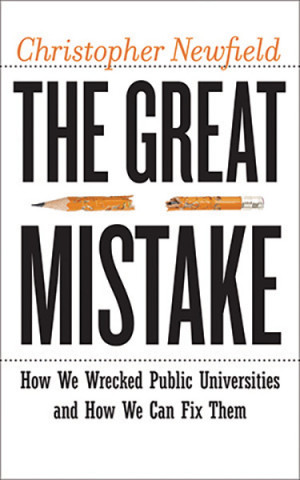
I set up a capabilities heuristic in The Great Mistake (before AI), and argued that every college should fund its achievement by every graduate. Last year, I modified it slightly for a presentation on AI to an interesting, sceptical group of Istanbulian engineers. 

Figure 1: 14 Intellectual Capabilities

The brown squares mark the only steps that, in my opinion, can be enhanced with AI.  All the others must be brain-only in their development, so that the resulting brain can use AI and not be used by it.  The first step, "ability to study," appears to be endangered by the passive use of LLMs services.  Same for "knowing what a research question is," which is trickier than it seems.  And the heart of both learning and research, Steps 6 and 7, creating a well-formed research question and then forming a thesis or hypothesis about it, are precisely what students can bypass with LLMs (as this classic undergrad essay explained).

Universities are not set up to help everyone have many or most, much less all of these capabilities. Under decades of financial pressure, most stopped trying.  As the latest and greatest ed-tech substitute for hands-on, face-to-face instruction, AI is causing cognitive damage whose variations are registered in new papers every day: yesterday's was AI's way of suppressing the ability to say "I don't know" in a way that enables thinking to continue. Academic advocates of AI increasingly insist on people actively using conceptual framings that stay independent of the models themselves (Andrew Piper).

There’s a large and growing literature of AI-related work about human capabilities and those that AI users absolutely need to have.  Pretty much all of those I’ve read insist that workers need to control technology and not be controlled by it. 

In his new book, The Reverse Centaur’s Guide to Life After AI, tech expert Cory Doctorow wants today’s “reverse centaurs,” like Amazon warehouse workers, whose powerful cyborg horse body dictates to their human brain, to be centaurs instead. In the process, he makes a particularly stark case for intellectual agency for all.

Automation isn’t necessarily the enemy of warehouse work: there’s nothing wrong with a forklift! The difference between automation that helps a warehouse worker and automation that torments that worker is whether the worker gets to choose where, when, and how to use that automation . . . 

When you find yourself surrounded by people swearing that a given tool is worse than useless and others swearing that it has made their lives easier and better, you can bet that the former group is made up of reverse centaurs who’ve had AI imposed upon them, [and that] the latter group is all centaurs who’ve gotten to make up their own minds about where, when, and how to use AI tools.  The solution to the paradox is to stop thinking about what the gadget does, and pay attention to who the gadget does it to and who the gadget does it for. (10-11)

Being a centaur requires massive labor of intellectual self-development so that one is basically smart enough to run the tech and not let the tech replace one's thinking.  The university is a central agent in this creation of mind. 

For intellectual power to exist at scale, graduates would have to be people who’ve not just had classes on “how AI is being applied within their fields” (p 13) so they can adapt to it. Graduates would have to be people with the capacity to put AI to uses that they themselves have conceived and designed. This means having intellectual agency over one’s “bundle of skills.” 

This high standard flies in the face of widespread passive AI use. It also defies the history of capitalism’s replacement of labor (and labor’s judgment) with technology. This standard also runs afoul of the unbelievable capital investment being sunk into AI infrastructure almost entirely on the premise of imminent superintelligence that can replace untold millions of workers at a fraction of their cost. I am sure that this premise is wrong, but the enormous sunk costs are pushing the world’s most powerful capitalists into forcing it to be right. One way of forcing rightness is to run down the “median person”—and spread a technology that also insures their mediocrity by rotting their brains.

There isn’t a conspiracy, but there is a neo-eugenicist Valley disdain for the regular smart people of exactly the kind universities exist to enhance. (Check out Theo Baker’s Stanford saga, How to Rule the World.)  The mind-boggling amount of capital consumed by the AI industry assumes the replacement (not the complementary enhancement) of mass quantities of human workers, which requires the industry to escalate their war on human capabilities. This means a war on the project of human development via formal education that runs from Plato to Kant, Fichte, and Schelling, on through Emerson, Douglass, Du Bois, Dewey, Jordan, Lorde, et al., continuing with current deep investigations in philosophy, software design, and cognitive science. Today's California Ideology substitutes AI for what it posits (erroneously) to be inadequate human intelligence.  

This is an epic historical shift, from trying to make humanity more intelligent, by any means necessary including tech, to trying to make intelligence artificial, without really caring what happens to humanity. 

Or to put it another way: 


Doctorow’s apparently simplistic dualism that privileges the active intellectual use of technology is in fact supported by detailed scholarly analysis. I’ve especially benefitted from the thinking of Brian Cantwell Smith on reckoning vs. judgment (my review), Alan Blackwell on human agency with programming (my review), and Vivienne Ming on the complementary strengths of humans and machines, who notes, “exploring poorly structured possibility spaces remains a profoundly human talent” (23).

In spite of the variable and often fabulous uses to which we put AI (say, as every centaur’s Personal Assistant, Trend 2), it’s hard to see how big tech’s sunk capital will allow the AI industry to climb down from its categorical and unjustified minimization of human capabilities.  

This in turn heightens the contradiction faced by colleges and universities. Their core function has been the creation of knowledge labor, with the default aim being “middle-class” stability and enjoyment. Around 1980, using the Bayh-Dole Act as a symbolic watershed, universities increased their visible service to knowledge capital.  In addition to shifting science towards tech transfer and licensing returns (with important opposition from many science faculty members), university officials have in recent decades bought into every ed-tech capital substitute for knowledge labor. Now the AI industry is proposing the ultimate loyalty oath: universities must affirm the inevitability of replacing much—most—eventually all (depends on the day and the speaker) university-educated knowledge labor with AI.

Again, the point of the university, even economically, has been to graduate free workers rather than serfs to any company’s tech. That’s always been a key reason why people take the time, trouble, and expense to finish university.  

For example, the University of California’s Undergraduate Experience Survey asks students why they selected their major. When they respond, four-fifths of students say “intellectual curiosity”; three-quarters say “prepare for a fulfilling career.”  Only half pick “leads to a high-paying job" (Table 1, p 6). The pecuniary benefit is baked into a college degree; college is an exhausting, expensive way to get a decent salary if you don’t also really want to acquire intellectual strength so you can have the challenge and pleasure of grasping reality and affecting the world. 

How are universities going to cultivate “human judgment, creativity, and subject matter expertise,” as UCOP put it this month’s report, “The Economic Impact of a UC Degree”?  Many people will say that you just need decent skills with using AI so you can set up a rig that works for you. I love how many smart and dedicated people are sharing tips on excellent chatbot workflow transformation all over the internet.  But all of these setups can suck out intelligence rather than extend it. 

All users need to have mental strength going into AI use, and continue to develop that strength.  And that requires tremendous (and ongoing) offline, brain-only work.  This work is the point of colleges and universities. They need to offer the regularity of back-and-forth cultivation that only elite universities have even tried. The need to furnish tutorials and small-group learning  for the masses, for the first time. This will start with much smaller typical class sizes than publics have right now. You can no longer have classes with 140 students that you call “discussions.”  Even 40 students is way too many for deep individual development.  Large lectures can no longer lack discussion sections, and departments will need to fund face-to-face interactions on which teaching and assessment is based. How will, a university like UC Irvine pay for meaningful assessments when they should no longer have TAs grade 300 papers written on laptops with multiple AI subscriptions? Universities now need to offer group work that’s engaged and supervised by advanced faculty, on the model of crits in fine art--with help via reassigning middle managers to the educational core. In contrast, most students now appear to be using LLMs to complete take-home exams and problem-sets, making these useless: for just one example, see  “How a Blind Professor Saw Through His Students’ Cheating” at Brown University.  Universities will need to develop oral tutorials and exams, with tech assists monitored and complemented by new intensities of face-to-face contact between students and instructors.

Here we run into a big problem. Any meaningful combination of these upgrades will bankrupt the current business model.  The model has been draining funds from instruction for decades, through vendor outsourcing, adjunctification, administrative growth, capital projects, and the many varieties of “mission creep.”  Universities with money to spend, spend it on administration. At MIT, “faculty grew by only 9.2% between 1985 and 2023, while administrative staff grew by 189%.”  This is a decades-old problem that has led to diluted instruction, against the talents and the wishes of the contingent faculty who teach the majority of the nation’s college courses by rationing their per-student time to survive. Universities have never addressed the administrative bloat, the reduced per-student instructional resources, or the steady one-way adjunctification.  Only union bargaining has slowed the drift. 

By the 2010s, the U.S. university system had locked in reduced investment in students that also varied by racial group (Black, Indigenous, and Latino students go to poorer schools than Asians and whites): they had set instructional funding at less than one-third of overall expenditures (see Nate Johnson on both points, comparing Figure 1 to Figure 3).  Teaching at public colleges is highly dependent on state funding and tuition: at UC Irvine, for example, 70% of “core funding” comes from these sources this past year (and 81% the year before). Nationally, state revenues for public colleges are still 2 dollars short of their (inflation-adjusted) level of 1999, having spent most of that period below the level at the turn of the century. Even with a 50% increase in (inflation-adjusted) tuition, total revenues have only increased 14% over 25 years, with likely all of that increase--and more--going to non-instructional functions. 

In short, the typical public college or university lacks the money to improve instruction to the point that the vast majority of its graduates can run AI and not be run by it. Non-wealthy privates are in the same position. 

The UC report I linked above, on the "economic impact" of a degree, ducks the question by saying the current system is working fine because look at the graduate salaries. UC grads do have better salaries than non-graduates and the graduates of some public colleges.  It is indeed still better to have a B.A. degree than not. But a UC graduate's earnings tells you little about their actual learning on a UC campus: it tells you about labor markets, and in this case labor markets for people who left college 5-10 years ago, in the pre-AI era.  The cognitive crisis must be faced directly, and so must the need for new (public) investment--a new political economy-- to support real solutions to it.  I'll discuss this issue in Part 2.

Posted by Chris Newfield | Comments: 0

Friday, June 5, 2026

Friday, June 5, 2026

Banff, Alberta back country on June 3, 2026  
This piece is my introduction to a panel at the Annual Meeting of the Consortium of Humanities Centers and Institutes in Banff, Alberta. 


CHCI funds research initiatives, among other things--see their Climate Futures call and other initiatives. The theme of this year's meeting was "Building the Future We Want," which is also an implicit theme of this blog. Building that future means putting humanities research into modes of influence in the world, which involves transforming our existing knowledge system, an issue with which I'm a bit obsessed.  


Posted by Chris Newfield | Comments: 0

Saturday, May 2, 2026

Saturday, May 2, 2026

Wayne State, Detroit on April 12, 2019  

This is the corrected text of a talk I gave online to the Wayne State University conference, “Public Budgets, Public Good,” on April 30, 2026.  Many thanks to the audience, whose questions about theory and practice were excellent. Thanks also to the sponsors: Labor@Wayne, AAUP, HELU, and Public Good U. I’m still sorry I wasn’t there in person.

∞∞∞

I’ve always seen the university as a force for the general development of society, having been influence by a tradition that includes Humboldt & Fichte, Kant, Hegel, Marx, Douglass, Ida B. Wells, Du Bois, John Dewey, CJR James, and many thinkers since.   This has made it easier to grasp the fact that the university’s largest effects are a combination of non-monetary and public.  These public effects have been rendered “dark matter” by the political and business worlds, which have steered people exclusively toward the private pecuniary effect of the B.A. wage increment over high school. College presidents and other officials have simply echoed them.  This is overbearingly true in the US and the UK, and amounts to a mass miseducation about education. But it is also true elsewhere, and apparently in China.

Posted by Chris Newfield | Comments: 0

Thursday, April 23, 2026

Thursday, April 23, 2026
New Haven People's Center on April 18, 2026  

I gave this talk at the 45th Anniversary Conference of the Whitney Humanities Center, Yale University,  April 17, 2026. Many thanks to the organizers, speakers, audience, and my co-panelists.

I’m going to talk about humanities ambition in a time of diminished authority for its fields,  and I’ll say we need big increases in our ambition in response.  But I have to note that the humanities won’t get enough help from their universities, and in many cases will have to fight them.  The Trump administration’s systematic efforts to erase people of color from the American past and present has been translated on campuses as quiet acceptance, via, in particular, the deletion of DEI programs and the merging or closure of departments associated with ethnicity, sexuality, or countries and cultures MAGA America dislikes.

Posted by Chris Newfield | Comments: 0

Tuesday, April 7, 2026

Tuesday, April 7, 2026

Stonehenge on December 21, 2025   

In the end, the university’s main value is its intellectuality, the treatment of everything that is with thinking and all its methods. 


That was the first line of the post I started drafting on Monday, on the holiday Easter Monday here in Britain. But I was struggling to concentrate.  I thought maybe I needed a rest day: I’d spent a couple of days last week writing a section on AI and the future of jobs for a collaborative report that we’re doing on the crisis of learning worsened by AI, and after devoting another chunk of time to it over the weekend it wound up at 6000 words. It’s not the length, it’s the sense of fighting inevitability from which I’d need a rest.


Posted by Chris Newfield | Comments: 1

Tuesday, March 24, 2026

Tuesday, March 24, 2026
UC Board of Regents, March 2017    
That is the question.

This is the answer: Never.  

Or not at least until the campuses fight and change current Office of the President (UCOP) budget ideology and practice. They have never done that.  Not yet.  

I’m going to compare UCOP’s January state budget show with their offstage borrowing.  State funding yields little, while the debt yields a lot.  

I’ll keep my eye on two major implications for the campuses. The first is a lock-in of structural deficits with continuing cuts to the educational core--to both teaching and research.  

Posted by Chris Newfield | Comments: 0

Monday, February 23, 2026

Monday, February 23, 2026

UCLA Royce Hall on May 14, 2018   
By early spring of the annus horribilis 2025, the UCLA Senate had lost patience with a UCLA Administration that had locked it out of any meaningful role in major decisions.  

The new CFO, Stephen Agostini, appointed in 2024, wasn’t working with the Senate in established ways. A new chancellor, Julio Frenk, had arrived in January, was to be inaugurated on June 5th, and seemed okay with increased opacity.  The Senate chair, Kathy Bawn, must have been worried that something much worse than shared governance could get locked in by the new administration. 

Posted by Chris Newfield | Comments: 1

Monday, February 16, 2026

Monday, February 16, 2026


East Village on October 31, 2022   
Looks like it.  

There’s some good stuff in Tyler Austin Harper’s Atlantic article, “The Multibillion-Dollar Foundation That Controls the Humanities,” but the piece unravels into a tool of the thing people actually hate about the humanities, which is not its implications for social justice but its civil wars. It blames the increasingly desperate struggles of the academic humanities not on right-wing enemies but on liberal humanists—a woke Mellon Foundation and its president Elizabeth Alexander.

I was one of the people that Harper interviewed for this article.  (Here, “Harper” always refers to the author, Tyler Austin Harper). He was fun to talk with, is a serious person, and worked hard on this piece, all of which I respect.  When we spoke, I emphasized our terrible money problems, which I argued tower over our manageable and ordinary methodological debates.  


I said that the real issue is our lack of the funding to produce and disseminate our knowledge at the scale that would get the kind of social attention allotted to medicine and computer science. We may think this is intrinsic to their topics and status but it is mainly the result of their vast organizational labor, labor of a kind that the humanities establishment, Mellon included, refuses to try. 


Harper cites my Public Humanities piece on funding—“Humanities Decline in Darkness”-- for a statistic in which federal humanities funding rounds to zero. But you have to get to his third-to-last paragraph before he makes his best causal claim about the current situation: 

The humanities are in the mess they’re in because of federal budget cuts, and because of administrators who care more about the football team than about William Faulkner, and because of the toxic pragmatism of an American culture that has a hard time valuing anything that is not immediately, aggressively useful. But the humanities are also in this mess because those of us who care about them have often preferred hunkering down in a defensive crouch . . . 


I would have finished that last sentence by writing, “and so we don’t build the data and resource infrastructure that would make our needs visible to politicians and the public.”  But that’s not where Harper goes.


Harper’s other most effective moment comes from Phillip Brian Harper, the Mellon program director for higher learning: 

“The sector needs to be taken by the collar and shaken very hard until resources that are adequate to the support of humanities doctoral students are jarred loose from higher-ed institutions themselves. . . . The role of the Mellon Foundation is to catalyze that sort of change. It’s not to serve in perpetuity as the piggy bank for research.” Mellon, he said, was never supposed to be a panacea for the humanities.


Great, but who will do the shaking of university management? Mellon? Phil Harper says its role is to catalyze. On this topic, it’s not.  


He is of course right that the situation is completely appalling. To repeat, even though sociocultural knowledge is essential to solving any of the world’s epic problems, the rich universities listed below spend almost none of their institutional funds for R&D on non-STEM fields.


Figure 1. Institutional Expenditues on R&D, Selected Universities


SOURCE: NSF Higher Education R&D Survey (HERD) FY2024, Tables 14, 23, 29.

Yes, these figures likely exclude individual faculty research funds via outside grants, named chairs, and other department-managed funds.  But as indicators of institutional investment in humanities infrastructure, they are shocking. Universities’ own refusal to fund humanities research is also one cause of our society’s inability to deal with its core problems.


Yet Harper comes not to bury funding failure but to chastise social justice. The fault for him lies not in Trump’s destruction of the National Endowment for the Humanities or 40 years of right-wing culture wars, but in Mellon’s interest in a better society.


∞∞∞


Harper makes two main claims. The first is that “classical” and “social justice” scholarship aren’t complementary approaches but rivals. They compete bitterly for scarce and dwindling funds. 


The solution to this is obviously an alliance between rivals to fight for massively better funding for all, at least ten times more funding than socio-cultural scholarship has today.  


But Harper diverts attention from funding with his second argument: “social justice” research is a betrayal of humanities scholarship, a kind of negation of it. This increase in “the decidedly sublunary work of furnishing political propaganda” makes Harper wonder whether the academic humanities are worth saving at all.  And Mellon, he writes, has shifted to funding this political propaganda since the arrival of Elizabeth Alexander as president.


Let’s try to understand this claim. Harper’s evidence for a policy shift is a Foundation announcement dated June 30, 2020. Mellon declared a new focus on “just communities enriched by meaning and empowered by critical thinking where ideas and imagination can thrive.” Board chair Kathryn A. Hall explained that “our reinvigorated mission and strategic direction . . . not only builds on our historic commitment to the arts and humanities, but rightly emphasizes a desire to make the ‘beauty, transcendence, and freedom’ found there accessible and empowering to all members of society.”  


The new direction assumes the complementarity of what we might call “basic” and “applied” humanities research, and not that applied research—addressing social questions—debases basic scholarship.  Complementarity—with awareness of different modes, aims, and questions--is assumed in every STEM field and social science of which I’m aware, so Harper has a special burden to show that the humanities are unlike all other forms of academic research in this way.


Alexander confirms complementarity in the announcement by adding, “We are a problem-solving foundation looking to address historical inequities in the fields we fund.” This also expresses reflexivity about Mellon’s own role in knowledge creation, which includes a past of supporting the kind of epistemic biases and limits that need constant correction in every field.


The new Mellon direction also seemed to aim at the democratization of humanities knowledge—at taking the results of humanities research outside of a small elite while also learning from communities about their existing knowledges and practices.


Harper presumably approves of problem-solving, and he definitely opposes the perpetuation of historical inequities which he agrees exist.  He sounds fine with humanities for the people, which is the official policy of the state humanities councils and the National Endowment for the Humanities (NEH) whose origin story he affirms. He writes,

[U]nder Alexander, the foundation deserves credit for working to create a more economically just landscape within higher education. Before Alexander’s arrival, Mellon tended to disburse lavish funding to institutions that were already rich. Now, as part of Mellon’s commitment to equity, it is making a conscious effort to provide funding to public and less selective institutions. It has also increased funding for university-led prison education programs


All true, good, and important.  So what is so bad about Mellon’s new direction?  


Nothing, actually. (Its inaction on overall funding is a separate question to which I’ll return)  But to save what must have been the original idea for the story, Harper spends most of the piece making the false argument that “applied” humanities scholarship (not his term) is political propaganda.


How does he show this?  First there’s his prior, the false legacy dualism in criticism and some related humanities fields in which the criticism of texts and historical materials (basic) is denatured and corrupted by engaging in criticism of society (applied). It’s this dualism that turns “social justice” into “political propaganda” that ruins scholarship. 


This dualism may encourage him to search his anecdotes for polarity. For example, he spoke with a scholar who “confessed that . . .he had reimagined his work to focus more squarely on race; he did win a grant. I suspect that this may not be a rare occurrence.”  Harper’s assumed incompatibility between the first and more race-focused version of this scholar’s work makes this a problem rather than progress. 


Second is Harper’s assumption that it’s bad to get steered or shaped by a call’s language or a program officers. There seems to be a tacit idealization of “classical” humanities scholarship as pre-social and not in any good way developed by thinking about problems it might solve, or by being asked to change emphases in a proposal by an agency official.  


I see this as a humanities provincialism about sponsored research, which always involves calls, program officers, public pressures, institutional forces and so on.  This is not epistemically less valid than idealized autonomous scholarship. Remember actor-network theory and dozens of related ways of discussing the collaborative nature of thinking.  So the scholar who “reimagined his work to focus more squarely on race” likely improved his project. Program officers at NIH, NSF, and other STEM agencies do this advising routinely.  Agency shaping can be good or bad. 

Harper doesn’t have the evidence to rule out good shaping in that more-race-oriented project or the others. (Gabriella Coleman’s valuable commentary on Harper, “The ExposĂ© that Wasn’t,” is really good on this point.)


So it’s not that “social justice” aims are inherently anti-intellectual and ruin scholarship. Better knowledge in many areas can come from working like Pasteur rather than like Einstein, to reference a classic study of the (complicated) relation between basic and applied research.  And it’s also not true that agency shaping is bad per se.   


So Harper falls back on a third way of making his claim that woke Mellon is ruining the humanities. That is to scorn sample program language as self-evidently non-scholarly.

Mellon’s newer Dissertation Innovation Fellowship focuses on “supporting scholars who can build a more diverse, inclusive, and equitable academy.” The guidelines list “thoughtful engagement with communities that are historically underrepresented in higher education” as one of the primary criteria used to evaluate the strength of an application; by my count, all 45 of the 2025 awardees work on issues of identity or social or environmental justice.

I assume Harper means this program, run by the American Council of Learned Societies (ACLS).  Awarded titles include the following: 


·      The Dam, the Road, the Port: The Transformation of the Brazilian Northeast during the Long Twentieth-Century

·      State of Mine(Mind): Affective Geographies of California's Rural North

·      Urban Tropics: Dwelling under South and Southeast Asian Urban Microclimates

·      Uneasy Intimacies: Seeing Irei and Aesthetic Ambiguity Through Fukunosuke Kusumi's Art

·      Black Anti-settler Placemaking: Cooperation Jackson's Eco-villages from Mississippi to Vermont

·      Fiber Optics: HenequĂ©n Classification and its Consequences

·      Troubled Waters : Natural Disaster, Space, and the State in Precolonial Panjab (1707-1849)


Check these and the others out for yourself.  They all analyze major issues and strike me as likely to make original contributions to knowledge.  I don’t at all see Harper’s justification for assimilating all the projects to “identity” and “justice” studies. To do this, he needs to stereotype everyone on the basis of the appearance of words like “settler,” “queer,” “colonial” etc. I don’t even see how they’re all applied rather than basic research. He offers no evidence (just the legacy assumption) that these are not intensely scholarly, deeply intellectual projects.


At breakfast before drafting this post, I read an interesting review of The Deformation: Attention and Discernment in Catholic Reformation Art and Architecture by Susanna Berger (Princeton University Press, 2025).  “Central to The Deformation,” the reviewer writes, “is the question of how religious elites wielded anamorphosis as a means of gatekeeping the divine.”  I love this kind of stuff. But is a book about the relations among perspective in drawing, theology, and institutional power in 17th century Europe clearly epistemically “classical”—pure, basic research-- and thus intellectually superior to work on “Affective Geographies of California's Rural North”?  The answer is no. Mellon / ACLS funded research simply cannot and should not be delegitimated with superficial separating of the sheep from the goats.


The same goes for Harper’s disdain for a grant to Colorado College.

In the summer of 2023, Colorado College hosted a conference based on this prompt: “How do the humanities contribute to anti-oppressive work, and how can humanities methods—from inquiry and critique to creative production and performance—dismantle systems of oppression, create and sustain community and solidarity, and advance liberation?” It does not seem to occur to those asking such questions that the humanities may not be especially well equipped to “dismantle systems of oppression.” Nor do they seem to consider that what might in fact be most valuable about fields like English, history, and philosophy is that they aspire to stand above the flotsam and jetsam of our immediate circumstances, and instead set their sights on what the classicist Leo Strauss called the “permanent problems” that have troubled human beings from time immemorial.

Harper doesn’t actually know what the conference organizers did and did not consider, but in any case, “how to dismantle systems of oppression” is one of the ‘permanent problems” of human beings. It is also a running theme of literature, history, and philosophy for thousands of years.  One might find the Colorado College formulations a bit plodding and yet not try to discredit the program through a false distinction between intellectual work and its social contributions.


I can imagine Harper doing a different kind of research that leads to a different article about the humanities.  He would go to Colorado College, interview the students, staff, and faculty involved in the program, and sit in on its courses for a few weeks while also visiting classes that aren’t part of the program.  He could then compare and contrast and identify the actual cognitive and other effects of the program on the participants. We would all learn something about what actually happens through humanities funding on college campuses to (and by) students and their teachers—for better and worse.  This is the real void in public understanding, and Harper’s dismissal of a program on the basis of its terminology doesn’t help fill it in.


So, Mellon’s new direction is less elitist. It puts greater emphasis on “applied” over “basic” research (“Pasteur’s Quadrant”) while insisting on their complementarity (and equal intellectuality). It funds some research on white supremacy and overcoming it--along with funding many other things, and really this funding is a drop in the bucket of overall social need for knowledge about racial nationalism, the authoritarian personality, etc.  Mellon program directors shape applications, as they always have.  They may now fund a higher proportion of outreach and communication programs compared to applied or basic research, but Harper doesn’t get into this important issue.  Finally, Mellon is the last big national funder in research-starved humanities field.  Only the last of these strikes me as a scandal.


∞∞∞


Daylight does appear when Harper takes the other side of his own argument. 

It is hard to argue that the tens of millions of dollars that Mellon is putting toward internships for working-class kids at public colleges and universities would be better spent financing dusty archival research on 16th-century France. But this calculus also says something about the deeper structural problems of a model that pits various social goods—programs for humanities undergrads, resources for Ph.D. students, traditional humanities research, support for emerging fields and endowment-poor universities—against one another.

Yes, absolutely: we must address with the intent of solving “the deeper structural problems of a model that pits various social goods against one another.”  We must at the same time argue for “financing dusty archival research on 16th-century France.” But it isn’t Elizabeth Alexander or Mellon that set up the zero-sum game. This happens when critics pit different kinds of humanities scholarship against each other.  


Mellon et al. didn’t set up the zero-sum funding game.  But what are they doing about fixing it? 


I’d trace some of Harper’s completely valid distress about the system to having grown up in this barren funding world where one’s work is always losing out to someone else’s.  The real issue with the humanities’ national leadership isn’t that they politicize scholarship, but that they don’t fight openly and systematically to fund a great deal more of it.  


This gets us back to Phil Harper’s statement: 

“The sector needs to be taken by the collar and shaken very hard until resources that are adequate to the support of humanities doctoral students are jarred loose from higher-ed institutions themselves. . . . The role of the Mellon Foundation is to catalyze that sort of change.”


But Mellon is not doing that. 


I can find reports galore about the crisis in STEM funding—everything from the cuts to indirect cost recovery to the losses of whole areas of research (like racial disparity in public health outcomes that NIH had funded for years) and of scientific personnel. I can find nothing from the humanities associations about their research funding problems.  


NEH has been gutted, yet MLA, which did indeed help sue the government over NEH, has joined NHA, AHA, APA et al. in neither collecting data to show the funding problem nor developing a systematic plan for building such funding. 


Similarly, the ACLS’s Strategic Framework 2025-2030 doesn’t have a sentence about tracking humanities research funding or expanding it. I see all these great scholars on the board. What are they doing?  What are we actually doing?  Why isn’t something like Figure 1 above on Mellon’s website as part of a large, structural analysis, rather than on the blog of an obscure professor? Universities need to be “taken by the collar.” But who will take the humanities agencies by the collar?


None of the solutions are really so abstract anymore.  People here and there have sketched out plans. I outlined one version in a long discussion paper for the MLA Executive Council in 2022, and ended my presidential address in January 2023 with a sketch of the steps we need to take, somewhat expanded in the print version (“Criticism After This Crisis”).  Also in 2022, a sub-committee of the Executive Council developed a reporting structure on cuts (or growth) across the country, planning to use the Association’s large, elected Delegate Assembly to feed information to headquarters for analysis and reporting. The Association never set this up. 


Two years went by, and the MLA then set up a panel explicitly about funding at the Convention in January 2025. 


Figure 2. MLA Convention Program 2023, Panel 139


The panel was an excellent (re)start on the topic, and the panelists had a good planning meeting afterwards.  We outlined NEH, Mellon, MLA, ACLS working together on research data, reporting, development. Then Trump took office and started his attacks. My colleagues bailed on the plan, which as far as I know, is dead.


With some discipline, we can replace our historic humanities pastime, discrediting each other’s research, with the project of building a material base for all of it.  If we can’t show basic mutual respect for divergent (and radical) research within the profession, then we are doomed.  But actually we can do this, and many, many of us already are.


I again invite both Harpers and everyone else into the effort of building the material base. 


Posted by Chris Newfield | Comments: 3