Top Navbar

  • Home
  • About Us
  • Guest Posts
  • Liner Notes

Searchbar

Showing posts with label Newsom. Show all posts

Monday, April 28, 2025

Monday, April 28, 2025

Mosteiro de Santa Clara-a-Nova,
Coimbria, Portugal on April 26, 2025   
by Trevor Griffey, UC Irvine

 Before 2025, California Governor Gavin Newsom developed a reputation for being a modest advocate for public higher education compared to his predecessors. This year, he proved that this reputation depended on flush state budgets, not on principle. 


When Newsom first came into office in 2019, the state had a projected $20 billion surplus, which allowed Governor Newsom to substantially boost spending for public higher education as part of what he called a “California for All” budget for 2019-20. 


And in 2022, with the state of California still receiving substantial CARES Act funding from the federal government, Newsom negotiated a 5-year “compacts” with the University of California and California State University systems that committed him to advocating for 5% annual increases to UC and CSU budgets. In exchange, the school systems committed to increase enrollment of California residents and increase student retention and graduation rates.


Though the compacts were legally nonbinding, they promised a sense of stability and modest recovery to UC and CSU after decades of inadequate and unpredictable funding. Unfortunately, they would soon be shredded because of a catastrophic accounting error.


Years of Austerty to Pay for Budget Mismanagement


According to CalMatters reporting, during the same legislative session that Governor Newsom negotiated the compacts, budget analysts working in his Department of Finance massively overestimated tax revenue for future years. They treated an anomalous spike in income taxes as normal, and over-estimated state revenue in future years by $200 billion per year. Legislators relying on these projections believed that they were balancing the state’s budget in 2022, and thereby set the state on a course to spend hundreds of billions of dollars more than it would collect in taxes. 


As the effort to undo the damage of faulty budget projections continued into 2024, Governor Newsom proposed “deferring” funding increases in the compact to future years. UC and CSU leaders successfully negotiated to receive a modest increase to their general funds in 2024-25, but in exchange for accepting an 8 percent cut in 2025-26. Since the Governor and the state legislature were also proposing an 8 percent cut to other state agencies, the shared sacrifice seemed fair. The compact was temporarily saved, but the Governor’s commitment to it was effectively over.


Governor Puts Majority of Budget Cuts Onto Public Universities


Budget cuts negotiated in 2024 seemed like a done deal. Then something unexpected happened: new, more optimistic revenue forecasts came in, and the state of California entered 2025 with a projected $363 million budget surplus.


The Governor could have proposed to use some of this money to give a reprieve to the UC and CSU systems, or try to sustain the compact another year. 


Instead, the Governor’s January budget proposal reduced planned cuts to state agencies, while leaving the 8 percent cut and compact deferral in place for UC and CSU. 


As the Legislative Analyst Office has highlighted, this move increased state government spending by $2.4 billion over the 2024 budget deal. The Governor also proposed increasing discretionary spending by $507 million, and proposed $150 million in new tax breaks for 2025-26.


To pay for this new spending, as well as cover billions of dollars of unexpected Medi-Cal expenses and rising costs for other programs, the Governor proposes to withdraw state reserves by about $7 billion in 2025, leaving $17 billion for next year. Remarkably, the Governor did not propose using any of those reserves to prevent or reduce cuts to public universities.


Indeed, whereas the State’s Special Fund for Economic Uncertainties is normally kept at $3.5-4 billion, the Governor proposed to increase that fund to $4.5 billion. If the Governor had simply thought to keep it at a normal $3.75 billion, he could have eliminated cuts to the UC and CSU system entirely for 2025-26. 


The rhetoric about the state budget in Sacramento is pessimistic. Concern that Trump’s reckless actions will weaken the economy further add to a sense of foreboding. Cuts to essential services seem inevitable, and this rhetoric of inevitability undermines politicians’ willingness to vote against the Governor’s proposed budget.  


Staff for the California Assembly’s subcommittee on education finance have instructed legislators that even though “CSU appears to be facing a fiscal crisis,” and “UC clearly faces significant financial challenges,” politicians should focus their hearings less on stopping the cuts and more on how the school systems “will weather increasing costs and potentially declining state and federal revenue.” 


This fatalism is baffling— more cowardice than analysis.  Decisions made by the Governor demonstrate that the need for cuts to higher education has been manufactured by treating UC and CSU differently than other state agencies. While state budget cuts may be necessary, they are being spread unevenly for political reasons, not financial ones.


As Jason Sisney, the budget advisor to the California Assembly Speaker, recently wrote, the July 2024 budget deal was that budget cuts would be equitably distributed across state agencies, and UC and CSU cuts would make up 22 percent of the state’s projected budget shortfall. Instead, Governor Newsom wants to increase spending, increase tax breaks, reduce cuts to state agencies, drawn down reserves, and still leave cuts to UC and CSU in place to cover 53 percent of the state’s resulting budget deficit. 


In other words, the Governor is proposing balancing the state’s budget on the backs of its four-year college students. This will take the form of increased class sizes, increased tuition, and increased debt, and possibly even one or more CSU campus closures and mergers. 


Can Democrats Stand Up to Their Governor?


On April 25, 2025, State Senator Catherine Blakespear, who describes UC San Diego as “in the heart of my district”, sent an email to constituents titled “Fighting for UC.” In it, she decried the Trump administration’s research cuts to UCSD, and pointed out that UCSD had already implemented a hiring freeze and was reducing graduate student enrollment. 


What Blakespear failed to mention is that she has declined to sign onto a letter from more than 60 of her colleagues in the state legislature opposing cuts to the University of California’s budget. In fact, she didn’t mention the Governor’s proposed budget cuts at all, or encourage her constituents to speak out against them. 


Blakespear made it seem as if UCSD hiring freezes and budget cuts were coming from the federal government controlled by Republicans, when much if not most of it is currently coming from the state government controlled by Democrats.


Like many Democrats, Blakespear is happy to oppose Donald Trump’s policies. But when it comes to standing up to a Democratic Governor, will she or others really “fight for UC”?


In my conversations with multiple state legislators this term, both Republican and Democrat, I have yet to find a single one who wants to cut the UC or CSU budget. I have yet to find a single one who wants the quality of instruction to go down while the cost of tuition goes up. 


Many California state legislators graduated from one or more public colleges or universities in the state. They know that California voters are mostly proud of their public higher education system, and see it as a core part of the services that the state provides.


And yet, when you ask a California state legislator if they’d vote against a budget that includes cuts to the UC and CSU, most Democrats— even those who sign letters opposing the cuts— will tell you that they have no choice but to vote for whatever budget the Governor, the Assembly Speaker and the Senate leader negotiate behind closed doors. Their ability to move legislation requires ceding their agency on the budget, or else be ostracized by their party leadership. 


When you meet with the staff of the Assembly or Senate leaders, you get the reverse message: the leadership needs to hear as much as possible from members before they head into negotiations about the need to protect higher education. 


Few will commit. Almost everyone is equivocal. One legislator I met with repeatedly asked if we could talk about how the state legislature could oppose Trump’s attacks on higher education, so we could avoid discussion of the state budget altogether.


And some share legislators whispers that because the Governor provided a 6 month delay to people impacted by wildfires to file their income taxes, and a 12 month delay to file their property taxes, his “revised” budget proposal, coming very soon, is likely to be even worse. 


Not treating delays in revenue collection as shortfalls is also somehow off the table. 


Taking their cues from elected leadership over the past couple years, UC has already increased non-resident student tuition 10 percent, and the CSU system is in the midst of raising tuition 34 percent over 5 years. Who knows what more may be coming?


Fighting for Higher Ed at the State and Federal Level


Shared sacrifice may be necessary during times of budget woes, even ones created by administrative error. Yet we as college teachers, students, staff and community members need to tell our politicians that balancing the budget on the backs of college students is totally unacceptable. 


For decades, politicians across the US, regardless of political party, have consistently raided the budgets of their public universities during recessions, or to cover the rising costs of health care, corrections, and other services they don’t want to tax people for. Politicians may publicly bemoan tuition increases. But they secretly depend on increasing student debt to balance state government budgets.


That game may be coming to an end. It ultimately relies upon federal grants and loans to students that Republicans are threatening to eviscerate in what the Debt Collective has called “the most dangerous higher education bill in history.” And it relies upon students believing that the inferior education provided to them in increasingly large and online classes is worth going into debt.


It's up to campus labor unions to invest their resources into organizing not just their own members but organizing students and community members to contact their legislators to oppose state government budget cuts.


It would be great if the defense of public higher education only required standing up to Donald Trump. But for now, we also have to stand up to Democrats whose support for public higher education is always hostage to their other priorities.


Contact your legislator to Stop the Cuts!

·      UC-AFT: For teachers and librarians represented by AFT

·      Teamsters: For UC and CSU clerical workers and building trades

·      University of California: https://www.universityofcalifornia.edu/get-involved/advocate/state-budget

·      California State University: https://www.calstate.edu/impact-of-the-csu/government/Advocacy-and-State-Relations/Pages/Budget-Advocacy.aspx
Posted by Chris Newfield | Comments: 0

Wednesday, January 12, 2022

Wednesday, January 12, 2022

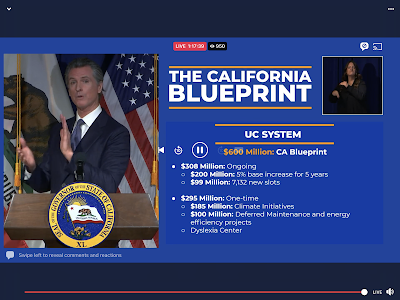
I've fixed the mistake in the Los Angeles Times headline on Gov. Gavin Newsom's higher ed budget proposal for 2022-23.  In fact, if you add one-time money from the current and coming years, Newsom is proposing overall cuts to UC and CSU.

The base general fund increase is five percent next year (see summary slide above), with five percent promised each year for five years total in a new compact between the university systems and the state.  

Newsom delivered  the compact promise with a joke about how he knows the people who lived through the last (broken) compacts will doubt this one too.  Newsom signaling he knows we think Sacramento compacts are worthless doesn't make Sacramento compacts less worthless.  So I assume only next year's five percent.

Newsom's five percent is better than Gov Jerry Brown's annual two or three percent--apparently twice as good.  However, Newsom gets an inflation rate that is twice Brown's too. The Personal Consumption Expenditures (PCE) Index accelerated from 4.2 percent to 5.7 percent from July to November 2021. CPI hit 6.8 percent, and projections for inflation in 2022 by Fannie Mae and others suggest a five percent increase will be entirely consumed by inflation.  Hence the term "flat," and also my sense that the corrected headline is still optimistic.  For more than a decade, two Democratic governors have been giving UC and CSU flat annual budgets--when they are not cutting them.  That is not changing.

The other touted feature is that the state is funding residential enrollment growth.  Newsom proposes it support 6,230 new California undergraduates with $67.8 million (or $10,882.83 per student).  Again, it looks good compared to Jerry Brown.  He proposes an additional $31 million to buy out 902 nonresident slots at the three flagships (Berkeley, Los Angeles, and San Diego), at $34,368.07 per student. Don't ask me how they came up with those numbers.  What is clear is that the nonflagships are not getting state funding for the nonresident students they have been unable to admit because of the enrollment cap that emerged from the political blowback caused by the flagships.  Newsom sets up UC for a multi-year series of tuition carve-outs that allow the flagships to keep their nonresident tuition premiums, maintaining intra-campus budget inequality.

Most UC campuses are at capacity and have been for some time, so getting new students means hiring new faculty and staff and building or expanding facilities.  In practice, it means more costs and also more hardships for existing students. They will have even more trouble getting courses and housing.  Next year's per-student rate is less than half of what UCOP says is the average cost of instruction of each student (that is vastly more than most departments receive per major but never mind). We can say that $10,882.83 will at best cover costs of the new students and at worse create new deficits.  Like the base increase, this is not an increase in UC's per-student operating budget.  (The small "cohort tuition" hike will also make very little difference.)

Last fall, I suggested 2021 might well be, financially speaking, Peak UC.  The governor's new proposal confirms that fear about a stagnant 2020s of unfunded mandates.  Further confirmation came from UC president Michael Drake ritually praising the governor's generosity, putting a cap on growth in the bigger revenues.

I'm not going to go into more detail on the numbers until they settle down, and won't chart any trends until spring.  Newsom is right to see budgets as "expressing our values," as he said at the end, but his presentation was a numerical mess, referencing three different sizes of surplus ($42 billion, $20 billion, $31 billion), two from his own office, and identifying dozens of individual program totals from two different budget years.  So in the meantime, let's take a look at some other issues raised by the presentation, both on the campuses and the state as a whole.

Newsom has exactly two ideas about higher education. One is that it maximize access on the basis of diversity, equity, and inclusion (DEI).  The other is that it prepare students for jobs, and by jobs he means jobs in technology. 

Newsom makes state funding contingent on several 2030 goals: UC eliminating racial gaps in grad rates, getting grad rates to 76 percent for four-year students, and getting students to debt-free graduation. These are essential goals and UC must achieve them. But they require fundamental change in the UC business model.  That now depends on undergrad tuition subsidizing research and other activities--so less money is in instruction and student support, which hurts retention differentially across racial groups.  The business model also depends on saving a lot of university money (my estimate is $755 million in 2019-20 using Accountability data) by capping financial aid, therefore forcing undergrads to borrow and work during the academic year (see Stage 2 and Stage 5 respectively).  

This is such an important point--the need to fund goals rather than simply assert them--that I'll expand a bit. You improve graduation rates in part by hiring enough instructors so that every student can get every class they need, when they need it. Because of chronic underfunding, many or most students on all UC campuses wait quarters or years to get admitted into at least a few of their core required courses.

How do you reduce racial gaps in graduation rates? You offer personalized, individual advising to every student who wants or needs it.  You don't tolerate caseloads of 740 students for each advisor, which Laura Hamilton and Kelly Nielson, in their important book Broke, report is the case at UC Merced's school of Social Sciences, Humanities, and Arts (page 123). 

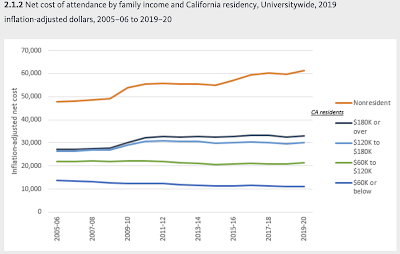
You also reduce racial gaps in graduation rates by taking students of color out of the cafeteria job they use to reduce their borrowing and into class: you cut their work hours ideally to zero while they are enrolled full time. You do not impose a Self-Help Expectation of $8,500 or $9,200 or $10,000 on every student with financial aid, even if they are low income, as every UC campus does. In other words, if you want to reduce racial gaps in graduation, you don't do this, for years and years: have a net cost of attendance of $10,000 per year (after financial aid) for students whose whole family earns $60,000 or less.

You also don't allow the poorest students to have the most debt at graduation.  

You stop doing these things by buying out financing gaps for poor and otherwise disadvantaged students, and then you put money into  personalized, intensive advising, well-funded student centers, and other things most UC faculty and staff could name off the tops of their heads.  When you start paying to provide these things, you're then able close your graduation gaps.

These are all things UC campuses want to do. None of them are things that either the governor or the legislature want to pay for.  None of them are things whose costs UCOP has itemized and justified in public in order to inspire the desire to pay for these essential things.

The governor mentioned diversifying university faculty.  This has been an explicit UC goal since the 1980s. Again there are racio-cultural obstacles. But the material ones are at least as important.  A diverse faculty comes from diverse doctoral programs, which means strong retention in those programs, means fully funding grad students from working-class backgrounds who are at greater risk of dropping out for lack of funds or excess debt.  UC does not fund its doctoral programs at the needed level.  

Thus in 2019-20, grad students went on a multi-campus strike over their rent burden, demanding a cost of living increase outside their union contract so they could cover costs in the private rental market. Nothing was done, and the students who started it (at UC Santa Cruz) were expelled for a while.  In the midst of the pandemic in early 2021, UCSD grads had to protest in the face of massive rent hikes in campus housing.  In 2022, rent burden is, if anything, even worse. The diversity of the faculty stops there, with unmanageable costs of living.  If it is serious about faculty diversity, UC should announce debt-free doctoral programs. But the governor and legislature would have to pay for it.

In sum, Newsom insists that UC close graduation gaps with essentially the same per-student funding that caused the gaps in the first place.  UC officials should point this out.

Now, on this question of college for jobs: Newsom and most policy people continue to work with a version of Human Capital Theory (HCT) descended from the 1950s, in which "learning equals earning."  In reality that is true only for a subset of students (generally already financially advantaged--for the theory's flaws see our LARB review-essay).  Policymakers are trying to fix the theory by saying, "tech learning equals earning," and UCOP encourages this splitting of STEM from other fields by publishing wages-by-major data.). 

Enter Gavin Newsom: propelled by half-baked but established neo-HCT, he is making these five percent state funding increase contingent on "supporting workforce preparedness and high-demand career pipelines," requiring 25 percent increases in degrees in STEM "and Education or Early Education" disciplines, as well as the same increase in "academic doctoral degrees," all by 2026-27.  The requirement is not exactly water-tight, and it also has a very weak justification in existing jobs projections.  The original 2015 report that started this "million missing college degrees" fixation shows most new jobs appearing outside of STEM (Figure 4).   Did anyone in the governor's office read the current occupational breakdowns for the state? It's the same story here, with tech a minor employer by size (though not by wages, which are high). But the STEM quota sails anyway, towing a legitimate fear about teaching shortages behind.

Even if the job market really did say STEM, it's an invasive step for a governor to mandate changes in degree outputs in a university.  Californians felt sorry for Floridians having to put up with Gov. Rick Scott making nasty cracks about anthropology and saying he didn't want taxpayers to foot the bill for useless degrees. Newsom is effectively doing the same thing. It raises allocation questions: Will new faculty lines to teach the expanded enrollments all go to STEM plus a few for education?  Will provosts need to stop hiring in arts and humanities for a number of years to pool lines in the "high demand careers"? Should California's future musicians, screenwriters, architects, designers, painters, film editors, historians, novelists, and journalists avoid the experience of being second-class citizens by going to UC? 

There are no answers, and this brings me to the experience of watching a governor's budget presentation on dozens of topics where the word "education" wasn't uttered until well after minute 70. Newsom organized his address around five existential threats. He had no vision of a New California, but ran through a series of hard problems that must be solved. I sympathize: he has not been having a joyful time. There's pandemic illness and also its political madhouse, with the recall trying to get rid of him for doing his public health job. There's drought and fire and the climate crisis behind them. There's the cost of living crisis. There's decades of underinvestment in transportation and other infrastructure.  There's a very polarized state economy, where a third of the workforce earns less than $15 per hour (page 3). There's a decades-old housing crisis, where so much private wealth has been absorbed into inflated housing assets that the state spent $5.2 billion last year--an additional University of California state budget--paying people's rent. 

Newsom brings a lot of energy to this slate of problems. He fired dozens of powerpoint bullets at them, each carrying a $100 M or $200 M or $1 B payload. But it's all the equivalent of filling (very important) potholes, keeping the electricity on, getting the shots in arms, giving the kids something to do in school until their parents get home.  

Even the tech future of green transition is remedial, trying to undig the hole of climate change in a state still almost entirely dependent on the private car.  There was something hollow in Newsom's enthusiasm for the state's green tech leadership: he cast the state's investment as bait for private investors, took it as an opportunity to hype the hegemonic tech sector that I think he quietly dislikes for its entitlement and arrogance as do most Californians, overpraised legislative honchos and others, and started referring to California as a "leader in this space" or that space--space being a term he used dozens of times.

Contrast this with how Newsom sounds on things he cares about. Then he is serious, knowledgeable, plainspoken, and open. What he really cares about is pre-K, school nutrition, homelessness, getting people out of encampments, mental health, universal health care, summer school for poor kids, a decent access to basic goods for disadvantaged people.  Whatever his neoliberal policies might be, Newsom's deeper desire, I felt watching him, is to ease the worst suffering.  This is also where he feels useful, even perhaps a bit of a hero.  But this desire doesn't find much to feed on in higher education as officials present it to him.

It's not just Newsom: the media isn't interested in higher ed either. During question time, the press had crisp questions about Newsom's contradictions on personal exemptions from Covid vaccines, his concrete plans for supporting reproductive rights, his borrowing of his recall opponents' plans for the mental health system, and his proposed changes in the Medicaid prescription program. They had nothing about higher ed.  This is a real problem for the sector. The governors' office doesn’t get vigorously questioned about higher ed, so they don’t prep for that, they rightly think the media and its consumers don't care about the details, so they never think, "we’re going to get pounded on mandating STEM degrees so we’d better think this through."  

I’ve written about Biden-era Democrats assigning college to a dedicated space in the welfare state. The good news is that they want government-run social development—Biden has in fact broken with key tenants of neoliberal Obama-Clintonism.  The bad news for higher ed is that the Biden-Newsom mainstream has no intellectual developmental plan for higher ed to address. Biden-Newsom are a real policy advance on Obama-Brown--an advance for children, the food insecure, the mentally ill, the unhoused, the uninsured, but not an advance for college students or the educational system.  

For them, the knowledge economy is abstract scenery, a slightly smoggy familiar sky.  We may need a million more college degrees, but that's just a logistics problem—there’s no interest in process or content or quality upgrades to say nothing of revolutions in thought or in the public's collective cultural and political capabilities. For them, UC and CSU are server farms that should run quietly in the background. There's nothing heroic about them, and they won't make a hero of any president or governor.  They are of modest interest as economic infrastructure. They are certainly not, for this Democratic party, a state engine of destiny.  

This could be changed, in a couple of diverging ways. One would be all three segments busting out of the workforce preparation trap and developing exciting stories of college-fueled individual and social transformation.  I know some deans and individual faculty who could do this. I don't know anyone at the senior manager level who would. Please correct me if I've missed some folks. 

The second, more plausible path is to comply fully with the mainstream Democrat welfarist passion. Inspiration is also needed here, that makes the state's politicians heroes of social justice. But that means defining the processes that would allow UC (and CSU) really to meet graduation and the other targets, and then setting their actual price. 

Fix the funding, or miss the goals. It shouldn't be a hard decision.


Posted by Chris Newfield | Comments: 1

Friday, May 15, 2020

Friday, May 15, 2020
Its a simple story, as budget stories really are.

In 2019-20, the University of California received $3.724 billion of its revenues from the Golden State. That was a bit under ten percent of UC's gross revenues, budgeted to be $38.394 billion.  "Core" revenues on the campuses are about a quarter of that. The rest are medical centers and revenues from auxiliaries like housing.  That means that state general funds are about 40 percent of UC's educational core.

In November, the UC Office of the President got the Board of Regents to ask for an increase.  The base increase was a bit over $264 million.  Throw in some other line items, like paying for undergraduate enrollment growth !!, and you had $447 million in requested increases.

It looked ambitious, but it wasn't, for reasons of withdrawn one-time funds, etc.  It was a treading- water budget. Most campuses were already projecting structural deficits in a couple of years, even after years of good-pupil pursuit of non-public revenue streams like international students and for-profit masters programs.  The system projected a deficit as well. Base conditions on the campuses have long been bad--a whole concealed story in itself--and these increases kept this status quo.

This was  too rich for Gov Gavin Newsom.  In January, he offered UC half of its request - $217 million. It was a deed of anti-chivalry I heralded in my budget poem.  Then Covid-19 arrived and swept across the land.

Like every other university, and like every hospital system, UC took massive hits. Half were to the medical center, and half were to the campuses, more or less. The campuses had big losses in housing and dining as those were mostly emptied out. UC hospitals emptied beds and other facilities expecting a Covid-19 flood.  Long story short, UC projects total losses of $2.7 billion -- by June 30, 2020, for the current fiscal year.  Teresa Watanabe's story in the LA Times was rightly titled, "UC Reeling Under Staggering Coronovirus Costs.'

The current best case, the thinking goes, is that Covid-19 disrupts UC through Fall 2020 but then normalcy returns. 2021 would then be a fairly normal year-- face-to-face instruction, laboratories at full throttle, much higher cleaning, testing, tracing, and monitoring costs but also normal revenues.  In this best case, UC assumed a no-cut state budget.  If the state held firm, losses would be only another $4.4 billion or so for 2020-21. They would come from lost non-resident tuition and various Covid-19 expenses in the fall (testing, temporary classrooms for social distancing, etc.), and not losses from the state.  UC would be out $7 billion or so from March 2020 through end of June 2021, but could possibly cover that with borrowing and additional stimulus funds--emphasis on possibly. That was still at least a 10 percent loss for 2020-21--as the best case.  And it depended, to repeat, on a flat state budget -- neither the $447 million nor the $264 million increase, but merely a $0 increase for next year.

$0 was too much for Gavin Newsom. He has now come back again with another cut. Rather than just under $4 billion for UC, in the already-reduced January offer, Newsom proposes $3.369 billion, down about $629 million, a cut in the state share of 15.72 percent.

This pushes the best-case 2020-21 losses (on the January budget for that year) to more than $5 billion.  I'll put this another way.  About half of the $4.4 in losses were on the campuses--around $2.2 billion.  Newsom's cuts have just increased UC's core campus loses by nearly 30 percent.

States are supposed to help their major public systems, not disable them.  California forgot this long ago. It has forgotten this most completely with the educational pillars of its storied knowledge economy.

Sacramento looks for the cheapest deal, and it has gotten it with the University of California.  Newsom's new general fund figure, around $3.4 billion, is about what the state gave UC  in 2001-02, two decades ago.  Since then, inflation has run 46 percent, and undergraduate enrollments are up 52 percent.  A flat state general fund share for UC, reflecting both, would be $7.8 billion next year. Newsom has decided UC isn't worth even half of that.

In effect, the state is planning yet again to do serious damage to UC quality.  Research, doctoral education, undergraduate education, and their basic infrastructure have not recovered from the 2008-11 cuts, and the governor proposes to hit them again.

I'll just pull out two major issues.  UC doctoral students are the backbone of UC teaching and research.  Those in private housing need a COLA to afford rent in most UC locations. Where is that money supposed to come from when the UAW contract is renegotiated?

Secondly, racial disparity.  Undergraduate graduation rates vary by race: the 4 year rates are 54/57 percent for African American and Latinx students and 73/76 percent for white and Asian American students.  This is the most rudimentary quality measure--not what did you learn, but simply did you finish--and yet UC lacks the funds to achieve racial parity in basic grad rates.  It costs money to (a) make up for weaker preparation coming from California's de facto segregated high schools (many lack 2nd year algebra or calculus, for example); and (b) give enough financial aid to keep poorer students from working too much. State cuts = more racial disparity, plain and simple.

Think of the difference between Newsom's $3.4 billion general fund offer and the inflation-enrollment corrected amount UC should have, $7.8 billion, like this.  In 2001, Underrepresented Minority (URM) students were 16 percent of UC's undergrad population. This year, they are 29 percent.  The state now invests half as much in a student body with twice the share of black and brown students.

Everyone decries this textbook structural racism--the Regents, the governor (p 48), and every liberal Democrat who also does respectability politics by saying there must be "sizable reductions in services", or saying, "a hand up, not a hand out."  Herbert Hoover would be proud. If Democrats don't want racial disparity, they should stop producing it with austerity, as though Keynes never lived, the New Deal never happened, civil rights were a chimera, and stimulus funding didn't actually build the country.

It's economically illiterate for California Democrats to revive Hoovernomics when it will hurt the most. The legislature should reject Newsom's cuts to the state's core systems.

UPDATE 5.19.  Yesterday, UC president Janet Napolitano announced a pay freeze for "policy-covered staff employees," 10 percent salary cuts for her and the campus chancellors, and the continuation of ladder-faculty merit reviews (the coded language here will need careful parsing, and will probably be implemented somewhat differently on the various campuses).

Towards the end, she noted,
From mid-March through April alone, we estimate that systemwide financial losses totaled nearly $1.2 billion, and we anticipate these losses will continue to climb in the months ahead. Needless to say, this significant loss of revenue is having an enormous negative effect on our budgets. Additionally, Governor Newsom last week announced a revised State budget for 2020-21 that includes a 10 percent funding reduction for UC of $372 million.
Newsom's May cut takes UC down to $3.369 billion.  Why does Napolitano describe this as a ten percent cut for 2020-21, not 15.72 percent?  It depends on how you count. It's a
  • 10 percent cut from 2019-20's general fund appropriation of $3.724 billion.
  • 16 percent cut from Newsom's January budget proposal (see Dept of Finance)
  • 20 percent cut from the UC Regents' November budget proposal (of $4.228 billion).
With a 20 percent cut, Newsom joins Arnold Schwarzenegger and Jerry Brown in the 20 Percent Higher Ed Cuts Club.

I don't know why Napolitano is minimizing the size of the state cut, making it seem like half of what it actually is when compared to the University's official request in November.  That November request was not large enough to make UC solvent (second budget slide here): many UC campuses were projecting deficits on its basis.  Add in the non-state revenue losses and UC's 2020-21 is an unprecedented budget disaster.


Posted by Chris Newfield | Comments: 2