• Home
  • About Us
  • Guest Posts
  • Liner Notes
Showing posts with label professional knowledge. Show all posts

Thursday, April 23, 2026

Thursday, April 23, 2026
New Haven People's Center on April 18, 2026  

I gave this talk at the 45th Anniversary Conference of the Whitney Humanities Center, Yale University,  April 17, 2026. Many thanks to the organizers, speakers, audience, and my co-panelists.

I’m going to talk about humanities ambition in a time of diminished authority for its fields,  and I’ll say we need big increases in our ambition in response.  But I have to note that the humanities won’t get enough help from their universities, and in many cases will have to fight them.  The Trump administration’s systematic efforts to erase people of color from the American past and present has been translated on campuses as quiet acceptance, via, in particular, the deletion of DEI programs and the merging or closure of departments associated with ethnicity, sexuality, or countries and cultures MAGA America dislikes.

Posted by Chris Newfield | Comments: 0

Monday, March 9, 2026

Monday, March 9, 2026


Genoa, Italy, on June 26, 2024   
You aren’t likely to have looked for criticism of Trump’s
illegal war on Iran from college presidents or governing boards.  If you did type the search string, “university president criticizes war on Iran” early on March 5th you would have gotten a string of university professors commenting as individuals (“Law school professors say strikes on Iran violate international law”).  I got the same result on March 8th.

This is an established pattern: university professors go out in force and use their expertise to affect public debate about a major issue. Universities practice “institutional neutrality” and say nothing. The justification, as explained by an advocate, Daniel Diermeier, president of Vanderbilt University, is that an institutional position “risk[s] establishing a ‘party line’ and stifling debate among students and faculty.” 

Posted by Chris Newfield | Comments: 1

Tuesday, January 20, 2026

Tuesday, January 20, 2026


By Michael Meranze

In his last post, Chris made a call for increased faculty governance on budgetary matters and a proposal for how we might do it.  I want to follow up by taking up the problem of governance in a different realm: the very definition of universities.  It is here that faculty face not only an internal but an external challenge and also need to build upon recent efforts to challenge the managerial class's monopoly on definition and meaning.

If the Trumpist attack on higher education has taught us anything it is that university governance is broken.  Faculty, students, and staff can no more count on legally instituted university governors than on state legislators to protect the academic freedom or institutional autonomy of colleges and universities.  Of course, as we have been arguing on the blog, this inability of managers and boards to speak clearly and effectively against those who wish to reduce higher education to either job training or the mouthpiece of the state has been clear for years.  

Posted by Michael Meranze | Comments: 1

Saturday, March 22, 2025

Saturday, March 22, 2025

Columbia University on November 1, 2022
I learned of Columbia University’s surrender to Trump’s extortion using $400 million in federal research funds towards the end of a dinner in London.  We had a couple of good friends over, one American and the other Turkish, both have lived and worked in the UK for many years.  

We’d been joking about how we were all in the same situation now, the “oriental” and the American despots pacing their twin quarter-decks, ranting and illegally harpooning their enemies, while their crews tried to stay out of sight.  The analogy didn’t quite work, since Turkish students have been in the streets protesting president Recep Tayyip ErdoÄŸan’s arrest of his strongest opponent, Ekrem İmamoÄŸlu, the mayor of Istanbul. But it diverted us for a few minutes.


 But reality sank in again. The American remarked that she saw the failure of Trump’s opposition as permanent. U.S. democracy was effectively over.


The people of the United States have grown up assuming that their institutions were set in stone, she said. That they could never crumble. No one could take them over.  Now look.  They don’t know what to do. They aren’t doing anything.


They are figuring it out now, I said.  People are scrambling to reassess. Trump is taking their government apart. They’re yelling at their congresspeople in town halls.  People are suing him right and left, which have blocked a lot of what he’s tried. When they get more of a grip they’ll start to fight.


They are years behind, the American pointed out. The right organized. They funded their institutes. They wrote a plan. They published the plan. The plan told everybody what they were going to do.  He got inaugurated and they are doing the plan.  The response of the Democrats is to let him do it.  


The lawsuits are working, I said. I noticed the other two seeing me flail.  Everything Trump is doing is either illegal or implemented illegally.  There’s a lot of resistance.


Yes, and so? She replied. Trump’s army of lackeys will appeal to the Supreme Court and the Supreme Court will give Trump whatever he wants. End of story.


He doesn’t control all the judges, or the lawyers.  Federal workers are protesting.  There’s a lot of resistance out there and it’s starting to build, I exclaimed.  You’re not being sufficiently dialectical! We laughed at that.


I was getting a bit upset, not because my friend was wrong to prject total defeat for the Trump opposition but because my confidence in the opposition rang hollow in my own ears. 


I was expressing a confidence in the fighting will of the professional managerial class (PMC)—experts like judges and university managers—for which I knew perfectly well there is no historical evidence.  In my youth I had written a whole book about the cultural genesis of their submissive individualism.  


And there I was saying well, the existing PMC will take despotism lying down but the emerging PMC will fight! I was saying, to restate Bertolt Brecht’s line, “Would it not be simpler if the people dissolved the PMC and elected another?”   


Time to take a quick trip to the loo, where I saw that Michael Meranze had sent me the Wall Street Journalstory about Columbia’s capitulation.  Back downstairs, I said, Ok, just to prove your point, and read them the headline.  No laughter this time, just reckless eyeballing that said, of course. 


This is another one of those “shocked but not surprised” moments because it is a self-destructive capitulation that will encourage further Trumpian attacks on the sector while voiding academia’s rallying principles.  It follows a formula for academic mismanagement:


1. An outside power threatens a university with financial or legal pain and punishment. This can be a state legislature, a set of wealthy donors, a private-sector lobby, the federal government, an extramural funder, etc.


2. The threat has legal or financial flaws that potentially weaken its prospects, and professional experts and/or activists expose them.  Seeing the flaws requires practice experience and also generally the professional expertise of lawyers, international relations specialists, economists, critical race theorists, and the like. Not coincidentally, such people are found on university faculties, and thus some faculty members of the threatened university bring their scholarship to bear.  In effect, the professional half of the PMC offers knowledge-based authority to the managerial half. 


In this case, a group of Columbia law faculty devastated Trump’s procedure in relation to Title VI requirements.  A national group of legal experts did the same.  And an M joined the P in PMC: Princeton’s president, Christopher Eisgruber, approached the very threshold of calling for collective university solidary in confronting the Trump administration’s attacks: “Universities and their leaders should speak up and litigate forcefully to protect their rights.”  


Also, the journalists Matthew Haag and Katherine Rosman detached the original $400 million figure from any basis in federal funding (opaquely related to the $988,670,000 that Columbia received in federal funds in FY 2023, Table 22). In the early 1990s, when Trump was facing bankruptcy, he tried to get Columbia to buy his former freight-yards property on the Upper West Side. He kept moving his asking price, and finally put it at … $400 million.  Columbia’s commercial property consultants told them its market value was $65-$90 million, meaning Trump was asking 5 times market. When Columbia tried to appease Trump by saying they’d pay the top of that range or $90 million, Trump stormed out of the meeting five minutes after it began. The sale never happened, but Trump seems not to have forgotten his price.


Similarly, student newspapers have been calling for their administrators to do meaningful battle against Trumpian repression. Obedience won’t save Columbia or any other university, the Harvard Crimson observed. The Daily Princetonian summarized the attacks on universities, scholars, and peaceful protesters before praising Eisbruber’s statement and then demanding that he walk the talk.)


3. The professorial knowledge appears as a power that creates a will to act against the threat. It inspires expectation—among faculty, staff, students, and parts of the public, including some journalists reporting on the situation and politicians looking on. The expectation is that this time senior management will stand up against the threat. They will refuse the blackmail, take Trump’s agencies to court, and organize other university administrators into a united front.


4. The senior managers ignore the professional expertise and submit to the threat. The opposition is defeated from within, by its institutional superiors. This degrades the conditions of opposition to all phony, predatory threats and the cycle promises to repeat. 


There are many infuriating aspects of this decision. They start with a total lack of common sense about dealing with bullies that any ten-year-old schoolkid could explain.  At the New York Times, Troy Closson reports, 

'It was not immediately clear whether the university’s actions would be sufficient to reclaim the $400 million in federal money. A spokeswoman for the Education Department, one of three federal agencies named in the letter, did not immediately respond on Friday to a request for comment, including to questions about the potential restoration of federal funding. . . . The Trump administration has told the university that meeting its demands was “a precondition for formal negotiations” over a continued financial relationship and that the White House may call for other “immediate and long-term structural reforms.”

You owe the bully obedience; the bully owes you nothing.'


Infuriating aspects continue with the gall of presidents to submit in the name of the very people who opposed submission and gave valid reasons for their opposition.


 As in most such cases, the surrender by the university managers brings bad concrete outcomes. In this case, it’s adherence to a wrong, repressive definition of antisemitism, more policing, intervention in admissions procedures, and a government-dictated supervision of a racialized academic department.  The Columbia administration has accepted the Trumpian premise that ethnic-type studies need if not total elimination then a firm hand as a permanent assembly of little brown brothers. This is an insult to higher education in general. 


Just as bad, the surrender converts the threat’s lie to truth.  The Columbia letter defines the campus that in reality most criminalized its anti-war movement and most militarized its response as indeed the hotbed of “Discrimination, Harassment, and Antisemitism” that the Trump regime falsely said it was.  


I’ve often criticized the petty versions of this. The annual thanks that University of California presidents give the governor for substandard funding have played a key role in suppressing opposition to cuts and impoverishing California’s public universities.  Columbia’s administration has now solidified the false premises of Trump’s campaign for authoritarian control over political speech and academic freedom. The next victims, the University of Pennsylvania and the others on Trump’s hit list, will have a much harder time establishing the public basis of their refusal.


What an unforced disaster.  I continue to believe in the potential power of the P in PMC. The professional critiques were superb and empowering.  However, I spent two decades trying to form P-M alliances via UC’s Academic Senate, and the power gulf kept getting wider and the M-accountability weaker.  


The P has lost an undeclared civil war to the Ms and are going to have to claw power back from them. Trumpism is an opportunity to do this. Professionals, including professors, can discover that power only by fighting not just Trumpian tyranny but its lesser forms embodied in academic managerialism. A vote of no confidence by the Columbia faculty would be start. But it will need to continue with a gradual but extensive development of professional self-determination via new forms of self-governance in academic units, and co-governance of the finance of the institution itself as a determinant of the existence of academic freedom.  It will require levels of confrontation of an intensity normally found, in the U.S., only in civil rights movements. 


Columbia’s Folly will inspire a new era!  There I go again.  Yes, well, it's up to us.

Posted by Chris Newfield | Comments: 5

Saturday, February 22, 2025

Saturday, February 22, 2025

Yonsei University, Seoul on February 11, 2025
I’ll give this to Trump.  He makes more and bigger mistakes faster than any politician in US history. And his mistakes are also more angry, insulting, and destructive than those of other politicians.  He is the GOAT in these areas. But we need to see this as a weakness more than a strength.


I was half-way through a post refuting the Muskian project’s claim to knowledge when I saw that the Post’sPhilip Bump had written it for me.  There’s been a lot of progress in the past two weeks about the Trumpian project as knowledge destruction, particularly through Musk’s military wing. 


lot of good knowledge work has been degrading Musk’s research credibility. For many people, it’s basically over. The Bump Rule is now widely in effect: “The safest approach to Musk’s rhetoric  . . . might be the one he wants to apply to government funding: reject it all as dubious until there’s reason to think it isn’t.”


The most famous example is that Musk’s big X announcement of widespread Social Security fraud, concealed by bureaucrats and exposed by DOGE, was based on ignorance of an old software program’s convention for dates.  A twitter swarm of experts posted about his COBAL knowledge gap.


Journalists wrote fact-checked stories. Others offered Musk advice about how to conduct actual research.  Many said that Musk should have some evidence of his claim before POTUS holds a press conference about it.


Journalists have been checking DOGE work in the way research colleagues would normally check work inside an academic research team before it is released.  They find low standards. “DOGE’s Only Public Ledger is Riddled with Mistakes,” the New York Times finds, having previously exposed basic mistakes with decimal points.


Bump laid out the conclusion about Muskian knowledge:

Musk isn’t very interested in the truth. His interests are in slashing government funding, undermining the political left and, where possible, both. So he kept at it, sharing numbers over the weekend that suggested the Social Security Administration had 1.5 million people aged 150 or older in its database, a subset of the nearly 21 million aged 100 or older.


Trumper error combined with brutality—fuelled by the stated desire to traumatize workers—depends on a multi-dimensional lack of knowledge.  It also depends on making followers think knowledge is irrelevant and opponents think knowledge completely powerless.


I’ll discuss some strengths of this machine before going on to say why they are vulnerable.


It intimidates people to watch Trumpism makes war on knowledge, civil service, skilled employees, general competence, non-corruption, constructive government itself, and of course independent expert authorities. Friday night, while firing the Black head of the Joint Chiefs of Staff to replace him with a less qualified white man, and removing the first female head of the Navy, Trump also fired the senior lawyers in three military branches.     


It intimidates people to think about Musk’s treasure chest and the power to threaten every single elected Republican in the US with political extinction if they stray out of line. 


It intimidates people to think about the orc army of knowledge refusers known as MAGA.  


It intimidates people to think about civil service employment law being categorically voided through sheer arrogant executive belligerence. It’s designed to make people think, “no one is safe, including me.” And it does.


There’s Trumpism’s control of 2.5 of the 3 branches of government (it doesn’t quite command the lower courts). 


There’s Trump’s claim to be dictator and king, his unlimited aggression in the display of total power, his casual destruction of all relationships, and the apparent ease with which he intimidates even billionaire oligarchs through threats of retaliation.  


Trumpism draws power from its anger and violence, coupled with its confusion and ignorance.  Violence that cannot be addressed with facts, arguments, or other elements of reason is the most frightening kind.  Trumpism channels the political version of the culture of casual abuse, masquerading as a special vitalism, and carrying a head on a pike.


This nexus of threat turns wrongness itself is a power, as Bump notes about DOGE’s repeated bungling. 

The result is a weird variant of the Dunning-Kruger effect, in which Musk and his lackeys appear to know too little about how government systems work to understand what they don’t know. Instead of then realizing the gaps in that knowledge and tempering future comments, Musk builds a defensive position around his claims, constructed of partisan tropes and attacks on his critics. It unfairly reinforces skepticism in the government. But that’s entirely the point.


All this is true.  Wrongess in the pursuit of power is no weakness.  It proves the power. 


And yet all of this is not working as well as one might expect.


We should take stock of the fact that the reign of (t)error is revealing the limits of Trump’s mandate. Here’s a recent Post-Ipsos poll.


Trump has famously split the country, but the result is widespread revulsion for his policies.  Non-Republicans—the country’s numerically dominant group—give him majority support on only one of these 33 policies.  Three-quarters of his policies receive 25% non-Republican support or less. 


That’s a base to build on. It can assume majority rejection of Trump’s policies and decline of the status of Trump’s superstar Musk.  


Anti-Trump lawfare continues to expand and is doing well in the courts. For example, on Friday a judge extended the injunction on the NIH cuts. (The Lawfare tracker can help you keep score.)  


We’re seeing wide circulation of stories of the pointless immiseration of good workers, posing the biggest public test ever to Republican claims to care about working people as more than human shields for their tax cuts and giveaways of public resources to business.


The core premises of Trumpism can be readily undermined, sometimes in one image, from US history’s most repressive effort to erase words referring to women and people of color to the DOGE war on government bloat that doesn’t exist.


Then there’s the sheer repetition of the unending everyday Trumpian offensive: it signals that its victories depend on lying, cheating, and stealing, including public resources and people’s careers.  


Concealed weakness is also the meaning of the extremely belligerent treatment of Europe in the Munich meetings, or the escalating craziness of the CPAC conference, which brought a new Nazi salute—this one from Steve Bannon—and Elon Musk wielding a chain saw like the federal government’s serial killer. 


It’s important for strategy to stay clear about the weakness signalled by these things. Oppositional strategy has to be clear about the hidden meanings of the show. As Trumpist spectacle requires an ever grander ritual sacrifice, Trumpism will remind more people of the end of Dr. Strangelove on a loop, and see its destructiveness as an anti-knowledge project.


This brings me to the position of the anti-Trump opposition. To succeed, it has to bind expertise to a new narrative project, not move away from expertise in search of affective power.  


I mention this because so much critical theory and social science has decided that argument and evidence are relics of our failed Enlightenment and are no longer relevant to mass politics.  To put it more subtly, though the professional-managerial class (PMC) may still prefer rationality the masses do not, and this is why the PMC backstabs social movements and is despised by everyone.  


William Davies’ Nervous States(2018) made a good systematic case that affect has replaced reason as the medium of politics.  On this model, we are in the period of what the philosopher Brian Massumi (2015) called “ontopower,” operating through the intuitive and the speculative, leading to pre-emption, or Deleuze’s control.  Or in Carolyn Pedwell’s terms, understanding current technological society requires that we “relinquish our persistent attachment to human-centric notions of will, agency, and intentionality” (unpublished ISRF AI Group Paper). Trump’s rise, in its dependence on affective spectacle and bullshit of every kind, seems to confirm the need to cling no longer to fact-checking, argument and evidence. 


Many people have pointed out that the right beats the left in the department of grand narratives and affective attachments to them. But what does this really mean about the role of expertise in the overall ensemble?


The historian John Ganz has taken this issue up in his important history of the U.S. right, particularly his book on the Bush I period that produced Pat Buchanan and the culture warriors that prequelled Bannon and Trump. He’s come back to this issue a lot, most recently in a post about Republican mythic politics.  But to repeat the question, what is the relation between knowledge and narrative in a leftist mythic politics?


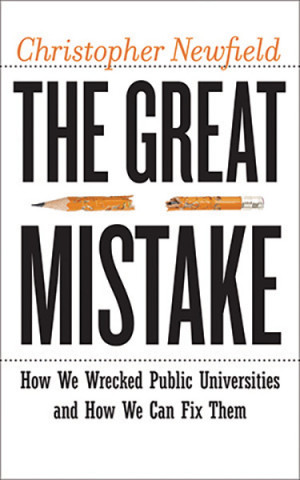
I completely agree that the left needs a positive narrative about the society it wants and why it would be so much better than what we have. It has to involve pleasure and liberation, and freedom from oppression, from the shattering of hatreds, and from the depredations of contempt.  I’ve written a cumulative and positive left narrative around higher education—many many posts of the 2010s on this blog, the “recovery cycle” in The Great Mistake, etc.  Some phases of this narrative seem reformist, some more radical, and all have fallen outside the Hallin spheres  of consensus and of legitimate controversy as policed by academic administration. (I like the Hallin spheres better than the Overton window.)  This kind of narration has to be built out for the whole range of institutions and communities.


This can and must be done.  It overcomes the endless distraction of playing defense, of being trapped in the unending series of critiques that have to be levelled at bad ideas coming from inside the house—from university admin for example—as well as out.   To build the alternative narrative takes discipline and sustained collaboration.  Both are really hard. 


And yet, to ask the question again, does the new narrative achieve mythic power only when it overcomes the limitations of intentional knowledge and critique? Ganz seems to be saying yes. He invokes a passage from George Sorel, quoting Sorel as follows:

The idea of the general strike, engendered by the practice of violent strikes, entails the conception of an irrevocable overthrow. There is something terrifying in this – which will appear more and more terrifying as violence takes a greater place in the mind of the proletarians. But, in undertaking a serious, formidable and sublime work, the socialists raise themselves above our frivolous society and make themselves worthy of pointing out new roads to the world. 


I agree that expert analysis has to join with and become a movement for it to change society or point out the new road towards it.  But I don’t agree with the opposition between fact-checking and the sublime strike in which the latter is the source of the new mythic narrative.  Ganz elevates Musk and DOGE to the level of myth, and writes


This mythic nature of these notions makes the liberal attempts to fact-check or dispute their contents piecemeal a futile exercise. The positivistic approach of liberal pundits, as expressed most characteristically in the unimaginative vox.com mentality, is completely out of its depth when it tries to deal with the policy merits or demerits of these new right-wing myths


We are indeed sick of our pathetic liberalism—and its enablement of the worst projects like Israel’s annihilation of Gaza.  But that does not include Vox’s fact-checking and other earnest and learned effects to expose lies as an essential part of the defusion of violent Trumpian control. 


The left absolutely needs to keep and to rebuild knowledge as such. That means radical knowledge and social movement knowledge and also very much knowledge based on professional expertise—on electrical engineering and ethnic studies alike.  


The appeal to the imagination has to arrive on this basis of knowledge if it is to arrive from the left.  The left is not about regeneration through violence, to recall Richard Slotkin’s great title incarnating the meaning of the US as a permanent frontier.  The right is about that.  The left is about the end of that myth, to misstate the title of Greg Grandin’s excellent book analyzing and debunking. the long violence of US national history.  


So Musk must be fact -checked.  We know that Musk is bullshitting us in the Henry Frankfurt sense of lying in order to control of the audience, and we know this because of some experts in things like COBAL and some medical statisticians on social media and because of reporters like Makena Kelly at Wired, whose editor set up a unit dedicated to tech in government in anticipation of the need to report out on a crusade.  


“Imagination” in the new myth cannot skip data, analysis, argument, persuasion, or organization on the basis of all these things.  It’s where the left’s new narratives will come from.


Posted by Chris Newfield | Comments: 0