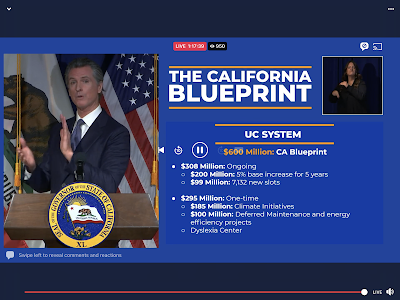
The base general fund increase is five percent next year (see summary slide above), with five percent promised each year for five years total in a new compact between the university systems and the state.
Newsom delivered the compact promise with a joke about how he knows the people who lived through the last (broken) compacts will doubt this one too. Newsom signaling he knows we think Sacramento compacts are worthless doesn't make Sacramento compacts less worthless. So I assume only next year's five percent.
Newsom's five percent is better than Gov Jerry Brown's annual two or three percent--apparently twice as good. However, Newsom gets an inflation rate that is twice Brown's too. The Personal Consumption Expenditures (PCE) Index accelerated from 4.2 percent to 5.7 percent from July to November 2021. CPI hit 6.8 percent, and projections for inflation in 2022 by Fannie Mae and others suggest a five percent increase will be entirely consumed by inflation. Hence the term "flat," and also my sense that the corrected headline is still optimistic. For more than a decade, two Democratic governors have been giving UC and CSU flat annual budgets--when they are not cutting them. That is not changing.
The other touted feature is that the state is funding residential enrollment growth. Newsom proposes it support 6,230 new California undergraduates with $67.8 million (or $10,882.83 per student). Again, it looks good compared to Jerry Brown. He proposes an additional $31 million to buy out 902 nonresident slots at the three flagships (Berkeley, Los Angeles, and San Diego), at $34,368.07 per student. Don't ask me how they came up with those numbers. What is clear is that the nonflagships are not getting state funding for the nonresident students they have been unable to admit because of the enrollment cap that emerged from the political blowback caused by the flagships. Newsom sets up UC for a multi-year series of tuition carve-outs that allow the flagships to keep their nonresident tuition premiums, maintaining intra-campus budget inequality.
Most UC campuses are at capacity and have been for some time, so getting new students means hiring new faculty and staff and building or expanding facilities. In practice, it means more costs and also more hardships for existing students. They will have even more trouble getting courses and housing. Next year's per-student rate is less than half of what UCOP says is the average cost of instruction of each student (that is vastly more than most departments receive per major but never mind). We can say that $10,882.83 will at best cover costs of the new students and at worse create new deficits. Like the base increase, this is not an increase in UC's per-student operating budget. (The small "cohort tuition" hike will also make very little difference.)
Last fall, I suggested 2021 might well be, financially speaking, Peak UC. The governor's new proposal confirms that fear about a stagnant 2020s of unfunded mandates. Further confirmation came from UC president Michael Drake ritually praising the governor's generosity, putting a cap on growth in the bigger revenues.
I'm not going to go into more detail on the numbers until they settle down, and won't chart any trends until spring. Newsom is right to see budgets as "expressing our values," as he said at the end, but his presentation was a numerical mess, referencing three different sizes of surplus ($42 billion, $20 billion, $31 billion), two from his own office, and identifying dozens of individual program totals from two different budget years. So in the meantime, let's take a look at some other issues raised by the presentation, both on the campuses and the state as a whole.
Newsom has exactly two ideas about higher education. One is that it maximize access on the basis of diversity, equity, and inclusion (DEI). The other is that it prepare students for jobs, and by jobs he means jobs in technology.
Newsom makes state funding contingent on several 2030 goals: UC eliminating racial gaps in grad rates, getting grad rates to 76 percent for four-year students, and getting students to debt-free graduation. These are essential goals and UC must achieve them. But they require fundamental change in the UC business model. That now depends on undergrad tuition subsidizing research and other activities--so less money is in instruction and student support, which hurts retention differentially across racial groups. The business model also depends on saving a lot of university money (my estimate is $755 million in 2019-20 using Accountability data) by capping financial aid, therefore forcing undergrads to borrow and work during the academic year (see Stage 2 and Stage 5 respectively).
This is such an important point--the need to fund goals rather than simply assert them--that I'll expand a bit. You improve graduation rates in part by hiring enough instructors so that every student can get every class they need, when they need it. Because of chronic underfunding, many or most students on all UC campuses wait quarters or years to get admitted into at least a few of their core required courses.
How do you reduce racial gaps in graduation rates? You offer personalized, individual advising to every student who wants or needs it. You don't tolerate caseloads of 740 students for each advisor, which Laura Hamilton and Kelly Nielson, in their important book Broke, report is the case at UC Merced's school of Social Sciences, Humanities, and Arts (page 123).
You also reduce racial gaps in graduation rates by taking students of color out of the cafeteria job they use to reduce their borrowing and into class: you cut their work hours ideally to zero while they are enrolled full time. You do not impose a Self-Help Expectation of $8,500 or $9,200 or $10,000 on every student with financial aid, even if they are low income, as every UC campus does. In other words, if you want to reduce racial gaps in graduation, you don't do this, for years and years: have a net cost of attendance of $10,000 per year (after financial aid) for students whose whole family earns $60,000 or less.
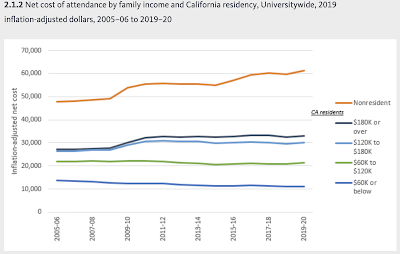
You also don't allow the poorest students to have the most debt at graduation.
You stop doing these things by buying out financing gaps for poor and otherwise disadvantaged students, and then you put money into personalized, intensive advising, well-funded student centers, and other things most UC faculty and staff could name off the tops of their heads. When you start paying to provide these things, you're then able close your graduation gaps.
These are all things UC campuses want to do. None of them are things that either the governor or the legislature want to pay for. None of them are things whose costs UCOP has itemized and justified in public in order to inspire the desire to pay for these essential things.
The governor mentioned diversifying university faculty. This has been an explicit UC goal since the 1980s. Again there are racio-cultural obstacles. But the material ones are at least as important. A diverse faculty comes from diverse doctoral programs, which means strong retention in those programs, means fully funding grad students from working-class backgrounds who are at greater risk of dropping out for lack of funds or excess debt. UC does not fund its doctoral programs at the needed level.
Thus in 2019-20, grad students went on a multi-campus strike over their rent burden, demanding a cost of living increase outside their union contract so they could cover costs in the private rental market. Nothing was done, and the students who started it (at UC Santa Cruz) were expelled for a while. In the midst of the pandemic in early 2021, UCSD grads had to protest in the face of massive rent hikes in campus housing. In 2022, rent burden is, if anything, even worse. The diversity of the faculty stops there, with unmanageable costs of living. If it is serious about faculty diversity, UC should announce debt-free doctoral programs. But the governor and legislature would have to pay for it.
In sum, Newsom insists that UC close graduation gaps with essentially the same per-student funding that caused the gaps in the first place. UC officials should point this out.
Now, on this question of college for jobs: Newsom and most policy people continue to work with a version of Human Capital Theory (HCT) descended from the 1950s, in which "learning equals earning." In reality that is true only for a subset of students (generally already financially advantaged--for the theory's flaws see our LARB review-essay). Policymakers are trying to fix the theory by saying, "tech learning equals earning," and UCOP encourages this splitting of STEM from other fields by publishing wages-by-major data.).
Enter Gavin Newsom: propelled by half-baked but established neo-HCT, he is making these five percent state funding increase contingent on "supporting workforce preparedness and high-demand career pipelines," requiring 25 percent increases in degrees in STEM "and Education or Early Education" disciplines, as well as the same increase in "academic doctoral degrees," all by 2026-27. The requirement is not exactly water-tight, and it also has a very weak justification in existing jobs projections. The original 2015 report that started this "million missing college degrees" fixation shows most new jobs appearing outside of STEM (Figure 4). Did anyone in the governor's office read the current occupational breakdowns for the state? It's the same story here, with tech a minor employer by size (though not by wages, which are high). But the STEM quota sails anyway, towing a legitimate fear about teaching shortages behind.
Even if the job market really did say STEM, it's an invasive step for a governor to mandate changes in degree outputs in a university. Californians felt sorry for Floridians having to put up with Gov. Rick Scott making nasty cracks about anthropology and saying he didn't want taxpayers to foot the bill for useless degrees. Newsom is effectively doing the same thing. It raises allocation questions: Will new faculty lines to teach the expanded enrollments all go to STEM plus a few for education? Will provosts need to stop hiring in arts and humanities for a number of years to pool lines in the "high demand careers"? Should California's future musicians, screenwriters, architects, designers, painters, film editors, historians, novelists, and journalists avoid the experience of being second-class citizens by going to UC?
There are no answers, and this brings me to the experience of watching a governor's budget presentation on dozens of topics where the word "education" wasn't uttered until well after minute 70. Newsom organized his address around five existential threats. He had no vision of a New California, but ran through a series of hard problems that must be solved. I sympathize: he has not been having a joyful time. There's pandemic illness and also its political madhouse, with the recall trying to get rid of him for doing his public health job. There's drought and fire and the climate crisis behind them. There's the cost of living crisis. There's decades of underinvestment in transportation and other infrastructure. There's a very polarized state economy, where a third of the workforce earns less than $15 per hour (page 3). There's a decades-old housing crisis, where so much private wealth has been absorbed into inflated housing assets that the state spent $5.2 billion last year--an additional University of California state budget--paying people's rent.
Newsom brings a lot of energy to this slate of problems. He fired dozens of powerpoint bullets at them, each carrying a $100 M or $200 M or $1 B payload. But it's all the equivalent of filling (very important) potholes, keeping the electricity on, getting the shots in arms, giving the kids something to do in school until their parents get home.
Even the tech future of green transition is remedial, trying to undig the hole of climate change in a state still almost entirely dependent on the private car. There was something hollow in Newsom's enthusiasm for the state's green tech leadership: he cast the state's investment as bait for private investors, took it as an opportunity to hype the hegemonic tech sector that I think he quietly dislikes for its entitlement and arrogance as do most Californians, overpraised legislative honchos and others, and started referring to California as a "leader in this space" or that space--space being a term he used dozens of times.
Contrast this with how Newsom sounds on things he cares about. Then he is serious, knowledgeable, plainspoken, and open. What he really cares about is pre-K, school nutrition, homelessness, getting people out of encampments, mental health, universal health care, summer school for poor kids, a decent access to basic goods for disadvantaged people. Whatever his neoliberal policies might be, Newsom's deeper desire, I felt watching him, is to ease the worst suffering. This is also where he feels useful, even perhaps a bit of a hero. But this desire doesn't find much to feed on in higher education as officials present it to him.
It's not just Newsom: the media isn't interested in higher ed either. During question time, the press had crisp questions about Newsom's contradictions on personal exemptions from Covid vaccines, his concrete plans for supporting reproductive rights, his borrowing of his recall opponents' plans for the mental health system, and his proposed changes in the Medicaid prescription program. They had nothing about higher ed. This is a real problem for the sector. The governors' office doesn’t get vigorously questioned about higher ed, so they don’t prep for that, they rightly think the media and its consumers don't care about the details, so they never think, "we’re going to get pounded on mandating STEM degrees so we’d better think this through."
I’ve written about Biden-era Democrats assigning college to a dedicated space in the welfare state. The good news is that they want government-run social development—Biden has in fact broken with key tenants of neoliberal Obama-Clintonism. The bad news for higher ed is that the Biden-Newsom mainstream has no intellectual developmental plan for higher ed to address. Biden-Newsom are a real policy advance on Obama-Brown--an advance for children, the food insecure, the mentally ill, the unhoused, the uninsured, but not an advance for college students or the educational system.
For them, the knowledge economy is abstract scenery, a slightly smoggy familiar sky. We may need a million more college degrees, but that's just a logistics problem—there’s no interest in process or content or quality upgrades to say nothing of revolutions in thought or in the public's collective cultural and political capabilities. For them, UC and CSU are server farms that should run quietly in the background. There's nothing heroic about them, and they won't make a hero of any president or governor. They are of modest interest as economic infrastructure. They are certainly not, for this Democratic party, a state engine of destiny.
This could be changed, in a couple of diverging ways. One would be all three segments busting out of the workforce preparation trap and developing exciting stories of college-fueled individual and social transformation. I know some deans and individual faculty who could do this. I don't know anyone at the senior manager level who would. Please correct me if I've missed some folks.
The second, more plausible path is to comply fully with the mainstream Democrat welfarist passion. Inspiration is also needed here, that makes the state's politicians heroes of social justice. But that means defining the processes that would allow UC (and CSU) really to meet graduation and the other targets, and then setting their actual price.
Fix the funding, or miss the goals. It shouldn't be a hard decision.