Top Navbar

  • Home
  • About Us
  • Guest Posts
  • Liner Notes

Searchbar

Monday, March 3, 2014

Monday, March 3, 2014
Business Week thinks so: its headline is "Krugman Move Boosts CUNY Effort to Escape Columbia, NYU Shadow."   In this piece, cool is a public city college doing the following things:


  • stealing star faculty from rich private universities, recalling the glory days when CCNY "graduated 12 Nobel laureates between 1930 and 1950."
In recent years, CUNY has hired a number of professors away from elite universities, including Jeremy Kahn, a mathematician from Brown University; Vijay Balasubramanian, a theoretical physicist from the University of Pennsylvania; David Joselit, an art historian from Yale University; and Cathy Davidson, a technology scholar from Duke University.
  • reclaiming the core mission of mass quality:
CUNY has about 274,000 students seeking degrees and almost 250,000 in continuing education and certificate programs, said William Kelly, interim chancellor and past president of the graduate school. It has 24 campuses spread across five boroughs.
“A university can be both public and provide access to a half-million students and pursue the highest goals imaginable,” said Kelly. “What has happened here is that the university has reclaimed its commitment to both access and excellence. Public universities need to do both.”
  • hiring large numbers of full-time faculty: "CUNY has stepped up faculty recruiting, boosting the number of full-time professors to 7,500 from about 5,000 over the past 10 years."
  • not saddling its students with debt: at CUNY "about 80 percent of baccalaureate and associate degree students graduate without debt."  Prof. Davidson made a particular point of saying "part of the draw was the university’s high quality and the low cost to students."
  •  having high levels of innovation: Prof. Joselit remarked, “Public universities are much more willing to experiment with the format, at least in the humanities and social sciences,”
Is public anything more experimental than its private version?  That's how it reads.   Although the job moves of these major scholars are largely symbolic, their visibility, along with statements like these, might help make public colleges seem exciting again.

* * *

How has CUNY been able to do all this full-time faculty hiring at its tuition level of under $6000 per year?  Not by suppressing wages: faculty salary tables at the Chronicle of Higher Education show CUNY sometimes above and sometimes below average salaries in all professorial categories (2012 Almanac).  The recipe seems to be to staff most of the campuses like colleges rather than like research campuses--with the obvious exception of the Graduate Center.

Graduate Center staff consists of about half full-time and half part-time professors (75% of full-time professors are tenure-track);  about two-thirds of its overall teaching staff are graduate students. On the other hand, a check of a few of the CUNY colleges shows lower percentages of full-time faculty.  Hunter has 705 full-time and 1175 part-time faculty (or 37.5% full time): the comparable figures are 38.3% full-time at CCNY and 41% at Queens.

Teaching loads are also pegged to standards for teaching rather than research universities, judging from the experience of the faculty I know at Queens, Brooklyn, Hunter, and Baruch Colleges, meaning that everyone I know in the humanities and social sciences is teaching three or more courses per semester rather than 2 and 2. 

As for research itself, CUNY does much less bench science than universities of comparable size.  The NSF's Higher Education Research and Development Report for FY 2011 ranks the top CUNY unit, CCNY, in 182nd position, with expenditures of less than half those at lowest-spending University of California campus, UC Riverside. Hunter is at 219th, Queens at 265th, and so on.  The Graduate Center doesn't appear, and may be lumped together with CCNY, but it's worth noting that none of the recent hires mentioned in the Business Week piece require laboratory facilities.

One conclusion is that it's easier for public universities to be experimental when they don't have to pay fo rexperimental science.  CUNY also isn't paying for full-scale, full-time research faculty spread throughout the system.  CUNY hires great full-time research faculty at all of its colleges, and then doesn't give them research faculty conditions. Obviously this limits  CUNY faculty's overall research output.

Can public universities maintain or upgrade instruction while staying major players in basic research? The first answer is yes, in the sense that they have been maintaining their 2/3rds share of overall R&D (Appendix Table 5-3).

A second answer is no, they won't sustain this going forward, since they are already having a hard time affording STEM research. For example, they spend nearly twice the share of their own resources supporting research as do private universities: "Public academic institutions supported a larger portion of their S&E R&D from their own sources—22%, compared to 13% at private institutions."

A third answer is that public universities will always be able to sustain or even increase research output--if they increase the share of non-STEM research in their mix.  CUNY can lag in overall R&D expenditures while still having a huge arts, humanities, and social sciences research output since these fields (borrowing the AHS acronym from Gerald Barnett) spent only $3.5 billion of the $65.8 billion spent on R&D in US universities was spent on STEM.)  You can be 265th in expenditures while being an AHS powerhouse, given these fields' much greater bang for the buck.

* * *

A contrasting example appeared in the news last week--Duke University--whose costs were the subject of a piece at NPR's Planet Money.  Duke, the article noted, claims that the University loses money on the $60,000 a year it charges to go there, since it allegedly spends $90,000 per student per year.  This is about 6 times UC's combined per-student in-state tuition --minus financial aid--plus state general fund).

The gap in per student expenditures between top privates and mass publics is shocking and socially inefficient: it's something this blog has been denouncing for years, that the Delta Project's studies made visible to policymakers (Figure 18), that education economists like Archibald and Feldman have analyzed, that I've argued causally reduces attainment and increases racial disparity.

The innovation in the Planet Money piece is that an MSM outlet stages a debate between standard and alternative higher ed accounting, juxtaposing Duke's provost Peter Lange and UC Berkeley's independent budget analyst, professor emeritus of physics Charles Schwartz.

Using the standard approach (I am describing, not endorsing it), Duke reports that a quarter of the $90,000 of per-student expenditure is affluent students subsidizing other less-affluent students, and that another quarter goes to paying faculty salaries. (In the context of familiar claims that academic salaries are the core of higher ed's "cost disease," this is not a large slice.)   Another quarter goes to "sponsored activities," which is close to the normal 20% or so that research universities spend to subsidize extramurally-funded research. The final quarter of the pie chart goes to overhead, which includes facilities and non-teaching staff.


Prof. Schwartz's point has long been that faculty research time gets lumped together with teaching time, so that the faculty cost of instruction is exaggerated.  Provost Lange counters that research and teaching are intertwined at a research university.  (For the record, Prof. Schwartz has never denied this, but has shown how they can be disaggregated so we at least know how much universities are spending on what.)  The Planet Money piece produces an accurate description of the debate:
In the end, Schwartz and Lange don't disagree on the value of what goes on at places like Berkeley and Duke. The disagreement is over the story that Duke tells its undergraduates.
So if you're a student at Duke, are you getting a massive discount on the cost of your education? Or are you subsidizing a giant educational edifice that you as an undergraduate student will barely come into contact with?
The answer sort of depends on what kind of student you are.
If you're engaged in research and capitalizing on your professors' expertise, maybe you're getting something that's worth more than what you paid. If you've got a good financial aid package, you're definitely getting a good deal. But if you're a full-paying student, who's not learning much from professors outside the classroom, it's the university that's getting the deal.
This formulation puts huge pressure on elite universities like Duke to subsidize student costs and to make sure every single student is experiencing artisnal research-learning.   This would be a big change for students who are buying a brand affiliation that will get them to the head of the line for the careers of the 1%, which, judging from Laura Newland's alarming memoir of her Duke undergrad years, is most of them. (You can listen to Doug Henwood's interesting interview with her January 30, 2013).

After many lousy years, I think momentum is starting to shift back towards public colleges. The challenge for them now for has several parts:
  • Get affordable for students again--by being honest about the limits of financial aid and restoring correct levels of public funding.
  • Define hands-on and research learning that brings Duke-style intensity to public university students.
  • Build budgets that allow research and teaching to interact at all types of public colleges. This means transparency about research costs so that research activity can be increased.  
Fewer people than ever will pay $60,000 or even $16,000 for a degree. But they will pay for real learning--if they understand its costs. 
Posted by Chris Newfield | Comments: 2

Thursday, February 27, 2014

Thursday, February 27, 2014
AFSCME announced today that they had reached a tentative agreement with UC and that the strike planned for next week has been called off.  As you will see, this tentative agreement is the result of a long series of bargaining sessions and will be voted on soon by the AFSCME membership.  Negotiations between AFSCME and UC about the contract for Patient Care Technical Workers will continue next week.  I have copied the announcement below.


AFSCME 3299 ANNOUNCES “HISTORIC” TENTATIVE AGREEMENT FOR UC SERVICE WORKERS

Members Must Ratify 4 Year Agreement; Strike Scheduled for March 3-7 has
been Cancelled; Bargaining with AFSCME 3299 Patient Care Technical
Workers to Continue this week

Oakland: The University of California and AFSCME 3299 have reached an
historic, tentative, 4-year contract agreement for the system’s 8300
Service Workers. As a result, next week’s scheduled strike by AFSCME
3299 represented UC workers has been cancelled.

For UC Service workers affected by the agreement—99% of whom are
currently income eligible for some form of public assistance—the
potential settlement includes 13.5% across the board wage increase (over
4 years), affordable healthcare benefits for both current employees and
retirees, and important new safe staffing protections—including limits
on contracting out.

“After more than a year of good faith bargaining, we have finally
reached a historic agreement with UC that will pull thousands of its
full-time employees out of poverty and begin to rectify staffing
practices that needlessly put our members and the people they serve at
risk,” said UC Service Worker and AFSCME 3299 President Kathryn
Lybarger. “While this proposed settlement includes compromise on both
sides, it honors the contributions that career service workers make to
this institution, as well as UC’s responsibility to build ladders to the
middle class. Our members are deeply grateful to the thousands of
students, faculty, colleagues, elected officials, and everyday taxpayers
who have stood with us, and stood for the principles of fairness and
dignity that bind every member of the UC community.”

While UC Service Workers have secured a tentative agreement, the 13,000
UC Patient Care Technical Workers represented by AFSCME 3299 remain in
bargaining with UC, with more sessions scheduled for later this week.
The Patient Care Technical Unit had been scheduled to sympathy strike
with Service Workers next week.

“The Patient Care Unit has been engaged in good faith bargaining for
more than 20 months—even longer than Service Workers—and like Service
workers, has already given UC 80% of what it wants, including the
university’s top priority of pension reform,” Lybarger added. “Having
seen the unflinching resolve of our membership and the many thousands of
Californians who support them, it is our hope that the spirit of
compromise that UC finally brought to the table yesterday to reach a
settlement with UC Service workers will continue in upcoming bargaining
sessions with the Patient Care Technical Unit. If it does, we believe
that an end to this unfortunate, protracted dispute may finally be
within reach, and a new period of cooperation can begin."

------------------------------
-------

Dear Brothers and Sisters:

We did it!

Late last night, the Bargaining Time signed an historic, 4-year
tentative contract agreement for UC Service Workers (SX) that meets all
of our core demands on wages, staffing and job security.

Accordingly, we have cancelled the system-wide strike that was scheduled
for March 3-March 7th.

Here is what UC Service Workers Have Won:

Wages: 13.5% in ATBs; 2% steps in 2014, 2015, 2016; plus $200 signing bonus.

     4.5% ATB 60 days after ratification, plus $200 signing bonus
     3% ATB July 1, 2014 +2% step
     3% ATB Oct. 1, 2015 + 2% step
     3% ATB Oct. 1, 2016 +2% step
     Double Time Pay after 12 Hours

Staffing: New Protections on Contracting Out, Seniority and Layoffs.

     Arbitration language to ensure UC cannot layoff SX employees due to
contracting out

     Agreement that Service work at new UC facilities (UCSD/Jacobs
Hospital, UCSF Mission Bay, and UCLA/Luskin Hotel and Conference Center)
will be performed by AFSCME 3299 SX Unit

     Seniority in Layoffs, Transfers, Promotions, and Scheduling

     Temps must be laid off before career workers

Healthcare Benefits and Retirement:

     1 Tier Pension
     Freeze on Kaiser and Healthnet Premiums for life of the Contract
     Current Employees Grandfathered into Old Rules on Retiree Healthcare
     Freeze on Kaiser Rates for Retirees during life of the Contract

And NO PTO!

Download the Victory flyer in ENGLISH, SPANISH, and CHINESE.  More
information about member meetings and a ratification vote will be coming
soon.

But we are not done yet.

By standing firm these past twenty months, you made today’s historic
victory possible. Now, we must keep up the pressure to ensure our
brothers and sisters in the Patient Care Unit receive the same fair
contract settlement.

PCT Bargaining is scheduled for February 27th and 28th. And we are
asking you to call Janet Napolitano at 510-987-9074, to remind her that
AFSCME 3299 will not stop fighting until UC provides Patient Care
workers the fair wage increases, staffing protections, and job security
they deserve.

Thank you for your continued strength and resolve.

In Unity and Solidarity,  
 
Posted by Michael Meranze | Comments: 0

Saturday, February 22, 2014

Saturday, February 22, 2014
David Dayen has a provocative article at the New Republic on the effects of student debt on household formation.  Drawing on a range of studies, Dayen is able to show that the recent skyrocketing of student debt, combined with the continued depressed state of the economy and the job market, has led young people to put off the traditional American steps towards household formation and generational independence--particularly purchasing of housing.  Dayan makes clear what others have pointed out, that the rise in student debt is not only dismantling the future of recent and current students but is also producing an ongoing drag on the larger economy that will only lengthen the country's economic weakness.

Actually, things are worse than Dayen suggests.

Dayen draws particularly on two reports produced by the New York Fed (or related economists).  The first report reminds us that not only did outstanding student debt as "reported on credit reports" pass the one trillion dollar mark in 2013 but that it increased by $114 billion in that year.  Put in perspective, the increase in debt in 2013 alone was more than half the total student debt in 2000.

The second report sharpens the issue however.  It makes clear that in recent years a significant shift in debtors' practices has taken place.  Before the recession, individuals with student debt were more likely to enter the housing and automobile debt markets (due to their greater confidence in their prospects) than were those who did not have student loans (primarily I think because they had not attended college).  But since 2008 that has reversed itself.  Individuals with student debt are now less likely than those without student debt to have longer-term credit investments.

Now no one knows, exactly why this is.  It is likely a combination of factors.  As Dayen and the Fed researchers note, it is related to the collapsed job market, to the fact that it is harder for young people to get credit with tightened restrictions on individual borrowing (I guess that was instead of actually regulating Wall Street and the Banks) and because the increase in the size of student debt makes people less willing to take on other debt (quite sensibly).   But as with unemployment, underemployment, and lowered wages more generally, there are ripple effects that serve not only to hold back student debtors but the economy as a whole.

Yet Dayen does not draw out the full implications of the data.  As do many, he points to the long-term rise in higher education tuition, drawing on data provided by Bloomberg.  In so doing, he accepts the undifferentiated chronology contained in the claim that tuition has risen by more than 500% since 1985 and thereby throws us back on the neo-liberal emphasis on the "cost-disease."  But if you look more closely at Bloomberg's data you will see that nearly 60% of that growth has occurred since the early 2000s--in other words since the beginning of the heyday of state disinvestment in higher education.

Insofar as the dramatic increase in student debt is helping to undermine the future of the economy, the internal privatization of public higher education (the shift of burden from public investment to private debt) has played an important role.

Oh, and just for the record: UC has not done that great a job on this issue despite its claims for its financial aid programs.  According to its own 2013 Accountability Report the average debt for UC student borrowers was just under $20,000.  According to Fed researchers the average student debt was just over $20,000.


Posted by Michael Meranze | Comments: 0

Tuesday, February 18, 2014

Tuesday, February 18, 2014
Out here in California, our Democrat-controlled state government has been busy repainting higher ed austerity as abundance. Last week's Legislative Analyst's Office reports form an interesting case in point.

Appearing to be a rejection of Democrat Gov. Jerry Brown's college funding scheme, they assert the full adequacy of the current public funding base and call for inflation-capped funding augmentations that will come in large part from tuition increases.  The LAO does want higher ed segments to get a budget keyed to workload, which is an improvement on the governor's more Platonic approach to university funding. But the LAO folds in UC's unfunded students, accepts the current cost share between the general fund and student tuition, and sets up figures that will be impervious to current senior managemnt arguments for better funding.

Meanwhile as Michael noted, the faculty at the University of Illinois-Chicago are going on strike today.  Reading through an explanation for the strike, I found at least one argument that would work better with state government that what most public universities are doing right now. 

What are we doing now? We are in general broadly hinting that current state funding isn't enough. For example, in an interview with UC's President Janet Napolitano, the Chronicle of Higher Education's Eric Kelderman noted that California is on the "vanguard" of economic and demographic shifts towards low-income and first-generation students, and asked whether UC's post-cuts funding was enough to meet the needs of the state in the future.  Pres. Napolitano replied, "No. We have to be talking to the state about increases--increases in the right way" (3:13).

Does this mean more than the 5 percent partial restoration of prior cuts that Gov. Brown has said is the upper bound? Pres. Napolitano didn't say.  UC has previously calculated that it needs annual 12 percent state restorations (see previous posts like  "Addressing the Austerity Lock-In at Public Universities," Jan. 2013) or "The Old State Funding Model is Dead: What Will Replace It?, Nov. 2013).  The Governor and legislative leaders have assured everyone that this will never happen. The current track is that UC will have climbed back to the same state general fund income in 2015-16 that it had ten years before, uncorrected for inflation and enrollment growth.

But why should public universities get much faster state funding growth, exactly? What do public universities need more money to do?

President Napolitano mentioned maintaining and building large capital facilities, keeping low tuition, and planning future enrollment growth.  (She did not mention faculty salaries and pension costs, for which I am very grateful.)   How do these needs play with state government?

Enter on cue the LAO report, "Analysis of the Higher Education Budget," which is not to be confused with the no less attractively titled "A Review of State Budgetary Practices for UC and CSU" referenced by Dan Mitchell at the UCLA FA Blog.

The LAO shows UC core funding as better than ever (Figure 1), up 10 percent over two years in a soft economy and in the midst of a tuition freeze.  The crucial calculation from the state point of view comes in Figure 2, below.  As you read it, bear in mind that the Georgetown University Center on Education and the Workforce recently calculated that the country's 468 "most selective" universities spend on average $13,400 per student per year on instruction (Part 2).


The LAO tells us that even after massive state cuts, UC spends nearly $10,000 more per student than the "most selective" college average.  It also shows UC spending twice what CSU can spend per student, and four times what the community colleges spend.

I am not saying these numbers are accurate: they no doubt greatly overstate how much money winds up in the classroom.  But as presented, the figures destroy any UC claim to inadequate funding. They also make a tacit case for giving new state money to CSU and CCC, since entry-level learners need more instructional resources if they are going to achieve the national goal of increased degree completion.  (The Georgetown report, Separate and Unequal, is a searing, unforgettable analysis of the economic and racial consequences of underfunding).

The first element of a better public research university response would be that much of that money goes to support the core mission of basic research: in UC's case, that we are after all a research university.

On this point, President Napolitano's major innovation has been the new slogan, "We teach for California. We research for the world." This has played well in the state: you may have noted the Sacramento Bee's enthusiasm for assurances that, in spite of a major shift towards the admission of non-resident students, UC is still in the business of educating Californians.

But the second half of the statement implies that UC research should be supported not by the state but by rest of the world, since it's the world that mainly benefits.  This isn't true, and in fact the opposite of the new slogan is just as true: We increasingly teach the world, thanks to the pursuit of non-resident tuition, and we research for California--in ethnic studies and literary history as much as in agriculture and electrical engineering.  Our research is also tied to our  instruction, and is not a separate activity in which undergraduates have no role to play.  Were they separate, UC students should save half of their tuition by going to Cal State.

We've often criticized insufficient support for research costs on this blog (e.g. Michael last month)--and the lack of transparency about them.   If the state doesn't understand the costs of research, it has no reason to pay them.  That is exactly what has been happening, as we can see clearly in a figure from a Public Policy Institute of California report that I discussed in 2012.  The numbers are different from the LAOs because this figure excludes tuition revenue.

The state has plainly decided to fund UC, the research university, more like Cal State, a comprehensive, teaching-oriented university.  If the state doesn't need to help fund research, why shouldn't it cut per-student general funds to Cal State levels?

To keep this convergence from continuing, UC needs to disaggregate and explain research costs.  These can indeed be justified, and we need to do this as a large-scale collaborative project.  UCOP will be formally required to present disaggregated expenses information to the state next year.

While we are waiting for this to happen, we can also focus on instructional costs.  And here, Chicago is more helpful than Sacramento.

Michael has linked an article about the UIC faculty strike by Lennard Davis and Walter Benn Michaels, and they start from the fact that UIC's student body is working-class and first-generation--that it is, in other words, a lot like UC's:
Only about a third of our students come from families making over $60,000, and many of our students are from immigrant families, live at home, hold full- or part-time jobs, and even have children of their own. . . . [T]he UIC faculty and the UIC administration are completely united on the fact that we don’t think that the way to solve [retention and related academic] problems is by getting “stronger” (which is to say, richer) students. In fact, when we put together a “Strategic Thinking Report” back in 2005, we explicitly said we’re not looking to recruit “better” students; we want to do a better job of educating the students we have.
The main goal of UIC strategy, then, is to increase educational quality--which any reader of this blog has undoubtedly noticed has become a national movement.   Profs. Davis and Michaels add, "The UIC faculty is committed to that mission. And the whole point of the strike is to help us fulfill it."

What is the relationship between improved retention of lower-income students, educational quality, and a strike? At first it would seem wages as such: "The median salary of all faculty at UIC is about $65,000," they write, "less than what the average Chicago public school teacher makes.   But the deeper issue is working conditions that allow quality instruction: 
Start with the retention problem. The biggest falling off is between the first and second years of college, so our administration is (rightly) concerned with the first year experience. What courses do first year students take? Who teaches those courses?
Every entering UIC student takes at least one writing course; most take two. Not surprisingly, our writing courses are overwhelmingly taught by lecturers (i.e. non-tenure track faculty), on year-to-year contracts and paid a standard salary of $30,000. Furthermore, although the administration carries on endlessly about the importance of merit, they’re unwilling to mandate a promotion track for non-tenure track faculty, the whole point of which would be to reward merit. 
So what exactly does it mean to insist on the importance of the first year experience and then pay the people most responsible for that experience a wage that virtually requires them to work a second job? What does it mean to claim you want to reward the best and the hardest working when you not only won’t promote them, but you won’t even provide a position they could in theory be promoted to? You’re short-changing both the faculty and the students.
Public universities need new revenues to give students full-time faculty who can be more devoted to feedback, follow-through, advising, and the other forms of face-to-face contact that have been repeatedly shown to improve persistence and learning. They can get them from tuition hikes, which then deters and/or indebts exactly the most vulnerable students that they are trying to help. Or they can get these revenues from the state--on the grounds that a major upgrade in student learning--on a mass scale--is a public good that defends the future.

UIC and UC are research universities that operate in a state political environment in which the Cold War research funding deals are completely finished, and where tuition hikes can and should be capped by the basic facts that public college students are poorer and more diverse and more indebted (and arguably more interesting, worldly, and engaged) than ever. This means that we all have to make the teaching and the research case in interconnected ways and at the same time.  I think we are up to this, and the UIC faculty are making arguments that can help us in California.


Posted by Chris Newfield | Comments: 2
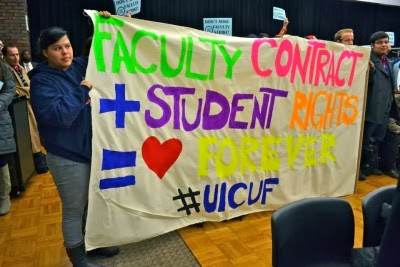
The Faculty at the University of Illinois at Chicago have gone on a two-day strike to protest wage compression (for both tenure-track and non-tenure-track faculty) and also to draw attention to misplaced spending priorities at the University.  At UIC the median salary for tenure track faculty is $65,000 and the standard salary for non-tenure track faculty is $30,000 per year.  The Union at UIC is pressing the administration to allow larger and more regular salary increases for both categories of faculty.

Just at the tenure-track and non-tenure track faculty are standing together, the strikers are also demonstrating solidarity with their students.  As Lenny Davis and Walter Benn Michaels note in a recent statement, UIC students tend to be poorer than their counterparts at related flagship campuses and face larger retention challenges. In order to improve their ability to stay in school students are required to take writing courses, writing courses are taught by lecturers and lecturers are not paid what is a sustainable wage (given the costs in Chicago).  By striking for 2 days the faculty have also ensured that they do not penalize their students.

You can get more information at the union's SITE.

UPDATES:

You can read an interview with the Union President here

And for more context of the strike in a longer perspective see here.

FOR NEWS ON SECOND DAY see here.
Posted by Michael Meranze | Comments: 0

Monday, February 10, 2014

Monday, February 10, 2014
by Philip E. Lewis, Vice-President
Andrew W. Mellon Foundation

Let me try to set the stage for discussion of our announced topic, the cost of program mergers and closings. I first considered the topic closings when, three years ago, the immediate past president of the Mellon Foundation, Don Randel, asked me whether we should consider a grantmaking initiative in support of such traditional fields as German, Italian and Russian studies or specifically in support of teaching the German, Italian and Russian languages. The question arose in the wake of the 2010 MLA report on enrollments, which discussed long-term trends in the study of foreign languages essential to scholarship in the humanities. However, the impetus behind Don Randel's question was more particularly the foundation's concern with retrenchment in colleges and universities that were reacting to the Great Recession of 2008. The MLA report on enrollments barely reflected the moves toward retrenchment, if it did so at all. However, we had previously had occasion to discuss a June 2009 article by Scott Jaschik in IHE about troubles in the field of German, and early in 2010 we were already hearing about cuts in Title VI support of international studies and foreign language programs that Congress was contemplating.

So the larger concern we proceeded to broach with people in various colleges and universities we work with was that the financial difficulties caused by the Great Recession of 2008 could have particularly severe effects on vulnerable academic programs or departments that were already plagued by relatively weak enrollments, a poor job market for Ph.D’s, sub-par resources for supporting a large corps of non-tenure-track language and writing instructors, and a great deal of facile public discourse about the need to connect undergraduate education to gainful employment. Over the next year or so, we came to the conclusion that it would not make sense to support those embattled traditional, commonly taught languages or other apparently imperiled humanities fields in the somewhat rarefied universe of institutions that Mellon serves. We undertook instead some discrete grantmaking related to areas studies and the less commonly taught languages.

Since that moment three years ago, two additional factors—one general and one particular—have come into play. The general one is obviously the interest in online educational opportunities that extend far beyond the domain of for-profit institutions that offer career-oriented degrees. The new online thrust, focused on the design of online courses eligible for credit in non-profit institutions, further loosens the once largely unquestioned hold of traditional in-classroom delivery of instruction. The particular one, which is perhaps unique to Mellon’s liberal arts colleges program, stems from institutions seeking to join in collaborative arrangements for the teaching of Arabic; they can only afford to do it consortially, but at least they are trying to do it in response to strong student demand. This latter trend points toward a related factor—an incidence of program-creation that is greater than that of program-closing—that needs to be included in the context we are considering.

All the factors I've noted--enrollment trends, the job market, the weak position of adjunct faculty, the shift of resources into professional programs, the growth of online instruction, and multi-institutional collaborations in Arabic language programs and often in Islamic Studies as well--contribute to a horizon toward which the topic of mergers and closings beckons, i.e., the effort pervading the whole of higher education to reduce costs by organizing the academic enterprise more efficiently or strategically.

Now, given the structures that prevail in the stratified, marketized system of higher education that we have, which do limit the room to maneuver of the responsible administrations, it is not surprising that closing departments and programs and forcing mergers are frequently considered managerial options. I believe it is fair to say that the data we have on closings and mergers that have actually occurred over the past several decades is thin and that analytic work on the phenomenon is sorely needed. But with that caveat in place, given that the closings and mergers reported over the past five years are relatively spectacular because they turn out not to be all that numerous, and given that administrations do not seem to be rushing at every turn to pursue them, one can reasonably ask why they have not been used more frequently.

At this juncture, the primary observation that I would make is that in classic institutions that would be in the upper quarter or third of the more than 4000 post-secondary institutions in the system, the most prominent effect of the department and program closings that have occurred in well established zones of their curricula has been to draw collective attention to the problems and risks we are facing. A closing or a merger typically results in serious intra-institutional discussions about what is at stake when operational changes are necessary and about how the integrity of an academic and scholarly mission can be preserved or undermined. So there have actually been benefits as well as costs, and one benefit of note has been the mobilization of programs at risk that need to renew and defend themselves. It’s not surprising that administrators hesitate to eliminate components of a curriculum and look for less visible means to make cuts.

Can we nonetheless imagine a scenario that has not yet occurred in which the numbers of closings and mergers that dilute programs would escalate? Could there be a really damaging shakedown that would spread across hundreds of institutions? Such a cataclysm seems far less likely to me than a rather more common phenomenon, less dramatic than outright program closings, that is also far more widespread and harder to study than the shuttering of programs.

The likelier scenario is what I would term shrinkage by attrition and reorganization, in which mergers--the folding of small departments or academic units into larger ones--would be a major device, but perhaps not the most significant one, which would be exemplified by the downsizing that occurs when faculty members retire and their positions are either eliminated or moved to another area of the academic enterprise. That process of resource reallocation is one that can occur with little fanfare. It is the natural result of the principle that allows the intra-institutional market, defined through the lenses of enrollment patterns or student demand, to dictate the ongoing reshaping of the academic structure (or perhaps one should say enterprise).

My guess, which stems from a sense of the history and structure of the system, but which the data worshipers in our world would correctly say is not yet well supported, is that the cost of this subtle, incremental diminution of support for the language and literature, for the liberal arts and humanities, for education as a broad intellectual project is far greater than that of the visible closings and mergers we have witnessed up to now. (A broad perspective that resonates with mine is offered by Russell Berman in “The Real Language Crisis," Academe (September-October 2011.) It is important for us to be talking about how we can recognize and combat that larger and more nebulous trend even as we try to draw the appropriate lessons from such closings and mergers as have occurred.
Posted by Chris Newfield | Comments: 2

Friday, January 31, 2014

Friday, January 31, 2014
By Michael Moon (Emory University) 

After twenty years of teaching in English departments at two other universities, eight years ago I moved to Emory where I took up a professorship in American Studies in the Graduate Institute of the Liberal Arts, a doctoral program in interdisciplinary studies founded around sixty years ago.  In fall 2012, the university announced plans to end the interdisciplinary doctoral program in its current form – in hopes, it was said, of fostering the broader development of interdisciplinary work through other departments.  As of now, a year and more after the announcement, the institutional form and main structures of support for interdisciplinary research and teaching at Emory seem very much up in the air. 


In the year before the changes in the interdisciplinary doctoral program were announced, I had already negotiated moving half my appointment to the Department of Women’s, Gender and Sexuality Studies.  Last year, in the aftermath of the announcement, I moved the remaining half out of the Graduate Institute and into the English department.

So from one perspective, it looks as though I’m back – or halfway back – in an English department after a substantial detour through interdisciplinary studies and American Studies.  But I should mention that I entered this profession in the late 1980s, and that what got taken up by the US academy as LGBTQ Studies and the then-emergent field of queer theory has been at least as much a focus of my teaching and research for the past twenty-odd years as American literature has been.  I co-directed a program in Women’s, Gender & Sexuality Studies at Johns Hopkins and am currently directing an initiative in queer studies at Emory.  My accepting a cross-appointment in a department of women’s, gender & sexuality studies this past year marks the first time in my by-now fairly long academic career that my commitment to queer studies and sexuality studies has been reflected in the name and mission of the department in which I have an official appointment.  In just the past few years, the department itself has expanded its name and range from being solely a Women’s Studies department to being a department of Gender & Sexuality Studies as well.

So, as you can see, before the merging and closing of departments became a widespread matter of concern, I undertook my own ad hoc set of experiments in mixing and moving among departments, disciplines, and interdisciplines.  Based on my own experience of rethinking and renegotiating my own relation to various programs and departments, I feel I can see not only some of the possible necessities but also some of the potential advantages of merging departments and disciplines.  I can also see some of the costs and dangers of doing so under the pressures that faculty are currently feeling and with the kinds of demands that we are currently facing.

Early in my time as a director of a Women’s, Gender & Sexuality Studies program, I remember making my annual call on an administrator to negotiate the next academic year’s budget.  He astonished me by beginning the conversation by saying something like the following to me, “How many more years do you and your colleagues intend to keep asking for resources for this program?  I mean, you’re in English,” he went on, “and there’ll always be an English department, but how many more years is there going to be a ‘need’ for a program like this one?”  In the moment, it struck me as even more concerning that he appeared to be saying this in all earnestness and not in a fit of pique.  He said it as though he expected me to name a fairly small number – we plan to keep coming back for support for two more years? three more years? – and get on with the meeting.  Instead, I said that English departments had certainly not been around forever or even for very long compared with a lot of other academic disciplines, and that it was quite possible that English departments might soon be morphing into other kinds of academic and institutional configurations.  But it seemed clear to me that we really weren’t there to debate the future of English departments, but for him to impress on me his vision of fields such as Women’s or Gender or Sexuality Studies as mere flashes in the academic pan.

Some years later, when the closing and combining of departments first began to be discussed widely, I remember a colleague reporting another conversation with an administrator about the bases on which decisions about these sweeping changes were going to be made.  Well, some departments, the administrator is reported to have opined, are too vital to the operations of the university to be mixed and matched or simply deleted.  “After all,” the administrator went on, “you can’t have a college without English and chemistry!”

The notion that English departments are permanent fixtures on the academic landscape might seem like good news at least to the faculty of English departments, but the way this “good news” is playing itself out is giving at least some of us in the field considerable pause.  What some administrators currently mean by an “English department” seems to me in the main not to be a place or a project that serves the intellectual and professional needs of my students or myself very well.  English departments turned out to serve the needs of faculty and students in queer studies for the first twenty years or so of my career in large part because many of them had – often through a process of prolonged conflict and division – turned themselves into major seedbeds of interdisciplinary growth during the 1970s and ‘80s, so that many fields which have since developed in varying degrees into autonomous disciplines, departments, and programs (critical theory, gender studies, lesbian and gay studies, queer theory, film and media studies, the whole spectrum of ethnic studies, postcolonial studies, cultural studies, etc.) spent their first decade or so as emergent academic fields as flourishing sub-projects of this or that English department. 

So one feature of the current academic landscape that disturbs me is the relentless shutting-down of anglophone literary studies as the kind of expansive set of interdisciplinary intellectual spaces which they’ve provided at many universities for the past several decades.  More and more, English departments are being reconceived as being primarily in the business of teaching expository writing, and the “contents” of courses in literature – both critical and historical “contents” – are being devalued and dismissed as “overly specialized” and “irrelevant” to the present-day mission of the with-it university. 

Similarly, the ecology of methods of interpreting a wide range of writings, literary and otherwise – e.g., “close reading” – is getting brutally reduced in many universities in the rush to make literary studies an outpost of “digital scholarship,” often itself conceived in fairly reduced form.  Many of the wide range of fields and practices currently operating under the umbrella of “digital scholarship” are still emerging and still defining themselves and establishing their connections with other academic fields and practices.  For better and for worse, the continuing impact of the digital turn within and beyond the academy is having massive effects on the entire range of disciplines and departments, effects that are changing and expanding our received ways of thinking about interdisciplinarity altogether. 

I believe that English departments will continue to lose intellectual and cultural ground to the degree that they continue to yield the high investment in interdisciplinarity that many of them have maintained until recently.  The digital turn affords us some very promising new ways of cultivating interdisciplinarity not only across departments but also across media and platforms. The current moment seems to me to be one when it may be both possible and highly desirable for the faculty of some English departments to re-exert our longstanding commitments to a still unpredictably wide range of interdisciplinary research and teaching as an integral part of what English departments do.  The disciplines and interdisciplines through which we now need to move may be quite a different configuration from the ones that we moved through in the 1980s and ‘90s.  Whatever the new mix turns out to be, it seems crucial to me that we as literary scholars and teachers play as active a role as we can in defining that mix, and not accept a one-size-fits-all redefinition of the English department from administrators, however well or ill meaning they may be.
Posted by Michael Meranze | Comments: 0

Saturday, January 18, 2014

Saturday, January 18, 2014
Governor Brown announced the names of his first 4 nominations to the Board of Regents.  Two of his appointments (Richard Blum and Norman Pattiz) are already on the Board and one of the appointments Monica Lozano had served for the previous 12 years.  For his first truly new appointment the Governor chose Richard Sherman, who has been CEO at the David Geffen Company since 1992.  According to the LAT, Blum, Pattiz, and Sherman have all contributed to the Brown's recent political campaigns.  If all four are confirmed the Board will still have 3 other vacancies left.

To say that these appointments are disappointing would be a massive understatement.  The Governor has made a point to show up at Regents meetings and has insisted that he wants to have an open and thoughtful discussion of new ways to sustain the university.  Yet in his first effort to name Regents he chooses to return two of the leading architects of present university policy (one of whom was chair during 2007-2009), asked back someone who already served 12 years, and for his new appointment has reached out to the Hollywood business elite.

I'm not going to get into the various questions that concern the individual Regents.  The more important point, I think, is that this reinforces the sense that Governor is quite comfortable with the managerial and corporate status quo at the University.  To be sure, he is happy to encourage debatable initiatives that assume that courses can be treated as song downloads and pretend that they will be cheaper.  But when it comes to approaching the University as an academic and educational institution he seems uninterested.  Nor has he shown much interest in finding people from outside the established business and political elite.

He could do better.

Posted by Michael Meranze | Comments: 1

Wednesday, January 15, 2014

Wednesday, January 15, 2014
As Chris noted in his last post, Governor Brown's proposed higher education budget contained few surprises.  Unfortunately, that means that his budget fails to address the real funding and resource shortfalls facing the three segments and will serve to strengthen the hands of those--like retiring Berkeley EVC George Breslauer--who advocate piecemeal privatization.  Although Brown correctly notes that he has staunched the cuts that have plagued higher education since the Great Recession--while ignoring his own role in the earlier cuts--the realities of his proposals display his unwillingness to do more than allow for a permanent underdevelopment of higher education. He lets himself appear as more of a friend to the sector than his proposals warrant.

In his discussion, Chris emphasized two points:  first the likelihood that Brown's budget plans would lead UC to rely more and more on lecturers and adjuncts and second, that it will increase the turn towards what EVC Breslauer refers to as "unit-level entrepreneurialism." (3)  Each demands attention.  Although the number of tenure track positions at UC has increased since 2007 the bulk of that increase is due to expansion at Merced.  (see the relevant statistics here)  At CSU there were in 2012 fewer tenure track faculty than there were in 2007 (14)  This despite increases in enrollments.  Nor is there any evidence that "unit-level entrepeneurialism" is likely to decrease: the recent proposal on policies for approving self-supporting programs is only one example.

But I want to focus on two other issues that underline the Governor's support (intentional or not I cannot say) both for privatization and for a policy discourse that conceals the question of privatization itself.

First: By tying state funding growth to a freeze on tuition while funding the sectors below the funds they need to face their challenges, the Governor effectively encourages campuses to increase the number of their non-resident students.  An increase in the number of non-resident students is, after all, the simplest way under the present funding regime for campuses to increase their revenue.  This situation is compounded by the severing of state funding from enrollment numbers.  I know that UC and CSU administrators might prefer this situation.  After all, it allows them to curtail enrollment if they want without losing funding.  And it avoids the traditional problem of enrolling more students than the state was supporting.  But it also means that there is no economic incentive for campuses to enroll an additional resident student compared to a non-resident student.  Now I realize that politically this is unlikely--UC is unlikely to curtail in-state enrollment and risk the damage that would result; CSU only does it under extreme duress.  But if Brown and UC were really concerned to, in the words of President Napolitano, "Teach for California, Research for the World," they would create a new funding model in which the state actually funded all resident students rather than encouraging campuses implicitly to seek out non-residents because of their economic value. 

This encouragement of non-resident enrollment, in turn, has several likely long-range effects--even leaving aside the more extreme market-derived prognostications of people like Brad DeLong.  First, despite UCOP's claims that the increase in non-resident enrollments does not curtail educational opportunities for residents, it is quite clear that it does.  UCOP may be right that there is no one-to-one swap out of resident for non-resident (although Berkeley did try that not too long ago) but even when that doesn't occur the effect is to place greater strain on the teaching, research, and support elements of the campus.  Given that the numbers of tenure-track faculty are not growing in accord with the increase in student numbers the faculty-student ratio will increase.  The Governor seems indifferent to this reality.  Moreover, it seems likely that the growth of NRT and especially international students will only increase inequality within the higher education system.  The greater resources of UC will be compounded compared to CSU and within UC the resources of those campuses that can draw international students most effectively (at this point Berkeley, Los Angeles, and San Diego) will grow faster than other campuses (Davis I believe plans to join the pursuit in a big way).  Put another way, Governor Brown's strategy is a strategy for increasing inequality within higher education.

Brown, of course, insists that given tuition increases over the last 5 years, the sectors have increased their total core funds even with state cutbacks.  But this is one of the clearest examples of why the notion of a "dollar is a dollar is a dollar" is false.  For under present circumstances, where UC's accessibility is tied to its financial aid programs rather than its tuition levels, a dollar in tuition is worth less than a dollar in state funding.  This is for the simple reason that approximately 1/3 of every tuition dollar needs to go to maintaining financial aid rather than to the educational operations of the institution.  Even Speaker Perez's effort to expand state financial aid simply deepens the fundamental logic.  For both treat support for higher education as a private and privatized good and not as a public shared function.  The economic burdens fall on students and their families.  And to make matters worse, as Chris pointed out in November the Governor has suggested that the increase Speaker's increase of financial aid is held as an alternative to increased funding for the University.

Second:  Both the Governor and the Legislative Analyst display a highly confused sense of higher education costs.  The key here, as Chris pointed out, is the emphasis on on-line courses as a mechanism for lowering costs and price.  The issue is not only that 2013 demonstrated that current technologies do not save labor costs nor work effectively in helping students overcome previous educational failings.  The issue is that what Brown tries to dismiss as "high-cost traditionalism" is not being driven by instruction (whose costs as Bob Samuels and others have pointed out has actually gone down over time) but by the demands of research--especially scientific research.  And the way that those costs are borne by universities.

Now before people blow a gasket I am not arguing here against research (scientific or otherwise) nor do I think that scientists are somehow at fault here.  The problem--which the Governor and others refuse to recognize--is that society expects universities to be the center of basic research, that the way that research is organized creates a large administrative structure as well demands expensive infrastructure, and that the costs of this structure combined with the infrastructure exceeds the funding (both direct and indirect) provided for scientific research.  Nor does this take into account the labor costs faced by researchers of responding to the various administrative and oversight demands.  Brown's rhetoric suggests that UC can cut costs through instructional technology (his insistence that instructional technology can overcome the challenges CSU faces is a whole other problem); but this emphasis on instruction prevents the open discussion of the real costs of basic research, of the demands placed on (or seized by) universities to perform needed research, and the willingness of society to support that research adequately.  As debates over the sequester and new practices at the NIH have made clear this is not a problem that is going to go away.  Universities have been able to overcome some of the shortfall through cross-subsidies.  But as the core of public funding is hollowed out those cross-subsidies will become less possible and both instruction and research will suffer.

If the Governor truly wants a discussion about the priorities of higher education he would need to move beyond the narrow confines of budget "realism" and trigger a debate about actual costs (for instance the balance between medical centers and campuses).  In exchange for the possibility of arguing for adequate funding, the Governor should demand from the systems clearer financial accounting (if you talk with Sacramento you quickly will see how frustrated they are at the lack of transparency). 

So, when the Governor insists that UC and CSU should simply make do, he not only is securing a state of continuing underdevelopment of higher ed, but, especially in the case of UC, he is encouraging a privatization of the University that will serve no one in the long run.  To make matters worse, in failing to grapple with the actual responsibilities and costs of higher education he prevents a public debate about what higher education for a better society would actually look like. Otherwise he is simply pretending leadership.


Posted by Michael Meranze | Comments: 17

Thursday, January 9, 2014

Thursday, January 9, 2014
There are no nasty surprises in the governor's budget proposal for higher education. For UC it's pretty much what we've heard: a 5 percent increase in state general funding in 2014-15 (stated as fractionally higher than that), and 4 percent increases in the two years to follow. These small increases leave the 2014-15 state share 14 percent below the 2007-08 level (Figure HED-01).  Following Gov. Brown's previous statements, these increases are made contingent on a tuition freeze.

The budget proposal has some contradictions that UCLA FA Blog explains.  I am if anything even more concerned than my colleague about the "Wall of Debt" alarmism in Figure INT-03 (page 4) as it affects both retirement and state investment, but that's a topic for another time.

The governor's framing narrative confirms that the historic state funding model is dead. This isn't the first time we've pointed this out (here's my November post on the subject, and Michael's from February on Sacramento austerity).  But the official proposal document is quite explicit this time.

First, after offering some moving language bout how important higher education is to the future of the state, the budget proposal asserts that the universities' requests to start rebuilding public funding are based in their "business-as-usual model of providing instruction" (35).  It defines what we normally think of as UC's combination of research and instruction  as the "highest cost-structure" which "receives the highest per-student subsidy" (36).  There is no mention of what that money does, other than express high-cost traditionalism.

The document does not offer a single example of high-cost business-as-usual so that we could understand what the governor's Department of Finance is talking about. I assume DOF means that UC and CSU haven't converted many or most of their courses to on-line.  If 2012 was the Year of the MOOC, 2013 was the year of the bust, both of educational claims for MOOCs, which even Udacity's founder has described as greatly exaggerated, and of the claims for huge cost savings.  My analysis of the budget for the Udacity-Georgia Tech online engineering masters showed no cost savings for online programs that produce decent results, and we are still waiting for the technology that delivers high quality at a new low cost.   The legs have been cut out from under the claim that something about face-to-face instruction fails to exploit massive potential savings--and yet the governor justifies ongoing low investment on that failed claim.

Obviously the governor thinks he is providing management incentives to improve, and there are certainly things about UC management and organization that can be improved. In reality, operational improvements take time and money, as the history of failed corporations abundantly proves.  Absent reinvestment--and internal UC organizational reforms--Gov. Brown's austerity will have two effects:

  • UC will make greater use of adjunct teaching labor (it has above-average tenure-track ratios now, but won't be able to sustain them).  This will happen at the very moment in which the factory model is obsolete, and yet that is increasingly all that UC can afford.  UC students need the same individualized, active learning that their friends at Stanford get so that they can succeed in creative industries, and yet this is exactly what the state's massive cuts and austerity restorations are not going to pay for.  Do Californians really want their public university children to get the leftovers of the creativity industries and whatever else Stanford's D-lab has put on TED?  That, unfortunately, is the funding model, even if we all manage to rise above it.
  • UC will shift an ever-higher proportion of its daily energy to what UC Berkeley EVC George Breslauer calls "unit-level entrepreneurialism, in the article that was the subject of Tuesday's Remaking post, EVC Breslauer is entirely right that this is what the austerity university is doing and will do: break down the campus into units, break down unit into discreet activities, and then charge a toll for each of the activities that can possible bear one.  Some are trivial, like renting rooms for weddings, and others, like executive education, divert resources and energy away from public education and towards forums that are exclusive because of their enormous surcharges.  EVC Breslauer estimates that this will yield $10-20 million. This is a fraction of the Berkeley campus budget, and comes with high transaction costs (could someone in higher ed management circulate Ronald Coase's "The Nature of the Firm" (1937) or at least the Wikipedia entry.  Could Brad Delong write a memo?). Above all, it will change its practices on the metabolic level from open to closed, from free to taxable--exactly as the governor's budget requires.

The governor is also ending the state's obligation to pay for enrolled resident students.  This has two parts.  First, some state funding is shifting from allocations to UC to scholarships for students (again see my November post mentioned above). The state will be more like the federal government, and funding more like a voucher program.  The second part is equally serious, which is that the state will simply not provide funding based on per-student workload.

 The Administration’s long‑term plan moves away from funding higher education based on enrollment targets. By itself, enrollment‑based funding does not encourage institutions to focus on critical outcomes — affordability, timely completion rates, and quality programs — nor does it encourage institutions to better integrate their efforts to increase productivity given the state’s investment. Instead, it builds upon the existing institutional infrastructure, allowing public universities and colleges to continue to deliver education in the high‑cost, traditional model.

Actually, we do need to build upon existing infrastructure to provide educational services. The state hasn't been doing this properly, and to imply that stable funding inherently corrupts is straight-up Thatcherite right-wing ideology for which there has never been decent evidence.

Why is the Brown administration using far-right arguments to justify a failure to meet the real higher educational needs of the state? Is UCOP actually contesting this? Could somebody up there find out? The current path, and its incoherent justifications, leads onto very bleak terrain.

Posted by Chris Newfield | Comments: 3

Tuesday, January 7, 2014

Tuesday, January 7, 2014
By Anonymous

In the last month of 2013 we were treated to two celebrations of the enduring public character of UC Berkeley.   Not surprisingly Frederick Wiseman’s documentary ‘At Berkeley’, with its portrayal of Cal’s senior managers battling against the twin forces of a dis-investing state and a student movement resisting tuition hikes, got all the attention.  Yet of arguably greater significance was an article by UC Berkeley’s Executive Vice Chancellor and Provost, George Breslauer, that outlined the new common sense and guiding philosophy of Berkeley’s senior management at that time and perhaps still now. 
  
Wiseman and Breslauer are fiercely critical of a political culture that has enabled the state to disinvest from higher education.  According to Breslauer, even after the passage of Proposition 30 state funds now account for just 14% of Berkeley’s total budget, down from 30% in 1999 and 70% in 1971.  Although, if one includes ‘restricted’ monies from federal and local government about 40% of Berkeley’s revenue comes from public sources, the withdrawal of state funding has indeed been calamitous.  Despite this Breslauer’s polemic is that Berkeley is now more of a public university than it used to be in the fabled Master Plan era.

Breslauer’s contention is that UC Berkeley serves California more effectively now: our student population is more representative of its population, while our graduates contribute more to public service and the state’s economic growth than ever before. He lacks historical data to substantiate any of these claims.  It is not even clear what metrics could be used to establish that Cal graduates, or the research conducted at Berkeley, contribute more to the state’s economy and public service than Stanford.
  
Nonetheless, it certainly is true that the student body is more diverse now than it once was. Thanks to the state’s changing demographics, the achievements of the civil rights and feminist movements, affirmative action policies and much else besides there have been real advances: 53% of undergraduates are women, and 45% of Californian resident students are Asian-American. There is also still a good way to go to make Berkeley look like the public California.  In 2012, African Americans who make up 7% of the state’s population represented just 3% of undergraduates (down from 5% in 1993), while those who identify as Chicano or Latino make up 35% of Californians accounted for just 13% of students at Berkeley (the same as1993). According to UCOP statistics, just 129 African Americans from California enrolled as freshmen at Berkeley in 2012.

If Berkeley’s undergraduates still fall short of reflecting the racial diversity of California at large, Breslauer paradoxically contends that the dramatic increases in student tuition (up 67% since 2007/8) has allowed it to become socio-economically more diverse.  The Berkeley’s senior management embrace of the ‘high tuition/high aid’ model, he argues, has allowed them to redistribute 33% of resident tuition to low and middle income families: those earning under $80,000 pay no tuition while those with incomes between $80-140,000 receive financial assistance.  There are those who take this argument further suggesting that the old flat and low tuition fee of the Master Plan era represented a subsidy for the 7% of the state who went to a UC from the 93% who did not – and the assumption is that this favored the white, male, middle class over the rest.  In short, the contention is that Berkeley senior management are progressively redistributing wealth through tuition fees
.
There is a lot to contest here.  Once again there is no historical data to suggest that the very low tuition charges of the Master Plan era (at today's prices tuition costs in the early 1960s were just $1,000 , a decade later they had doubled, and even by the early 1990s they had only reached $4,000) was what restricted admission to the middle classes.  At the very least we would need to consider how a range of other demographic, social, economic and political factors made Berkeley’s students predominantly white, male and middle class half a century ago. The quest for equality of educational opportunity across social classes now is an important one but it can only be achieved by state and federal action not by local actors shifting the burden to a small and random percentage of Californian students who plunge deeper in to debt.  In the meantime the high sticker price of a UC education may well actually deter many in low-income families from considering it as an option.  UCOP’s own figures show that these families earning less than $50,000 still have to pay almost $12,000 a year even after all the scholarships and grants.  

Though empirically unsubstantiated, Breslauer’s arguments nonetheless highlight the central doctrine that makes it possible for him to contend that Berkeley is more than ever a public university - namely that what matters is not where its funding comes from but how it is spent.  For Breslauer it appears a dollar is a dollar is a dollar; as long as funds are used in appropriate ways it does not make any difference whether they come from the state, a private donor, a commercial contract or a student loan.  According to this doctrine the diversification of Cal’s funding model does not represent a step towards privatization if those funds cement the excellence of Berkeley as a public institution.

This is sophistry. It makes a big difference where the money comes from and what power is ceded to those who contribute it. Here is why.

The student debt financing of Cal through rising tuition fees corrodes its public character by making higher education a speculative private investment.  Why should 40% of the class of 2013 graduate with loans averaging 18k (and this before the full force of the tuition hikes of 2009-11 are apparent)?  Their education is in fact a public good that will enrich California economically, politically and culturally.

Private donors and corporations have given generously and their names are increasingly prevalent across the campus in research programs, endowed Chairs, buildings, and even Departments.  We are repeatedly assured that donors do not influence FTE allocation but they can and do influence the direction of research by providing funds and infrastructure in some areas and not others.

Commercial operations have changed the character of the campus.  The persistent and continuing financial drain of Athletics—whose handling itself reflects the influence of a donor-driven outlook—has encouraged a good deal more commercial use of campus spaces as Fox Sports TV recent use of Kroeber Square revealed.  Yet even academic units are now actively encouraged to embrace what Breslauer describes as ‘unit level entrepreneurialism’ to generate ‘new revenue streams’ through commercial use of their assets (namely space, academic programs and online technologies). (3It makes a difference where the money comes from when academics are encouraged to think about revenue generation and campus spaces are commercialized.

And with privatization as diversification comes not just new sources of money but the consolidation of a corporate view of the university.  It is not just the ‘restructuring’ of Bain’s Operation Excellence, or the centralization and removal of staff to remote sites through Shared Services, but the creep of corporate language (of service providers, end-users, markets, unit level entrepreneurialism and customers) that leave many faculty and staff feeling alienated and mystified by who creates the conditions of work.

The mystery is that Breslauer is rightly scathing about state disinvestment in public higher education and acknowledges the corporate creep on campus but he then minimizes the damage they cause (or the need for reversing them) by suggesting that the high tuition/high aid model has made Berkeley a better public university after all.

Keeping Berkeley’s reputation as the world’s best public university despite its growing dependence on private funds and corporate management models is clearly important for Breslauer. It turns out then that saving Berkeley’s brand depends upon claiming it is still a public university. Otherwise it becomes just a larger and poorer alternative to Stanford. 
 
The elephant in the room here is that it is keeping Cal competitive not maintaining the quality of mass higher education across the University of California that concerns Breslauer. Instead of advocating for public reinvestment his energies are directed at convincing the state to loosen control of UC’s budget, and the Regents to delegate more to campuses, so tuition fees can continue to rise. Berkeley’s senior management are confident that they can continue to raise income from student tuition, capital campaigns, commercial contracts and research grants.  This is Berkeley and if the UC system threatens its ‘excellence’ they would be prepared to go it alone. 
  
Berkeley is not just a flagship campus. It is part of a system of higher education in California that extends across the ten campuses and through the state universities and community colleges.  The ecology of that system is critical to the health of Cal, the quality of students we teach and the employment opportunities of our graduate students.

If we are really committed to keeping Berkeley a public university we should call for reinvestment by the state.  Proposition 30 went some way to restore, but not make good, the cuts made to public higher education in California by Governor Brown in his first year in office.  It would cost the median tax-payer in California just $50 to restorelevels of student funding to its level in 2000/2001.   Now that is a way to keep Berkeley a public university.
 
Posted by Michael Meranze | Comments: 4