Top Navbar

  • Home
  • About Us
  • Guest Posts
  • Liner Notes

Searchbar

Monday, August 27, 2018

Monday, August 27, 2018
I yearn to return to my beloved topic of truth and fantasy in university budgeting.  But last week it was impossible to avoid the Ronell affair.  There's all sorts of good (and terrible) stuff out there.  The Daily Mail?  Et tu New Zealand? (photo credit).  More links below--though I won't link to the trolling of Ronell's non-condemners, some of which sounds like it was written by a GRU cyberwarfare unit.  

The Ronell case has become for me a case study of the interaction between perm-austerity in the academic humanities and graduate student mental health.  It questions the existence of graduate student academic freedom.  It also shows a systemic failure of faculty governance that, in spite of everybody's pessimism, needs to be fixed.

For anyone just back from deep vacation (or not in the humanities): Avital Ronell is a prominent professor of German and Comparative Literature at NYU.  One of her former graduate students, Nimrod Reitman, filed a complaint with the University charging her with sexual harassment, sexual assault, and other misconduct. An 11-month NYU investigation found Ronell to have committed sexual harassment (but not the other charges); the University has suspended her for a full academic year without pay.  It confirmed that her behavior was "sufficiently pervasive to alter the terms and conditions of Mr. Reitman’s learning environment.”  Case closed?-- investigation conducted, individual offender identified and punished, behavior  sanctioned as violating professional standards.  Message received by that university community and others. In fact not-- the public case was just getting started.

The turning point was a New York Times story on August 13th that refocused the issue around the superficial contradiction between being a harasser and being a lesbian and/or queer woman and/or feminist: "What Happens to #MeToo When a Feminist is the Accused?"  The article also focused on a letter of support for Ronell sent privately on May 13th to the NYU administration.  Signed by an all-star roster of senior faculty in or near Ronell's discipline, it has been widely viewed as demanding leniency for Ronell's conduct on grounds of her elite status, and following an old-school patriarchal practice of casting the complainant into disrepute. Although the signers moved too quickly because they were apparently afraid NYU planned to fire Ronell, they seemed to let their own authority outweigh their lack of knowledge about the case.

The literal answer to the NYT title question is straightforward: nothing happens to #MeToo.  Of course women can harass, queer women can harass, and lesbians can harass--although mountains of international data show that they do it much less frequently than do men.  Ronell's harassment of Reitman (a gay man) doesn't say anything literal about the #MeToo movement except what we already knew: gay men can be in it, women can be at odds with it, and no social movement requires uniformity or purity of victimhood. In a lucid piece, Nisha Bolsey concluded, "The approach of feminists should be clear: to believe Reitman. To attempt to discredit him in the name of feminism is not only wrongheaded, it undermines the cause of feminism."

Such statements weren't enough to resolve anything, once the group letter of support for Ronell went viral.  The philosopher Judith Butler's apology for key elements in the original letter wasn't enough.  Complex analyses on the widely-read queer site Bully Bloggers by Ronell non-condemners Lisa Duggan and Jack Halberstam were definitely not enough.  The reason was that the letter disparaged the graduate student while defining Ronell's mentorship of students as"no less than remarkable over many years." If these fifty prominent senior faculty would take no action against one of their own in this kind of case, then by extension graduate students in general could expect faculty toleration for harassment.   

I was struck by the high proportion of academics who seem to agree, as one FB comment put it, that "harassment of students has always been the norm and MANY students are harassed every day by ordinary, non-star faculty."  Many were worried that fixating on Ronell would encourage the profession to "overlook all of the ORDINARY ways in which predominantly straight white men have been sexually intimidating their students, in milder and more violent fashion, ALL of the time, before and after and regardless of theory and its present standing."  Harassment is a kind of general condition of grad life because the faculty who don't do it themselves don't get involved in stopping it.

This crew was self-selecting so I don't know how representative the sample is. But the logic needs to be taken seriously, and it goes like this:
  1. Ronell is not the exception but the norm 
  2. Ronell is the norm not because most advisors of doctoral students are sexual or nonsexual harassers but because
  3. Structural inequalities of power not only condition but control all advising relationships
  4. Such that (all) graduate students live in a state of permanent quasi-subjugation or, at the very least
  5. A permanent fear of retaliation
  6. Which means graduate students have no functional academic freedom
  7. Nor do they have creative intellectual latitude of the kind that enables original thought and the value of the humanities
  8. And because the faculty are the problem not the solution, this is not going to change.
Checkmate. 

Some examples: Masha Gessen's perceptive overview in The New Yorker highlights what we might call the tyranny of the faculty member's own vulnerability, and ends citing Derrida on the impossibility of justice. Corey Robin, in the Chronicle of Higher Education, concludes, "For all the revelations of sexual harassment within academe that we’ve seen in the past few years, we continue to leave that imbalance of power to graduate students, as individuals, to figure out" -- which of course they can't. Also in the Chronicle, Lee
The shame-harassment spectrum will endure as long as capitalist austerity does.

On Facebook, my quanty self tried to specify just how many Ronells people think there really are--one per department? 25 percent of each  department? We seemed to converge around two per department, but many made the point that the actual number doesn't matter: it's the possibility, the fear, and the near-certainty that if something does happen, nobody short of a Title IX officer is going to do anything.  And that cure can be worse than the disease (see Laura Kipnis in The Guardian). Back to the 1 through 8 cascade. 

Facebook discussions also turned up a strong sense that public universities are more egalitarian and offer less latitude to despotism.  One person, who went from an elite private doctoral program to tenure at a large public research university, wrote   
Untie funding from individuals— ours teach their way through and advisors have no input on funding. Democratize decision-making about funding for [all departmental programs].  Lastly, on the national front, abolish recommendation letters.
All of which got many cheers.

These would help.  But also: could we not think much more about how faculty can improve graduate mental health and academic freedom by working harder to end austerity in graduate education? 

Drew Daniel and everyone else are right that the root cause is competition under austerity, and yet most tenured humanities are fine with perpetuating it by shrinking their graduate programs.  The humble project of cooperative downsizing has been going on for nearly four decades--and here we are, weaker than ever, and expecting more weakness to come. If you are not entirely sure why austerity always does this, Mark Blyth or Richard Seymour can help.   

The alternative is to increase demand for our students. That will involve increasing undergraduate enrollments, intensifying undergrad education, and enlarging and explaining the humanities research agenda. We need non tenure track positions to be converted into tenure track positions.  Obviously this cuts against current trends, but current trends will bring more of the rot we're here to discuss.

To grow the humanities and Theory, we need to wrestle with the Theory legacy.  First, most of the modern version takes the university for granted.  A great exception was Jacques Derrida.  Another has been Judith Butler: in addition to her institutional work, she has also theorized the university as a condition of critique and as one important source of social justice: this Critical Inquiry essay (2009) offers a good overview.  The university needs its own ethics of care.

Second, we need to be clear that this Ronell case (leaving her scholarship aside) should have zero impact on its future.  Research universities fund disciplines based on the intellectual value of their research topics and programs.  They fund theory across the board, in engineering and economics and art history and philosophy, because theory is about getting at invisible forces that shape or control the empirical world.  Theory is also about refining methods of study so that our study is less rather than more distorting of what we study.  This turns out to be very hard to do--in chemistry as well as philosophy.  Theory is thus the condition of all intellectual progress and also of disciplinarity--not to mention rigor and validity.  So nothing Ronell did can embarrass the intellectual project.  The point is obvious if we glance at another field: no one said the disgrace of astronomer superstar Geoff Marcy might tarnish the search for exoplanets.  The same is true of critical theory in German or in any other language and culture.  Theory's issues are quite unexhausted, even as the material conditions of their study have been slashed.  We need to hold universities accountable to their intellectual mission and not let them use marketing, liability, or financial issues to advance the under-study of core issues.

What about this term that came back from the dead last week: High Theory (HT).  It is associated with French deconstruction and poststructuralism as it crystallized in the 1960s and 1970s and migrated to American humanities departments.  Ronell is a Germanist, so closer to those complex literary and philosophical cultures that were also taken up by the original French poststructuralists.  I got my PhD in a time and place where HT was going from insurgent to hegemonic, though it didn't keep me from turning into someone who studies the university's plumbing. I offer three quick points about it.

The good: as I already noted, theory studies foundational issues and HT got literary criticism past its Cold War positivism into new depths.  HT works on the relations between language, reason, consciousness, affect, the unconscious, objects, other people's subjectivity, and various related factors. It is preoccupied with invisible causes of visible things, and with their intractability.  It attracts the kind of people who, if they were in physics, might study the evidence for the possibility that our curved universe, the brane, sits in a bulk of multiple higher dimensions.   I've had a debate with some university studies scholars about whether intellectual Bildung is really compatible with democracy.  I think it is: difficulty is the lesson of theory for democracy.  Ronell by all accounts has among other things tried to disrupt linear narratives and common sense. Intellectual conventions do need to be tested and violated, or else nothing new ever happens. This not too sympathetic Martin Jay review of Ronell's Fighting Theory is a good reminder of disruption's positive side (h/t Helen).

The bad: in my experience, HT never figured out how to teach the full background you needed to understand the immediate ideas and texts.  Some people didn't really try.  But most did, with mixed success.  If you are in a course on Wordsworth and post-structuralist theory, how do you read enough Derrida to understand the professor and your classmates while also covering the Wordsworth carefully along with canonical Wordsworth criticism?  If you are in a seminar on Derrida and poststructuralism, how do you learn enough linguistics to understand his critique of Saussure, and enough Husserl to understand his critique of phenomenology, or enough Levi-Strauss . . . you get the idea.   Maybe 10-20% of the grad students were solid enough in three background areas to scramble to master the fourth or fifth that you needed to understand one of the major authors in your course.  My cohort did okay because of nearly-ideal funding conditions, but to my knowledge HT overall never solved the basic curriculum problem.  And here's my real point: because HT never faced the curriculum problem, it never faced the resources problem--more time, more collaboration, more archives, better searching, more depth.  The political economy of research has been put of until tomorrow, for decades.

The ugly. The gaps in student attainment were filled by a status Darwinism.  There were the truly smart who could follow the masters and the not smart enough who couldn't.  The New York Times piece reported, "Maybe, Professor Ronell suggested, [Reitman] was frustrated because he just wasn’t smart enough." This essentialism has again become a major grievance, and it has been hurting HT's reputation and dampened interest in learning it for going on 40 years.  

In reality, the source of different levels of performance is different levels of education. Ronell would naturally try to recruit graduate students with B.A.s from Yale rather than Oberlin or Cal State Fullerton--not because  all the smart people are at Yale but because Yale's philosophy, German, French, and other departments offer years of intensive training in seminar conditions in her exact tradition.  HT never denaturalized the foolish discourse of smartness, and in addition to wreaking psychic violence it has kept tenured faculty from pushing relentlessly for the economics that can fund the difficulty. 

Fund the difficulty!  When will humanities faculty address the basic political economy of their fields? TT faculty teach twice as many courses as their counterparts in the sciences, and have grads who do still more teaching while trying to learn research.  Hum faculty mostly mentor grads as an overload.  Extramurally-funded science labs give their doctoral students systematic training and experience in research and not just teaching (though they have problems of their own). The humanities have no equivalent: their grads operate in a semi-DIY environment in which it's easy to think, "my diss project has no structure because I am not smart enough."  I think that more structured and intensive research training would help grad mental health--and help re-professionalize some regressed faculty-student relationships. The economics will take some time to solve, but we'll never get started if we don't want it on academic grounds. 

This gets us to faculty self-governance.  My sense is that the helplessness of tenured faculty towards academic financing has been leaking for years into their relations to the departmental structures they actually do control.  In the Ronell case, there seems to be general agreement that she long felt entitled to evade professional standards.   Where was the DGS, the department chair, the other faculty?  Apparently not creating a support structure that grads felt could protect them from tyranny and retaliation.  

I don't mean that funding shortages are ever an excuse for tenured faculty inaction, especially at NYU where comparatively speaking there aren't any.  But faculty not confronting political economy is part and parcel of not confronting abuses of power, which are paired traits of neoliberal subjects. Writing in punctum,
I agree: and this "dynamic administration" of the "container" of doctoral programs is entirely in the hands of faculty and students, starting very much with tenured faculty.

I would very much like us--again, especially the tenured--to focus simultaneously and persistently on fixing the psychological and financial conditions of the humanities' theory projects in all their forms. That will mean growth and depth of graduate programs, i.e. anti-austerity.

for them:
I'm happy to help with the plumbing.

Posted by Chris Newfield | Comments: 6

Monday, August 20, 2018

Monday, August 20, 2018
August 19, 2018

I can only speak for myself since the signatories of the letter addressed to the NYU administration regarding the sexual harassment charges brought against Avital Ronell are not a group with a single view, and different authors helped to craft the draft version of the letter that appeared online without our consent. When the signatories learned that termination of employment for Ronell was under consideration by NYU, we were bewildered by the severity of this possible sanction.  We understood she was accused of conducting a “romantic friendship” and that her emails had been scrutinized for evidence of a sexual relationship.   Our aim was not to defend her actions – we did not have the case in hand – but to oppose the termination of her employment as a punishment. Such a punishment seemed unfair given the findings as we understood them.  In hindsight, those of us who sought to defend Ronell against termination surely ought to have been more fully informed of the situation if we were going to make an intervention.

Moreover, the letter was written in haste and the following are my current regrets about it.  First, we ought not to have attributed motives to the complainant, even though some signatories had strong views on this matter.  The claims of sexual harassment have too often been dismissed by discrediting the complainant, and that nefarious tactic has stopped legitimate claims from going forward and exacerbated the injustice. When and where such a claim proves to be illegitimate, it should be demonstrated on the basis of the evidence alone.

Second, we should not have used language that implied that Ronell's status and reputation earn her differential treatment of any kind.  Status ought to have no bearing on the adjudication of sexual harassment.   All faculty should be treated the same under Title IX protocols, that is, subject to the same rules and, where justified, sanctions. 

Immediately after the confidential draft letter was published online, I was in direct communication with the MLA officers (the Executive Director, the President and the First Vice-President) to apologize for the listing of my position within the organization after my name.  I acknowledged that I should not have allowed the MLA affiliation to go forward with my name.   I expressed regret to the MLA officers and staff, and my colleagues accepted my apology.  I extend that same apology to MLA members.

We all make errors in life and in work.  The task is to acknowledge them, as I hope I have, and to see what they can teach us as we move forward.

Posted by Chris Newfield | Comments: 3
This spring and summer, the Chronicle Review has published a series of faculty essays that agonize over the fate of the university in general and of the humanities in particular.  

In itself, this is a good thing.  The university does need to redefine its destiny, and yet the policy world is doing this without faculty voices.  But our work needs to be better.  Last week's entry is a case in point. 

I mean a piece by Adam Daniel and Chad Weldon called "The University Must Be Defended." It's a retort to responses to the authors' initial essay at the end of July, "The University Run Amok!"  

In that first piece the authors have an important core point:
The university is what it is today, in part, because of the atrophy of other public institutions, which has left universities to fill a widening void. Higher education is in a precarious position; so too is the American republic. In order not just to save themselves but to fulfill their social role, universities need a more refined understanding of their responsibilities to the public — and of how to meet them in ways that are consistent with their own animating purpose.
All true.  So what do the authors say should be the more focused public missions of the university core of teaching and research?  I couldn't tell you.  From here the piece goes sideways until it concludes like this:
Democracy does not need a prophet; it needs a public. And universities can help sustain, nurture, and establish that public by bringing knowledge out into the world and defending it as a common good. The history of American universities and that of the American republic are interwoven, and so too are their futures. It is not enough to save the university; we must redeem American public life.
Sounds like Daniel and Wellmon want the university to reverse mission creep and return to the core functions of teaching and research.  At the same time, they want it to do even more.  They call on the university not just to offer health education or STEM degrees to the public but to "sustain, nurture, and establish" the public and also to "redeem American public life."   Introducing knowledge to society and then defending it--through high-cost research, permanent PR campaigns, continuous donor solicitation, political lobbying, and advanced community services--is what got us where we are in the first place.  Daniel and Wellmon end their piece by calling for more of what they oppose.

What went wrong here?  Three things.  I bring them up not because this piece is bad but because it has features shared by most of today's academic jeremiads. (I should add that I admired Wellmon's co-authored review of The Great Mistake and his own book on the earlier history of research universities.)

So: 

1. Idealized causality.  Daniel and Wellmon spend much of the piece in a recital of intellectual touchstones of university history--presidential views in California, Wisconsin, Chicago, the passage of the GI Bill, etc.  They omit institutional analysis, even in the form of one case study.  They mention several candidates. Take Shanghai-based "UVA Global Llc": they note its existence, but what does it mean?  Does it spread the university core (teaching and research) to a new international public, making it good?  Is it a branding exercise offering substandard courses taught by exploited adjuncts, making it bad? What process produced it? Was it driven by board members with business interests in Asia? Was it invited by Shanghai officials concerned about limited access to higher education for local students?  We don't know--it's status here is as another thing UVa does.

They also mention UVa's 67-member police force.  What about it? Does it drain money from the classroom? Is there something about a university police force that is likely to intensify racist campus incidents or white supremacist marches, or to de-escalate them? Do the authors think universities should return to their core (and save money) by eliminating campus police departments?  Or are campus cops a sign of democracy (the institution could control its own police) or of its failure?  The essay doesn't discuss what the effects are of such units of the university, whether they are bad or good, or what their causes are such that they could be reversed.  

2. Sealed budget envelope. Daniel and Weldon don't have a budget analysis. The first paragraph lists a few top-line numbers, but these don't mean anything in themselves. Is the University of Virginia's $3.2 billion operating budget big or small?  Does it mean efficiency or inefficiency?  Is the medical school draining the campus or bringing it new net revenues?  Does managing so many units distract from academic development,or enhance it? 

The same questions arise for UVa's investment company: it is good, partly because it avoids paying management fees to commercial providers, or bad because its overhead is high?   How about buses?  Big campuses run bus systems for lots of reasons: to keep parking lots to a minimum, keep student cars off campus, keep student and employee cars off city streets, increase campus unity, reduce their carbon footprint, etc.  Is this bad for the instructional and research budgets, or good? Is it bad for the "common good," or good?  We can't tell from this piece.  

One author, Adam Daniel, is "senior associate dean for administration and planning." He presumably has data that could answer such questions.  He doesn't bring these to the table.  In general, we can't address issues of scale and impact without data analysis that uses net budget figures, broken down by relevant units, seen in cash-flow relation to others- for starters.

3. Unspecified social concepts and agents.  What do "democratic," "common," and "public" mean here? In the final paragraph that I quoted, these terms are more or less interchangeably good.  Elsewhere, public is bad, as in this passage that I found especially captivating.
The fate of American universities over the course of the 20th and now 21st centuries has been inextricable from the fate of American society more broadly. How can they fulfill their democratic responsibilities but avoid the endless accretion of functions that risks undermining them? How can universities adjudicate among their proliferating purposes? 
Scholars such as Christopher Newfield have consistently called for universities to recover a "public good conception" to overcome their capture by private interests. But it is precisely such a vague public commitment that makes the contemporary university’s situation untenable. The conflicting interests of the public, the systematic and long-term disinvestment in public institutions more broadly, the amalgamation of public and private interests — all of these make any return to an unalloyed commitment to an idealized "public" difficult and ill-advised. The university’s democratic commitments have become too centrifugal, pulling apart its interests, energies, and purposes. To save itself and to better serve its democratic purpose, the university needs to be not more but less reactive to public demands. (emphasis added)
One consequence of the ascendance of the "American" model is that it forced universities to justify themselves in public terms. But today the only widely shared moral language, the only commonly accepted way to talk and think about ideals and purposes, is the rubric of economic utility. 
Here the public hurts the democratic university by forcing it to meet too many demands.  But which public? The university hasn't kowtowed to poor students or immigrants or Native Americans or working-class students or students with 1050 on their SATs.  It hasn't bent to the will of transgender activists or anti-student debt advocates or non-Christians (in spite of the claims of U.S. Attorney General Jeff Sessions).  Nor have most universities bowed to the employability agenda and purged their liberal arts and sciences.  Daniel and Wellmon don't specify the public agents that they think have been pushing the university around.

I have the same problem with their claim that the university has been hurt not by private interests but by the critique of them--that is, by the work of a "vague" "public good conception" of the university that they attribute to me.   

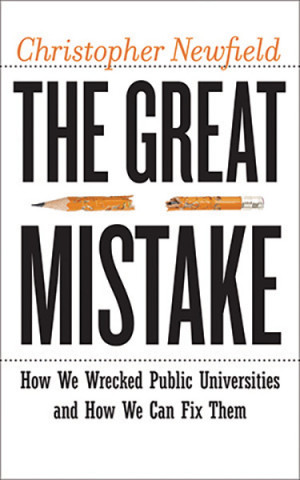
In The Great Mistake (just released in paperback!) I expend 10,000 words on this public good conception. Perhaps all of them are vague. But my two-sentence definition has been (1) negative, as not the reduction of the total effects of higher education to the private pecuniary good of a higher salary (a defining feature of neoliberalism in universities); and (2) positive, as "a good whose benefit continues to increase as it approaches universal access" (New Stage 1).  The first of these is in fact similar to where Daniel and Wellmon end up in their zig-zag towards a concern with the dominance of economic utility.  The second overlaps with well-established theories of network effects, social goods, and common wealth while also rejecting human capital theory (see Wendy Brown, Simon Marginson, Susan Robertson, et al.)

There are many weaknesses in terms like "public" and "social"--see Jason E. Smith's valuable critique of David Graeber's term "positive social value" in Bullshit Jobs.  But Daniel and Weldon don't define their concepts so that they could show how "public" has hurt universities more than or instead of "private."  The effect of the passage I cited is that of two academics seeming to strip "democracy" of "public" in its diversity, rather than beefing up shared governance so universities could better design their (democratic) response.

On to one of the responses: their omission of political forces drove Cathy Davidson understandably crazy.  Her piece is a good resumĂ© of five key features of the last forty years of policy doctrine that Daniel and Wellmon left out.  The first four are businessize (management), privatize (revenue sources), vocationalize (teaching), and austerityize (all public universities).  Only two of those are real words but you get the picture.  It's important to me that we see how they are all based on treating higher education as a private good.

In their reply to Davidson, Daniel and Wellmon note correctly that universities are also perpetrators and not just victims of outside forces.  Davidson seems to have helped them concede that the political world's "private, market-based approaches" did influence the university's loss of educational focus. They don't note the reason for this, which is that much or most of the value of educational effects, the non pecuniary and nonindividual effects, can't be returned to the person who paid for them, which invalidates the market pricing mechanism that is supposed to result.   But their acceptance of the existence of market failure gets us back to the starting gate at least, which leads them again to their call for a "democratic model" without the content to show how it would be different from what universities do now.
 
As you can tell from this post, I'm increasingly focused on how better methods can help get us out of the blocked debates we're suffering now.  Obviously for me that involves the interdisciplinary field of Critical University Studies.  It is grounded in existing university research across the disciplines. It examines the lived relations of academics to their workplaces (see the recent posts by Elin Danielsen Huckerby and Lizzie Swan).  It helps fix the three problems I've discussed.  It tracks institutional causality and studies resource flows.  It also uses what the philosopher Anna Alexandrova calls "explicit mid-level constructs" to link universities to political discourses, economic forces, and state power.  In any case, we all need to help each other do better.

Other recent pieces: there's Jeff Williams essay on academia's self-promotional imperative (a good example of CUS linking institutional changes to work experience). And Michael says don't miss the comments on this newspeak redefinition of shared governance.
Posted by Chris Newfield | Comments: 0

Saturday, July 21, 2018

Saturday, July 21, 2018
by Lizzie Swann
Faculty of English
University of Cambridge

As a scholar of the former, with a growing interest in the latter, this is a question I’ve asked myself a few times over the past year or so. On the one hand, most of my days are spent reading, thinking, and writing about topics that are likely to seem highly esoteric to most people outside of my discipline, and probably to some within it, too.  In the past month, for example, I’ve been working on an essay about early scientific experiments into what were called ‘self-shining’ substances (such as phosphorus), and how these experiments informed metaphors of light in contemporary poetry. On the other hand, as part of the British Academy Early Career Network on Critical University Studies, under the dynamic, astute, and generous leadership of Alison Wood at the University of Cambridge, I have begun, slowly, to familiarize myself with the administrative and financial processes, and political policies and ideologies, which underpin universities in the twenty-first century.

For the most part, I’ve been inclined to see these two sets of interests as absolutely distinct. Renaissance culture is a long-standing fascination, nourished by brilliant teachers, mentors, and colleagues. Critical University Studies is a more recent pursuit, prompted by a desire to know more about how the institutions in which I expect to spend my professional life actually function, about what kind of conditions of work I might expect, and about the different kinds of role I might take on. It also came from a desire to understand how higher education is perceived outside the academy itself, and how I might best justify the work that I do to people who are suspicious of it – people like the taxi driver who, after asking what I do for a living, asked in belligerent tones, ‘what’s the point of that, then?’

Recently, though, I’ve begun to wonder if I’ve been mistaken in seeing my research on Renaissance literature and history on the one hand, and my interest in Critical University Studies on the other, as separable and distinct – and whether this error, if that’s what it is, reflects a broader fallacy within Critical University Studies itself. In particular, it seems to me that CUS has tended to focus on broad social, economic, political, and institutional forces at the expense of sustained engagement with the passions and preoccupations that drive the research and teaching of particular individuals. Another way to put this is to say that it treats ‘the university’ as an institutional entity that is separable from the specifics of the work that takes place there. CUS seems to presume that an individual’s conditions of work have little or no bearing on the content of that work. So whether you’re working in a permanent position, or a short-term, teaching-intensive fellowship, may have a bearing on whether or not you manage to finish and publish that article on (say) the dissemination of Romanesque architecture in early medieval Europe, or the psychology of high-altitude climbers – but it will have little bearing on the content or argument of that article.

To me, this seems implausible: surely an individual’s conditions of work, and their feelings and thoughts about those conditions, will influence the kind of research they do, and therefore the kinds of knowledge they produce? In my own case, I’m sure that my current position as an ECR on an interdisciplinary collaborative project in the humanities has influenced, consciously or unconsciously, the work I do. Much of my current research, for instance, focuses on identifying points of contact, in the sixteenth and seventeenth centuries, between the different modes of knowing that we have come to associate with ‘the humanities’ and ‘the sciences’. My interest in this topic is, inevitably, driven by lots of different factors – but not least amongst them, I think, is that it provides a way to reflect, indirectly, on the hierarchical disciplinary structure of the twenty-first century university, and on my place (as someone who works in the ‘soft’ humanities rather than the ‘hard’ sciences) within that structure. In other words: I wonder if my desire to understand the historical commonalities between the humanities and the sciences is driven, in part, by an ancillary desire to recuperate some status for the humanities today, in a period when their value and worth can seem uncertain? This is, of course, a personal example, but I think there’s a broader question here about how the entity of the twenty-first century university – the subject of Critical University Studies – shapes the kinds of knowledge we pursue and produce within the parameters of our specific disciplines.

Another, less personal example, for instance, might be the pan-disciplinary surge of interest in materiality within the humanities and social sciences across the course of the last couple of decades. At risk of sweeping generalization, this material turn has been characterized by its affinities with a whole range of theoretical and critical ‘isms’ – most obviously constructivism, feminism, Marxism, and posthumanism – and consequently by its investment in breaking down subject / object binaries. To take just one somewhat arbitrary example from my own field: Will Fisher has argued for the fluidity of sexual and gender identities in the early modern period by exploring how clothing and prosthetic objects were used to ‘stage’ such identities.1 Here, sexual identity is not an irreducible psychic core, but a contingent material construct.

What relation might this kind of research, and the ‘material turn’ more generally, bear to broader social, political, and economic shifts over the course of the last few decades – most pertinently here, the much-decried neo-liberalisation of the university? An article by the literary critic David Hawkes points towards an answer here. For Hawkes, ‘the material turn’ is riven by an internal contradiction. The ‘insistence on the “materiality” of the human subject’ that is so characteristic of the material turn, Hawkes argues, ‘chimes perfectly with market ideology.’2 Despite this, however, ‘most materialist critics… still consider themselves, in some indefinable sense, of the political Left’ – and hence obliged to resist market ideology. As a result, new materialist critics:
…find themselves torn between their politics and their epistemology. On the one hand they claim that… the subject is an object, that it is material. On the other, they usually declare at least a nominal opposition to the economic system whose most conspicuous ideological effects are, precisely, the objectification of the subject and the subjectification of objects.3
In other words: despite its radical, emancipatory, leftist-ish rhetoric, the ‘material turn’ actually engages in precisely the kind of commodity fetishism that characterises neoliberalism, collapsing the social and spiritual into the material and economic.

This is not the place to discuss in detail whether Hawkes is right or wrong (I do feel compelled to note briefly that, although I find his broad argument ingenious and cogent, I think it unfairly flattens the nuances of some of the individual works he discusses). It’s also worth noting that Hawkes elides the question of agency: the materialism of cultural studies ‘chimes’ with the market ideology of capitalism, but it’s not clear which party banged the gong. Are materialist critics to blame for their espousal of the very ideologies they are politically committed to resist (as Hawkes implies when he takes them to task), or are they, too, the tragic victims of a market ideology which, like a twenty-first century Midas, inexorably translates everything it touches – including literature departments – into the terms of economic value?

Personally, I’d be reluctant to remove individual agency entirely from the equation: scholars’ intellectual and theoretical passions and preoccupations are never purely a consequence of broader forces. For a start, people’s choices of research topics and arguments are undoubtedly driven by very personal factors, too – by life events, by instinctive affinities and interests, by emotion and curiosity. In any case, though, Hawkes’ article is a timely reminder that the question of how specific research projects and intellectual trends relate to the social, political, and economic conditions of their production demands much more consideration that it’s yet received, either within the specific disciplines themselves, or within Critical University Studies.

The flipside of this, of course, is that in thinking more closely about how broad socio-economic forces within the university shape the knowledge that is produced there, we might also come to see how research in a range of disciplines can have significant implications for our understanding of the purpose and functioning of the contemporary university. Christopher Newfield’s work provides one exemplar here. In his book Unmaking the Public University, Newfield has traced links between the prominence of Foucault in literary cultural studies, and the market decline of related disciplines. In attributing change to systems rather than individuals or groups, Newfield suggests, an American (mis)reading of Foucault supported a culture of political apathy within literary cultural studies, whereby attempts to intervene in and shape the market were seem as naĂ¯ve or futile.4

This kind of syncretic thinking, however, is still relatively rare – and some of the onus for developing it should come not just from scholars who identify as Critical University Studies specialists, but also from those with a more traditional disciplinary identity. So perhaps part of the task of CUS is to encourage people working within traditional disciplinary parameters to reflect more on the relationship between the content of their work and the conditions of that work. To hypothesize: a firmly historical project on the development of more accurate ways of measuring time in the wake of the industrial revolution, and the consequences of this for workforces, for example, clearly has the potential to cast new light on the ethos of competitive overwork that characterises twenty-first century academia.

In other cases, we might use our research specialities in order to better theorize Critical University Studies itself. Recently, I’ve been pondering an issue that’s recurred a few times in our discussions within the British Academy Early Career Network on CUS – namely, the paradoxical position of Critical University Studies as a field which critiques the very institutions it also inhabits and, in part, helps to constitute.  This paradoxical position was, for instance, very much in evidence when Alison, as leader of the network, had to the reschedule a planned workshop due to the University and College Union strikes over pensions in February and March this year. In this case, withdrawing our labour for the university entailed deferring our critique of the university. With the strikers, scholars who work in the field of Critical University Studies are often fuelled by political outrage, and are deeply invested in activism – we are critical. But on the other, we’re trying to perform this transformative work from within and with the support of, universities as they currently are, with all their flaws – the very universities that our lives and livelihoods are so bound up on. So in a way, it can feel like we’re chipping away at the ground beneath our feet, or trying to see through the walls of a building that surrounds us.

How might we better understand, or perhaps even dissolve, this apparent conflict? Perhaps one way to do this is to think of it as a product of what the historians of science Lorraine Daston and Peter Galison have identified as the post-Romantic valorization of objectivity, which takes a subject’s involvement in the object of knowledge as a barrier to, rather than enabling condition of knowledge.5 Understanding – through the work of scholars such as Daston and Galison – the ways in which our categories of knowledge are themselves contingent historical constructs might then help us see our entanglement in the institutions that we want to critique not as a drawback, but as an opportunity.

To summarize: the two questions I’ve asked in this blog, then, are this. Firstly, how do the specific, substantive intellectual concerns of particular disciplines and works of scholarship reflect, contest, or contribute to the political and economic conditions that shape them? And secondly, conversely, how might specific, substantive research projects, within a range of disciplines and on a range of topics, help to shape and recreate both Critical University Studies, and the institutions that it is concerned with?

I don’t, of course, have definitive answers to these questions – but I hope they’ll be productive for discussion!


NOTES

1 Will Fisher, Materializing Gender in Early Modern English Literature and Culture (Cambridge University Press, 2006).
2 David Hawkes, ‘Materialism and Reification in Renaissance Studies,’ Journal for Early Modern Cultural Studies 4.2 (2004), 115.
3 Hawkes, ‘Materialism and Reification,’ 117.
4 Christopher Newfield, Unmaking the Public University: The Forty-Year Assault on the Middle Class (Harvard University Press, 2011), Chapter 9.
5 Lorraine Daston and Peter Galison, Objectivity (Zone Books, 2007).


Posted by Chris Newfield | Comments: 0

Tuesday, July 3, 2018

Tuesday, July 3, 2018
By Elin Danielsen Huckerby 
University of Cambridge

In January of this year, a new UK based Researcher Network for Critical University Studies held its inaugural workshop at Cambridge's Centre for Research in the Arts, Social Sciences and Humanities (CRASSH). Convened by Dr Alison Wood, the network aims to develop researchers' capacity in the field of CUS, to work to better understand how universities can serve the public good, and how to enact changes that will enable that service. 

The project arose from a recognition that expertise in this field is needed more than ever as universities, their environments, and their commitments become more complex – and as those complexities demand explicit pragmatic visions of what universities are and do. It also comes from a recognition of the fact that engaging in CUS, as a relatively new, cross-disciplinary and trans-sector field, poses challenges for early career scholars--that getting funding, and building visibility and viability can be particularly difficult.

In the past six months we have had the privilege of working with Professor Helen Small (Oxford), Professor David Berry (Sussex), Professor John Wood (ATTRACT, Emeritus Imperial), and Professor Chris Newfield, whom you know, who recently joined us for a two-day workshop and a public symposium on Academic Citizenship (20th-22nd of June).
***
How do you go about making (and making space for) a new academic field? The support of Cambridge’s CRASSH and of the British Academy cannot be overstated. Nor can the value of Alison Wood’s steady leadership and mindful attention to outcomes and actions. But simply bringing people together around even a loosely defined shared purpose can make an important difference. Everyone has been sharing their expertise, actively seeking the expertise of others, and worked to create new expertise. Through small group or roundtable debates, visualisations, brainstorming sessions, and paper-feedback discussions, we have covered much ground since January. 

Many of the themes that have emerged will be familiar to followers of this blog: Criticality itself, the balance between deconstructing and reconstructing, and the very idea of "the University.” We also asked the questions of what our object of research and critique is.  Is it the university itself? The forces shaping it? The discourses about it? Themes like representation, equality, diversity, within CUS and within higher education (HE) – themes of outsiders, insiders, boundary definitions and exclusionary powers. We weighed considerations of policy, of organizational pragmatism, and the limits of both; the civic value of universities, and related concepts of inheritance, curation and preservation; and universities as significant spatial forces, geographical, architectural, social, intellectual. They are spaces for awakening, disruption, dissent, and conformity. 

Other of our topics might be less obvious, like thinking through whether we could, in fact, do without such an institution entirely. And some issues have been large but vital: wisdom, truth, usefulness, and the challenges of developing accounts of these that will work to help us better understand what universities do, and how they are “fit for purpose.”  Again and again our network has returned to the people involved in universities– to students, faculty, administrators, managers, and to their positions, jobs, hierarchies, security and precarity. We have asked "who is the university?" and: who are "we" in this discussion of CUS?

Throughout our deliberations, we have been acutely aware of the tension arising from being part of the institution we want to examine critically.  Such self-reflexivity has distinct drawbacks and issues, but it can also be an advantage, and connecting researchers working in a number of institutions brings an (auto)ethnographic and experiential knowledge to bear, as well as first-hand knowledge of the internal workings of various institutional forms. We have also worried about what happens when you institutionalise a critical field, while simultaneously drawing inspiration from related network/discipline/movement models like Critical Legal Studies, Critical Race Theory, and Feminist Theory. 

The greatest need for us at this stage has become the need for a language and shared vocabulary, particularly for cultivating research beyond direct higher education scholarship. We have been asking: What is the social and cultural mission of the university, and of the humanities? What is a useful vocabulary for engaging with this? We might need, say, a taxonomy of contemporary University types, but also a way of talking that might articulate a more compelling vision of the University to those outside academia. And while our discussions have covered a range of topics and problems, the matter of what to do has continually been a part of them. How can we affect change? How can we slowly and steadily, with deliberation and care, construct a research field that supports such efforts? How can we make sure our results shape those efforts? How can we influence policymakers? Our own institutions? What will our first practical steps be? The issue that has dominated our exchanges this June has been where do we go from here?
* * *
I am new to this world: to academia; to the world of funding bodies, grants, fees; to research, to teaching, to being one of those who are the university. But while I’m our group’s most junior member, I can claim some experience outside academia: I came to this after a degree in computer science and years in the corporate IT world. I speak managerial fluently. 

When I left my job to do an MA in comparative literature, one of the questions my colleagues repeatedly put to me was why I would stop doing something useful to do such a useless thing? As I am Norwegian, and Norway’s higher education is publicly funded, this query was often followed by: and why should we pay for it? There and then my interest in the questions at the core of CUS was kindled. While I yet lack expertise in these matters, perhaps what I can offer is a couple of thoughts from the perspective of a newcomer.
***
 "Being an academic" is to many to adopt an identity where work and passion, personality and research interests, hours on and off the clock, cannot be kept apart. During our June workshop, Feng Su talked to us about his work on the idea of a scholar teacher: The scholar teacher places the student’s learning at the heart of their scholarship activities, and sees the transformation of students into competent and constructive citizens as a primary goal for higher education. Implicit is a shift from an individualistic "star researcher" self to a less self-centred sense of academic identity, one more expansive and relational. But what happens when we become scholar-teacher-activists, not just intent on shaping individuals within the boundaries of an institution, but intent on redrawing its lines? 

This last construction would make most of my former colleagues baulk. We might want to point to exemplary models like CLS or we might emphasise that even theoretical physicists are situated, human-language using subjects – but I doubt this would carry much weight. Outside of academia and its immediate circles of conversation (and often, also, inside), researchers are supposed to be as "objective" as possible: Provide data, discuss, possibly indicate a use. But actively work to ensure one side wins?
***
Perhaps this looks particularly suspect in a fellesskapssamfunn, a collectively minded society like Norway, where free higher ed is seen as a public good alongside free healthcare. Since everyone contributes to its funding through taxation, everyone gets to have an opinion. And it is great that all of us can feel a sense of ownership of our universities.  However - if you then "take sides" on a matter that is, also and inherently, a political issue, you might be suspected of no longer being a proper representative; not merely a biased scientist, but a partial public official.

Regardless of cultural context, we might have to worry about how we might come across as less "rational", less objective, and thus, to some, less trustworthy, than the camp that says "market forces are a force of nature, and we're only making observations." While we were gathered in Cambridge, the Norwegian Conservative/populist-neoliberal coalition government appointed a committee for the evaluation of new governance models for our universities, particularly what they call "The Enterprise Model" (foretaksmodellen). Adopting this model would separate universities from the state and reconstruct them as distinct, independent legal entities. This is being done under the (familiar) guise of supposedly ensuring greater academic freedom. Academics and unions have been outspoken against it, which led the minister for HE, Iselin Nybø, to say that she was "disappointed" in the immediate univocal reaction from academia – that she expected "more room for debate" and "more from this sector in particular." The minister was asking for academics to be less opinionated, or at least aim for "neutral" middle-ground. She lamented how "irrelevant" notions, like the prospect of this move leading to the introduction of tuition fees down the lane, or the idea that it was ideologically motivated, kept being dragged into the discussion of this one, separate, merely managerial-technical issue. Many of my former colleagues and non-academic acquaintances saw her as the voice of reason. 

Actively and visibly taking a stand will be used against us.  But "neutrality" always plays into the hands of whichever forces are pushing most strongly – and makes the stronger position stronger. Silence lets dominating voices continue to speak, and merely “offering information” lets others make the decisions. Creating a pretence of "objectivity" is not an option.
***
Getting people to stop using one vocabulary and start using another, to leave an old set of ideas behind and begin to realise new, is, as Richard Rorty often pointed out, not a matter of offering arguments against the vocabulary we want to replace, but of making the vocabulary we favor look more attractive. His recommended method was to "redescribe lots and lots of things in new ways, until we have created a pattern of linguistic behaviour which will tempt the rising generation to adopt it, thereby causing them to look for appropriate new forms of nonlinguistic behaviour" (Contingency, irony, and solidarity, xvi). In our June workshop, Chris urged us to use big words, to dare to articulate a vision, a bold purpose for the University – even if now, compared to sensible suggestions formulated in our current familiar (managerial) vocabulary, it might sound utopian, slightly embarrassing, and certainly opinionated. This should include advocating the right scholars, experts in their fields, have to have strong, informed and justified opinions – also for researchers in University Studies, and also on matters of policy. And it seems to me to me to be exactly what we need to do next.
Posted by Chris Newfield | Comments: 1