Top Navbar

  • Home
  • About Us
  • Guest Posts
  • Liner Notes

Searchbar

Monday, July 14, 2008

Monday, July 14, 2008
Today the Chronicle of Higher Education published the results of a job satisfaction study. It shows a sag in satisfaction in mid-career, but overall very positive reviews for jobs in academia.
71 percent of faculty members give high marks to collaborative governance on their campuses; 68 percent of tenured professors agree their colleges support a strong teaching environment; a nearly equal percentage of male employees (82 percent) and female employees (83 percent) say their institutions provide resources for work-life balance; and both groups are similarly satisfied with their jobs as a whole (86 percent for men and 88 percent for women).
These numbers are much higher than what I'd expect talking to friends and colleagues. There are two reasons for this.

First, the article notes, "The percentages of positive responses were fairly high because the study was not a random national sample but instead was conducted only at institutions that felt confident enough in the quality of their workplaces to participate in the Great Colleges to Work For survey."

Second, public universities do significantly worse than the privates:
Faculty members at public colleges have less confidence in their senior leadership than do professors at private colleges (65 percent to 56 percent). Among the more-senior faculty members — full and associate professors — the news is even worse for public-university leaders. Just under half of public-college professors in the top two ranks have confidence in their senior leadership, compared with 66 percent and 60 percent, respectively, at private colleges. . . .

In several other key categories as well, private colleges outperformed public institutions. Professors at nearly every rank gave their private institutions higher marks for research and scholarship opportunities. At private colleges, 79 percent of faculty members ranked their teaching environment positively, compared with 71 percent at public institutions.

Employees over all at private institutions ranked their compensation and benefits better than those at public institutions did (66 percent to 63 percent), as well as their work-life balance (84 percent to 78 percent). One area where publics performed better than privates: health-care benefits (75 percent to 68 percent).
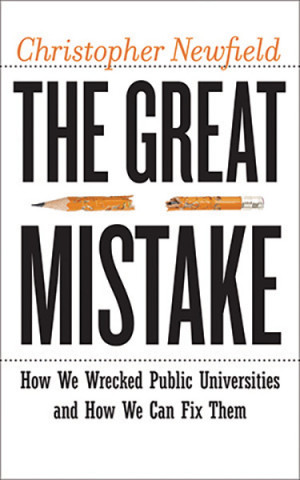
I have written a whole book on this topic and am bleakly satisfied to get some confirmation that there is fairly widespread awareness of the deterioration of working conditions in public higher ed.

Stagnation in professorial careers is an equally interesting issue, and this study is one of the first I've seen to take this on so directly:
For faculty members especially, the midcareer point is fraught with anxiety about what's next. After receiving tenure, they are no long-er protected from a heavy load of committee work. Some remain stuck as associate professors for years without a promotion. And unless they are superstars in their fields, it's not easy to get a job elsewhere.

"Faculty careers are flat unless you go into administration," says Saranna Thornton, a professor of economics at Hampden-Sydney College. "Even if you become a full professor, you essentially do what you did as an associate professor."
The flat career can poison the individual and the institution: associate professors feel themselves to be dead-enders long before they get labeled as deadwood by their peers, chairs, and deans. And decades of flat or declining funding means long series of ideas that are never actually implemented, which makes the stuck feeling worse.
Posted by Chris Newfield | Comments: 0

Thursday, July 10, 2008

Thursday, July 10, 2008
I've caught up with a truly shocking story that was broken last fall by UCLA's student paper the Daily Bruin. Since the university is one of my main areas of research I like to assume I'm not naive, but this piece took my breath away. It has the elements of deep corruption, and not just of aberration - large donations followed by admissions to super-competitive programs for OK-to-good relatives of the donors; open boasting by beneficiaries, suggesting there's no climate of prohibition around seats-for-sale; a leak; an inside investigation that finds no abuses and holds no one accountable; scattered outcries, resignations, and protests; a wall of administrative silence.

For a long time the for-sale sign on academia was seen as an isolated problem. It went with mediocrity, desperation, or individual corruption. As recently as 2003, Harvard's president emertius Derek Bok could write a book called The University in the Marketplace, express muffled rage at medical faculty for their arrogant obliviousness to the conflicts of interests they eagerly pursued, and still insist knowledge was not being corrupted. But the continuous pursuit of major and minor donors - as a central academic activity - is starting to change the focus, goals, metrics, etc of the institution.

Actually there's lots of evidence that this has already happened. Slaughter and Leslie's 1997 classic Academic Capitalism clearly explained the iron logic of income substitution. Jennifer Washburn's University Inc. was a well-documented cry for help that still needs to be addressed. Longtime science reporter Daniel S. Greenberg has a new book called Science for Sale that tells a nuanced story about mixed motives. All of it calls for better connections between the new dominance of fundraising culture and changes in both the directions of research and their results.

What we have to avoid is this: a new hybrid in which ultra-selective admissions generate small numbers of brilliant and economically diverse students that offer a front for lucrative academic influence-peddling. But this is what happens when fundraising gets woven into the research and teaching life of departments. It's the business version of Potomac Fever in Harvard's Kennedy School of Government, where every new project seems pitched to presidential candidates and the conclusions are written for their leading aides. We have enough knowledge for hire already - aka the major media. The university has to sound different from CNN or why not cut its public revenues to zero?

We Senate types are all out here pumping for public higher ed and yet we look more and more like the folks who run the plumbing-supplies store for Tony Soprano. That is, our corruption is looking less and less like an occasional accident and more and more systematic.

In May, the resident who went on the record for the November Daily Bruin story resigned from the department.
In his resignation letter, Kent Ochiai blamed the program’s chair for making his residency unbearable after the Daily Bruin published an article last November exposing preferential admissions within the orthodontics program for donors and their relatives.

Ochiai’s refusal as an applicant to donate a large sum in order to secure his own admission prompted The Bruin’s investigation.
Posted by Chris Newfield | Comments: 0

Tuesday, June 17, 2008

Tuesday, June 17, 2008
One of the most moving and graphic tales of adjunct life appeared in today's Inside Higher Ed. By graphic I mean a mixture of descriptions of impossible teaching loads, terrible hours, unpayable debt, non-healthcare, and summer unemployment pay. But in the midst of it he says this:
Some have asked why I continued to teach as a part-timer if things were so tough, and to be honest, every spring I begin asking myself that same question. In fact, I have left teaching twice. The first time I was offered a position as a business manager for a corporation that owns travel stops throughout the Southwest. The money was good, the hours were close to what I would put in as a part-time instructor (counting prep time and time grading papers), and I had benefits.

I hated it.

There is something about teaching that keeps pulling me in. I love writing, and I love sharing my passion for it with my students. I love feeling that I might be making a positive difference in people’s lives. I love feeling like I’m contributing something to my community.

The first time I left teaching, I stayed away for one year. The second time, I resisted the call for two years. Twelve years ago I moved to the Seattle area, landed teaching jobs at three different schools, and have been performing the juggling act of a freeway flyer ever since.
Then there's a semi-happy ending - for him.

The temping of a whole higher ed teaching profession is a crazy, thoughtless, destructive thing whose passage means we are sleepwalking about money and all means for all the Jacks who teach and teach and teach and don't write these articles.

The whole point of the humanities for me is to rescue our obscure selves from oblivion, which is where temping puts all the brilliant Jacks. So how screwed up is it that we teach the humanities with adjuncts? They teach, get back in their car, drive away, disappear.

This trend has to end.
Posted by Chris Newfield | Comments: 0

Monday, June 2, 2008

Monday, June 2, 2008
The New York Times has had good coverage of problems in the student loan industry - to put it politely. They have a good new piece on how some major banks are cutting back on loans to community college students, who are generally the least-well-off economically and who amount to 40% of the country's college students. The banks seem to be segmenting the student loan market, with loans to students at expensive private universities remaining fairly easy to get. "The banks generally say these loans are bigger, more profitable and less risky, in part perhaps because the banks expect the universities’ graduates to earn more." Some community colleges are getting redlined.

Michelle McClain, 40, who is studying to become a teacher, learned on Friday that she would have to find a new lender after Citibank dropped William Jessup University. The news angered her.

“The loan is between me and the lender,” Ms. McClain said. “I’m the one that’s taking out the loan, I’m the one whose credit is in jeopardy if I don’t pay it, I am the one totally responsible for the loan, and as long as I’m going to an accredited college, I don’t understand why it would make one iota of difference where I am going to college.”
Posted by Chris Newfield | Comments: 0
In a speech last week, University of Missouri President Gary Forsee cited some all-too-familiar stats about the decline of public funding for Missouri higher ed. Missouri is 47th out of 50 in per-capita spending on higher education, in part because the share of the U of M budget that comes from the state has fallen from over 60% to 30% in the last eight years.

Missouri's growth in student enrollments was also weak (39th of 50), so its increase in approporiations between 2001 and 2006 was actually above average (SHEEO's State Higher Education Finance FY 2006, Figures 12 and 13). That's a sad commentary on the rest of the country. Missouri is a little sadder though - its tax effort per capita is 0.71, where the US average is 1.0.

Forsee asks how Missouri can prepare itself for the economy of the future with that kind of higher ed spending. The same question goes for states that think they are the economy of the future, like California. California is still above the US averge, but not by much. A super-competitive economy supposedly means you need to be much more special to do well, not be somewhat above average.

We also need to explain how universities help broader social goals, like supporting "minority-majority" states that work because they are equitable. But even in mainstream economic terms, higher ed investment looks poor.
Posted by Chris Newfield | Comments: 0

Sunday, May 25, 2008

Sunday, May 25, 2008
Harvard alum Carroll Bogert has an excellent op-ed in the New York Times about what to do with Harvard's big endowment besides make it even bigger. She notes that T
he university’s endowment stands at $35 billion and is likely to hit $100 billion in a decade. At an annual growth rate of 13.3 percent — the average since inception, and regularly exceeded in recent years — Harvard can cover next year’s entire undergraduate financial aid budget with what it earns in the market in eight and a half days.
Deciding that swelling this flood of money was pointless,
A few hundred alumni have formed Harvard Alumni for Social Action, to try to channel 25th-reunion giving to destitute universities in Africa. In three years, we’ve raised $425,000 — a lot for the University of Dar es Salaam but hardly a match for our annual class “gift.” And evidently not enough to win the respect of President Faust, who has begged off meeting the group. Harvard clearly doesn’t like any effort that might divert a dollar away from its Cambridge coffers.
Bogert offers some decent explanations for why college grads - or at least Harvard grads - love to make the rich richer, but more to the point, you can find the Harvard Alumni for Social Action here.
Posted by Chris Newfield | Comments: 0

Sunday, May 18, 2008

Sunday, May 18, 2008
Some of the best recent defenses of public higher education have come from the business press, in the form of attacks on the huge and growing resource gap between even the strongest publics and the top privates. The powerful 2007 essay, "The Dangerous Wealth of the Ivy League," was published by Business Week, and begins with a wicked dig at vanity dorms at Princeton and goes on to say what few education leaders will say: the privates are cherry-picking faculty at the publics, paying much higher salaries, spending far more per student that their former peer "flagship" publics, and pulling away in lab facilities, publications, and other measures of knowledge production.

A year before that, the NY Times business columnist Joe Nocera criticized top-end fundraising in "The University of Raising Big Money." The movement for increased payouts at the fattest endowments kicked in later, and Nocera may have helped it along.

Public universities have over 4/5ths of total enrollments. Their quiet impoverishment affects everything - general skills, social integration, upward mobility, new technology, useful research, the general development of people and their society. Pulling top-quality resources back to the elite privates that educate 1 -2 percent of the college public is a perfect recipe for steady decline. Many more people need to start noticing this.
Posted by Chris Newfield | Comments: 0

Sunday, May 11, 2008

Sunday, May 11, 2008
About a month ago I went to Sacramento with a group of University of California faculty to try to offer legislators a faculty perspective on the need to spare California higher education from another round of cuts. We had messages developed by two reports that I had co-authored with other members of the Academic Senate's systemwide University Committee for Planning and Budget (UCPB).

Message 1: UC's state funding isn't too high, in spite of what the Governor alleged of all state agencies when he proposed across-the-board cuts, since it still hasn't gotten back to its 2001 levels.

Message 2: private money can't replace public money (even if we wanted it to), since there isn't enough of it.

Message 3: the Governor's proposed cuts can be filled in only with massive student fee hikes. (If all of the cuts were replaced only with student fees, the latter would need to increase 45% in one year.)

Since such an increase is unethical, counterproductive, and politically impossible, the UC Regents will increase the main student fee 7% percent this week and let the cuts come out of operations. This leads to . . .

Message 4: Students will pay more, and get less.

We were met by Democrats with a combination of agreement and fatalism. One said, "of course you're right, these cuts hurt the university and it hurts students. But there's no money this year. And there won't be any money next year either."

This is of course a political statement, not a financial one. There's plenty of money: even the state budget, perpetually hamstrung by Prop 13 requirements, controlled by the 1/3 Republican minority, riddled with constitutional budget guarantees for huge sectors like K-12 ($50 billion a year right there), and pitting higher ed against our incredibly expensive and yet still always federally-sanctioned prisons, receipts are down only 1 percent this year. The big structural deficit could be solved some other way - like the Governor reversing the cuts in vehicle licensing fees that account for about half of it. Whatever: our state poverty is political, and it's a politics that suits a governor who is already running for some other office.

Since politics is leverage, not logic, we asked about that. The Dims leadership won't do anything for higher ed this year - what's the payoff in that? The Chair of the Board of Regents, Richard Blum, investment banker and husband of Sen. Diane Feinstein (D-Calif.), seems already to have agreed not to embarrass the Governor with large fee hikes or enrollment freezes. And enrollment freeze was our only leverage in Sacramento. The UC administration gave that up, though threatened it politely for next year. No wonder even the Dems were promising nothing.

One of us went back to Sacramento last week and visited a Republican leader of one of the leg's higher education committees. This state Senator said he wanted UC to thrive and remain admired, but wasn't sure we were doing enough to fundraise in all categories. In fact, UC faculty have doubled their sponsored research (as measured in real dollars) since 1990. UC fundraisers have tripled their fundraising income in the same period. Licensing income is up but remains small (always under 1% of UC's overall budget). None of these numbers come close to addressing the budget cuts on the gigantic scale on which UC operates.

The key fact about public higher education is its sheer size. Better fundraising might close some gaps at a school with 1000 or 10000 students, but not at one with over 200,000. People say well, Princeton does great fundraising and look how rich it is - what's wrong with UC Berkeley?

What's "wrong" with Berkeley and UC is in fact what's right with it. Total enrollment in the Ivies in 2006-07 was 112,839. That means that the entire Ivy League's enrollment was 90,000- 100,000 less than the UC system alone - to say nothing of Cal State. The Ivy League's endowment was about $81 billion in 2006 (vs. UC's $6 billion or so), or say 20 x per student of UCs.

It just doesn't make sense to compare UC to an Ivy League university - it's a different kind of institution. UC makes enormous efforts in both research and fundraising, but on behalf of the population of a state that is bigger than most countries, and not just for a few thousand students at at time. This leads to . . .

Message 5: The only way to combine wide public access with the highest quality is with great public funding for public higher ed.

The real question is this: do we as a society really want to educate everyone to the highest possible level? That is, are we really trying to minimize the waste of the whole society's talents or not?

If we don't support great public funding for public universities, then our real answers are no. And for the case that society's major players didn't support this, see my new book!
Posted by Chris Newfield | Comments: 0

Wednesday, April 2, 2008

Wednesday, April 2, 2008
Here's a good example of a state governor - Ohio's - facing down a budget deficit and maintaining state funding for higher ed next year, along with his long-term plans. Here in California we should be so lucky.

The key quotation:

[Gov. Strickland] did not recommend any cuts in the nearly $2.38-billion that colleges are receiving from the state this year, an amount that represents a 7.7-percent increase over the previous fiscal year. The governor also proposed continuing to finance a statewide freeze on tuition that has been in effect for two years.

"In my judgment, higher education had been the budget whipping boy for far too long," he says. "It was time to keep faith with higher education."

Amazing! Higher ed is obviously a crucial long-term investment. It's also economically countercyclical in the short term. In the early 1930s, Hoover, Mellon and the other laissez-faire folks running the federal government watched consumption drop, profits decline, workforces shrink (in response to falling profits), and consumption drop even further as people lost their jobs. We're again learning a lot of New Deal lessons about the stabilizing (and constructive) effects of government action and investment. I hope in California we can follow Ohio's lead and learn them before another 2-3 year cycle of cuts (potentially our second 15-25% drop just in this decade), damages UC and CSU all over again.
Posted by Chris Newfield | Comments: 0

Tuesday, March 25, 2008

Tuesday, March 25, 2008
Who is our evil twin here in academia? The media?

They too are in the business of putting together and distributing information, so they are our twin. They lack our analytical standards and put out all sorts of nonsense, plus are rich and drive out real knowledge with their fake kind, so they are evil.

Or so it often seems when a member of the university community watches ten minutes of silly cable news or Bill O'Reilly saying the most absurd, falsifiable things without fear of challenge. The media seems to specialize in ad hominem argument - Bill can prove the falsehood of any statement in the New York Times by saying "the VERY LIBERAL New York Times" six times a minute. They are also pathetic copy-cats, recycling the same stuff from one source that wasn't correct in the first place. I saw this when three articles in major papers covered the Mark Yudof nomination to be UC's president with identical paragraphs on how his high Texass salary might be a problem. It's really pre-medieval, or plagaristic, or subcivilized, or well, just not very academic.

But I digress. My point here is that we should love our evil twin better and try to help it. Not Fox News, exactly, but print journalism, which is getting shafted by ad revenue declines and the unoriginal revenue thinking of its new owners. David Carr had a piece on the problem yesterday. He stirs the usual stuff around into a big ambiguity pie so we can conclude there is no solution to the end of the independent information train that is essential to democracy. So don't read the piece for that.

There was this interesting passage, based on a good quotation:
John Morton, a longtime newspaper analyst, is more pessimistic. “The industry is meeting these challenges by cutting, by reducing the news hole and the people who fill it,” he said.

“Newspapers have lived through recessions before and come back strong,” he added. “My worry is that when things do turn around, they will be coming back in an environment that is more competitive than ever because of the Internet, and that after all these cuts, they will have less stature, less product quality and less talent — all of the things that they need to compete.”

While I was on the line with Mr. Morton, I mentioned that we had been talking about newspapers on and off for over a decade. That makes us almost friends, I said. But we are fast becoming the kind of friends who see each other only at funerals and wakes.
Ha ha ha. My point here is that the same thing is happening to public higher ed. Capacity has been hollowed out for twenty years. Quality is still OK in core areas. But we regularly "start and starve" new initiatives, and can't throw whole teams at any research problems, and can't rapidly upgrade when we need to. This chronic underfunding needs to be seen for what it is, a recipe for stagnation and decline.

How can we describe it so that folks will see college funding as the social crisis it really is?
Posted by Chris Newfield | Comments: 0

Sunday, March 23, 2008

Sunday, March 23, 2008
The New York Times had a good piece about states cooking their graduation books. See the sample stats at left. California, self-described world headquarters of the knowledge society, had an actual high school graduation rate of 67%.

When UC President Clark Kerr defined the university at the heart of a new knowledge society nearly fifty years ago, he no doubt thought 67% would by now be the percentage of college grads in California. One scholar cited in the piece pointed out that at this rate California will reach its graduate rate target in 500 years.

"In California, we're patient," an official replied.

Actually, no we're not.

One of my colleagues on the nano and society project who teaches at Berkeley's business school said the signs of the Brazilianization of California are everywhere. I mentioned this to another guest who has been working abroad for years. She said no, the theory of California leaders is now closer to that of Ghana's.

OK we're getting far from home. But still, how many more decades are these crappy, falsified, HS grad rates going to be allowed to contradict what we say we stand for?
Posted by Chris Newfield | Comments: 0

Friday, March 21, 2008

Friday, March 21, 2008
Mark Yudof has been nominated to move from being the head of the University of Texas system to the presidency of the University of California system. I'm completely relieved that we found someone who has been running a big public university system and who has a record of fighting state governments for more public funding. Basic arithmetic shows that public universities are great only when they receive serious public funding: here's my Planning and Budget committee report on the UC case.

Here are two pieces by Yudof, both originally published in the Chronicle of Higher Education. The first is on the decline of public funding for public higher ed, and the second on the value of university systems to their states.

There are things to debate, but I'm also relieved that we may get a president who's given public funding this much lucid thought, and started writing about it in the early 1990s.
Posted by Chris Newfield | Comments: 1

Monday, February 25, 2008

Monday, February 25, 2008
Inside Higher Ed has a good overview of the Bush II Presidential Library controversy. The facility at Southern Methodist will have three parts, including a policy center that aims to "celebrate" the president and his record.

The obvious problems include:
  • knowledge being produced on a university campus without the normal safeguards of peer review
  • knowledge that will be received by the media and the public as valid because it comes from a university campus.
This arrangement is another sign of the difficulty universities have staying independent in the midst of desperate struggles for either adequate funding or big-league competitiveness (SMU's issue). But we shouldn't pick on SMU. The Hoover Institute at Stanford has for decades openly pushed conservative positions and systematically built conservative networks of scholars and top officials without feedback from Stanford's overall faculty. UC Berkeley recently signed a deal with BP that will allow BP scientists to conduct proprietary work in facilities built with public money and housed on campus.

The appointment of Donald Rumsfeld to a Hoover Institute position raised the issue at Stanford. An on-line petition against the hire raised over 4300 signatures. Some faculty proposed a motion last fall to investigate the process that led to the Rumsfeld hire. The Stanford Daily reported Philosophy Prof and motion advocate Debra Satz explaining, “I find it hard to understand the reasoning in appointing Rumsfeldnot because of his views, but because of his competence.”

The SMU Bush connection is a little more fawning towards a figure who is, like Rumsfeld, a little more disgraced than the normal donor or beneficiary. It's easy to assume that university resources would go into the partisan defense of weak records rather than into history and policy analysis. It's hard to image Chalmers Johnson being invited to Hoover or SMU to speak. The SMU case may help raise awareness of the fragility of academic freedom when it comes up against powerful interests, especially ones that haven't done too well and feel that they have something to prove.

Meanwhile, Stanford faculty are using Hoover's hiring of Donald Rumsfeld as a visiting fellow to try to established a new review process for affiliated institutes that trade on Stanford's name.
Posted by Chris Newfield | Comments: 0

Wednesday, February 20, 2008

Wednesday, February 20, 2008
The Council for Aid to Education has released its figures for higher education philanthropy in 2007. Overall donations were up 6.3 percent, which is close to the annual average for the last ten years. The Chronicle of Higher Education story also offered what have become standard comments about the skew in private giving towards the very top.
Large donations to the nation's wealthiest colleges accounted for much of the increase. The top 20 recipients (see table), which represent just 2 percent of the survey's respondents, raised more than a quarter of all the contributions.

"The top 20 historically have controlled a lot, and they're controlling a bigger and bigger share of private donations," said Ann E. Kaplan, the survey's director. "It's large gifts to large institutions that drive national trends."
The top 2 percent of institutions also accounted for 30 percent of the year-over-year growth in these donations. And "megagifts" remain a major factor in the shaping of higher ed.

Everyone is worried about the impact of the economic downturn that has already started. Ironically, it may only increase the influence of the megagifts. As one CHE consultant noted, "If the market falls and people's wealth shrinks, then you start seeing a slowdown, or people postponing capital contributions. . . . But the big donors, who drive these numbers anyway, tend to be stable."

There's another issue that is never mentioned. Little of this giving is unrestricted, so at public universities it cannot be applied to general operating costs to make up for public funding cuts. When our UC Planning and Budget committee heard officials from the Treasurer's Office talk about this, they estimated that unrestricted gifts are 2 percent of the total. Even in scholarship giving, only 20 percent are unrestricted. Over a period of years, the effect is not a happy substitution of public with private funding, but a campus divided by an iron curtain. The stem-cell research facility may be state-of-the-art, while the math department, dependent on public money, can't pay for phones in faculty offices or for TAs to give actual feedback on homework in calculus lectures with 500 students.

There is no evidence at all that private money is willing to pay for mass quality higher education - broad access at a top level. It pays for special projects for the best and the most famous. We are getting plenty of that, but losing the mass quality that underwrote both post-war prosperity and general quality of intellectual life.
Posted by Chris Newfield | Comments: 0

Monday, February 4, 2008

Monday, February 4, 2008
Student loans produced a lot of stories about conflicts of interest last year, and some mild clean-up activity. One pattern there was kickbacks - gifts from private loan companies in exchange for favors from university counsellors. Another was a revolving door between universities and private loan companies that increased collusion between the two. Sallie Mae sought a buy-out that would have given its CEO over $225 million personally (the sale did not go through; I don't know CEO Albert L. Lord's final cut, but he continued to seek a $900 million breakup fee after the deal collapsed). The Department of Education admitted to having overpaid private student loan companies.

The obvious theme here is that the activities of these private agencies increased the cost of obtaining a college degree. There were good stories about just how broke students are in part because of high-tuition coupled with high-priced loans. The most famous response was that some of the country's wealthiest private universities - led by Harvard - switced from loans to grants for lower-income students.

Whatever the response, a core principle remains: increasing the number of steps between the buyer and the seller - the student and the university - increases the costs to the buyer. We used to know that "middlemen" like railroads were bad for people like farmers. We seem to need to learn this all over again with higher ed.
Posted by Chris Newfield | Comments: 0